The Bronze Faces Buried in Sichuan
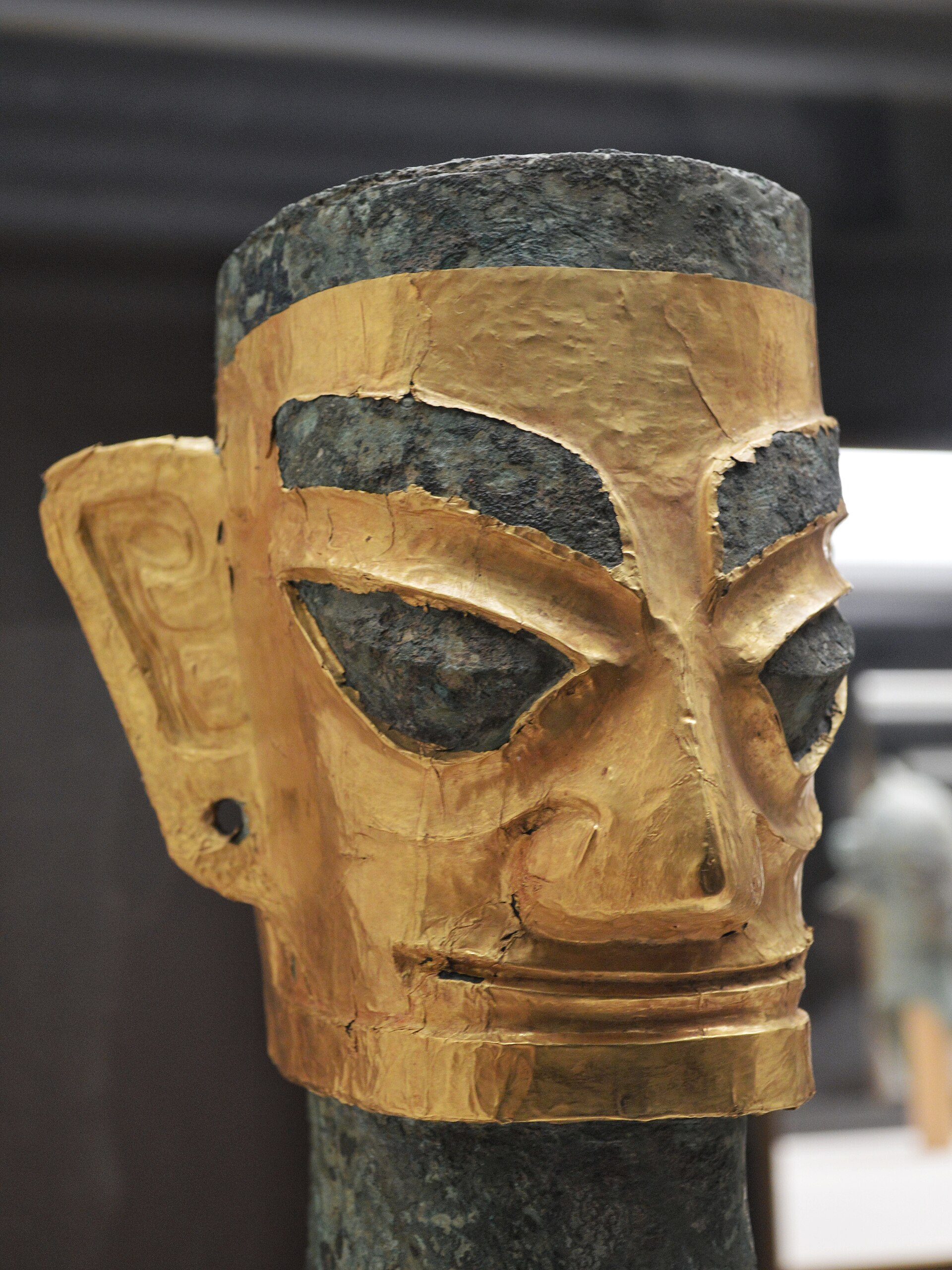
In 1986, workers digging in a Sichuan field struck something that shouldn't have existed: gold masks and bronze faces with eyes bulging out on stalks, buried and burned in pits no one had ever recorded. What civilization made them — and why did they smash their own treasures and bury the pieces?
The story begins quietly, in 1927, when a farmer dredging an irrigation ditch near Guanghan in Sichuan Province unearthed a stash of jade relics. Word spread slowly. Many of the pieces slipped into the hands of private collectors before anyone with archaeological training took notice. It wasn't until 1931 that Vyvyan Donnithorne, an Anglican missionary at the Gospel Church of Guanghan, recognized the find's importance. He brought in a local magistrate and Daniel Sheets Dye, a geology professor at West China Union University. The three visited, photographed, and measured the site, and a handful of items made their way to the university museum. In 1934, David Crockett Graham organized the first proper excavation.
But the site's true scale stayed hidden for another half-century. In 1986, local workers accidentally broke into sacrificial pits packed with thousands of objects in gold, bronze, jade, and pottery — many deliberately broken, burned, and carefully buried. Less than a month later, on August 14, 1986, a second pit turned up only 20 to 30 metres away, holding roughly 800 more objects.
What came out of the ground stunned researchers. The bronzes included sculpted human figures, animal-faced sculptures, bells, and decorative dragons, snakes, chicks, and birds, alongside axes. Gold objects included tables, masks, and belts. Jade yielded axes, tablets, rings, knives, and tubes. There were ivory carvings and clam shells too. None of it matched any known style in the history of Chinese art — it was something genuinely new to scholars.
At the center of the mystery are the masks: bronze faces with eyes that jut outward on protruding stalks, unlike anything seen elsewhere in ancient Chinese art. Chinese archaeologists have connected the Sanxingdui culture to the ancient kingdom of Shu, an ally of the Zhou dynasty in its defeat of the Shang, mentioned in the classical texts Shiji and Shujing. According to the Chronicles of Huayang, compiled during the Jin dynasty (266–420 CE), Shu was founded by a king named Cancong, who was described as having protruding eyes — a detail many scholars link directly to those startling bronze masks.
Other legendary Shu rulers named in the Chronicles include Boguan, Yufu, and Duyu. The abundance of fish- and bird-shaped bronze objects has led some to suggest these represent totems of Boguan and Yufu — Yufu's name literally means 'fish cormorant' — with the Yufu clan seen as most closely tied to Sanxingdui itself. A related site 40 kilometres away, Jinsha, shares deep ties with Sanxingdui and is thought to be a relocated Shu capital, possibly linked to the Duyu clan. The Sanxingdui site itself reveals an entire walled city, founded around 1,600 BCE, trapezoidal in shape, enclosing 3.6 square kilometres along the Yazi River — walls up to 10 metres high, ringed by defensive canals, with residential, industrial, and religious districts arranged along a central axis. Radiocarbon dating places the excavated artifacts in the 12th–11th centuries BCE, and the broader Shu kingdom appears to have persisted until Qin conquered the region in 316 BCE.
More from Archaeology

The Bronze Disc That Rewrote the Sky
Two looters with a metal detector dug up something illegal, invisible in value, and older than Stonehenge's final stones — a map of the heavens buried for over three thousand years.

The Faceless Women of the Ice Age
Long before writing, before cities, before the wheel, someone carved a woman's body into stone and ivory — and left no name, no face, no explanation.

The Pebble That Might Be Human
A palm-sized stone found on a Moroccan riverbank may be humanity's oldest attempt to see itself — or simply a trick of erosion.

The Crown That Vanished: Deshret and the Red Land
A crown worn by kings for three thousand years has never once been found in a tomb — not one. So where did it go?

The Face That Traveled Between Empires
A farm worker's shovel struck stone in 1897 and unearthed a face so striking it would be sold to France, seized as war booty, and finally traded back for a Velázquez.

The Boy in the Dark Tunnel
A schoolboy fell into black water inside an ancient tunnel and surfaced with his fingers brushing letters no one had noticed for 2,600 years.