The Cave That a Little Girl Found
A fallen tree disturbed a pile of rocks near a Cantabrian hillside, and a tiler's sharp eye caught the opening beneath — but it took an eight-year-old girl's gaze to reveal what was painted above.
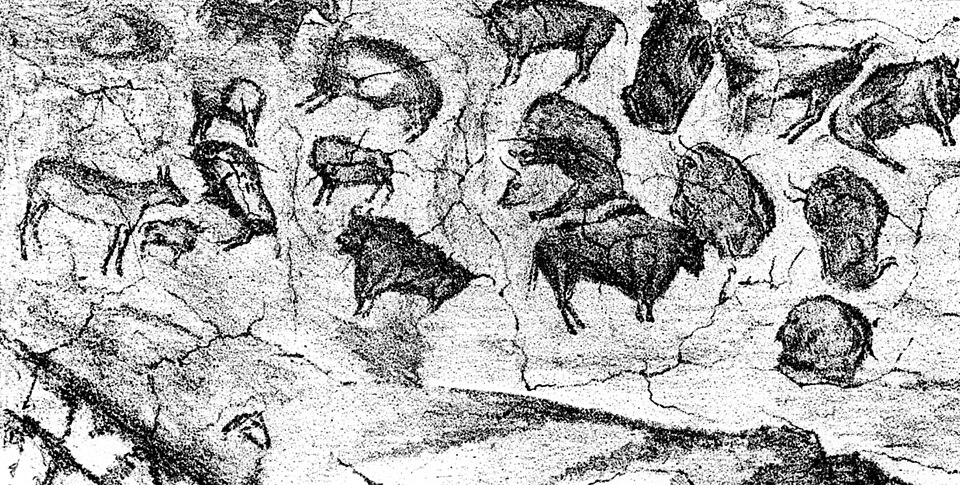
In 1868, near the market town of Santillana del Mar in Cantabria, a local tiler named Modesto Cubillas noticed that a fallen tree had disturbed a pile of rocks, exposing an opening into the hillside of Mount Vispieres. What he had found was the mouth of a cave that had lain sealed for roughly thirteen thousand years, ever since a rockfall closed it off and preserved everything within.
Eleven years later, in 1879, an amateur archaeologist named Marcelino Sanz de Sautuola was exploring the cave when his eight-year-old daughter María looked up at the ceiling and saw what he had missed: vivid animal figures painted directly onto the stone. Sautuola realized these were not decorations from his own era. He teamed up with Juan Vilanova y Piera of the University of Madrid, and together they excavated the site and published their findings in 1880, arguing that the paintings dated to the Paleolithic.
The response was, at first, enthusiastic acclaim. But the mood shifted quickly. French specialists, led by Gabriel de Mortillet and Émile Cartailhac, refused to accept that prehistoric humans could have produced such sophisticated art. At the 1880 Prehistorical Congress in Lisbon, Sautuola and Piera's conclusions were openly ridiculed. Critics accused Sautuola of forgery, pointing out that the cave walls and ceilings bore no soot marks — strange, they argued, for paintings supposedly made by firelight. Sautuola later proposed that the ancient artists had burned marrow fat rather than other fuels, which would have produced far less soot.
The dispute dragged on for over two decades. Sautuola died in 1888, fourteen years before the scientific world reversed its judgment. Vindication finally came in 1902, as similar prehistoric paintings turned up elsewhere across the Franco-Cantabrian region, making the case for Altamira's antiquity impossible to dismiss. That year, Émile Cartailhac published a startlingly honest retraction in the journal L'Anthropologie titled 'Mea culpa d'un sceptique' — the confession of a skeptic.
Cartailhac went on to co-write books about the cave, working with Henri Breuil, a Catholic priest and skilled draughtsman who produced hand-drawn reproductions of the paintings. Further excavations followed over the twentieth century: Hermilio Alcalde del Río between 1902 and 1904, Hugo Obermaier between 1924 and 1925, and Joaquín González Echegaray in 1968, each adding to the archaeological record.
More from Archaeology

The Bronze Disc That Rewrote the Sky
Two looters with a metal detector dug up something illegal, invisible in value, and older than Stonehenge's final stones — a map of the heavens buried for over three thousand years.

The Faceless Women of the Ice Age
Long before writing, before cities, before the wheel, someone carved a woman's body into stone and ivory — and left no name, no face, no explanation.

The Pebble That Might Be Human
A palm-sized stone found on a Moroccan riverbank may be humanity's oldest attempt to see itself — or simply a trick of erosion.

The Crown That Vanished: Deshret and the Red Land
A crown worn by kings for three thousand years has never once been found in a tomb — not one. So where did it go?

The Face That Traveled Between Empires
A farm worker's shovel struck stone in 1897 and unearthed a face so striking it would be sold to France, seized as war booty, and finally traded back for a Velázquez.

The Boy in the Dark Tunnel
A schoolboy fell into black water inside an ancient tunnel and surfaced with his fingers brushing letters no one had noticed for 2,600 years.