The Cave That Held Three Kinds of Human
A single pinky bone, no bigger than a pebble, and its mitochondrial DNA forced scientists to rewrite the human family tree.
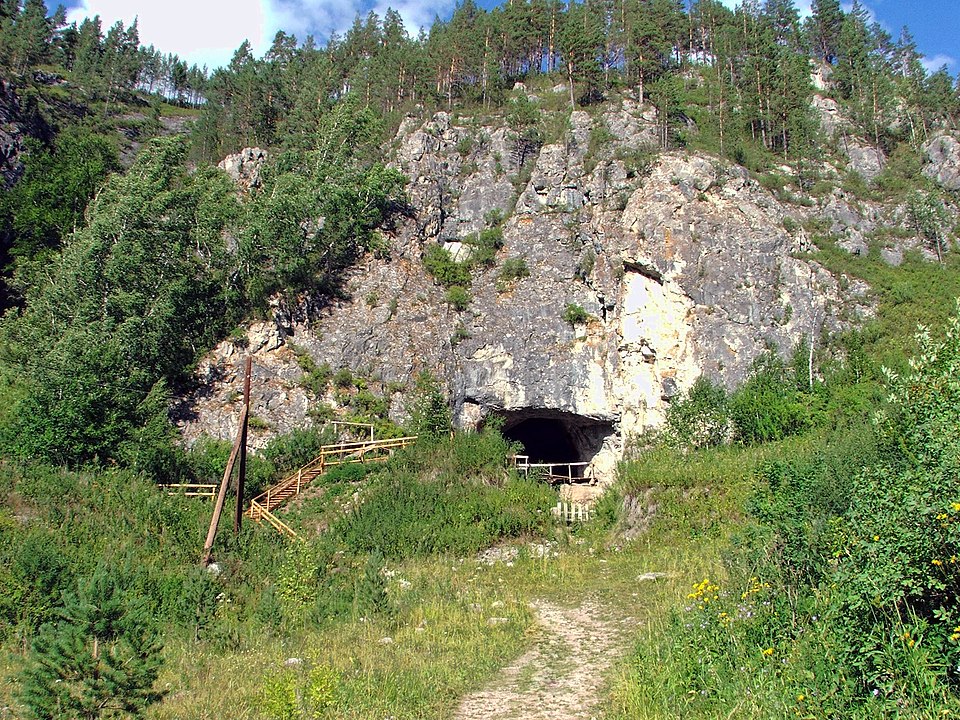
In the Bashelaksky Range of Siberia's Altai Mountains, a limestone cave sits some 28 meters above the Anuy River, its three galleries carved from ancient Silurian rock. In the 18th century an Old Believer hermit named Dyonisiy, or Denis, lived within its walls, and it is his name the cave still carries. Yet the story that would make Denisova Cave famous began long before him, buried in 22 sediment layers stretching back 125,000 to 180,000 years.
Soviet-era scientists began excavating here in the 1970s, uncovering Mousterian and Levallois-style stone tools, ornaments of bone and mammoth tusk, ostrich eggshell beads, and a bracelet fragment of polished dark green chlorite. Among these finds was a seven-centimeter sewing needle carved from bird bone, roughly 50,000 years old — among the oldest needles known anywhere in the world.
The cave's true significance emerged in 2008, when researchers found a tiny fragment of a child's finger bone in the East Gallery's layer 11.2. Svante Pääbo and his team at the Max Planck Institute for Evolutionary Anthropology analyzed its mitochondrial DNA in 2010 and found something unprecedented: a genetic signature unlike any known human. This was the Denisovan, a previously unknown branch of humanity, named simply after the cave where it was found.
Further study showed the Denisovans were related to Neanderthals and had interbred with the ancestors of modern Melanesians, leaving traces of their DNA in people living today. As Pääbo put it, this cave might be the one place on Earth where all three human forms — Denisovans, Neanderthals, and modern humans — are known to have lived, if not always at the same time.
In 2010, another discovery deepened the mystery: a toe bone from the same layer as the Denisovan finger, this one belonging to a Neanderthal woman. Dubbed the Altai Neanderthal, she lived roughly 120,000 years ago and yielded the first high-coverage Neanderthal genome ever sequenced. Curiously, she was genetically more distant from other Neanderthals than they were from each other, suggesting interbreeding between Neanderthals and modern humans happened after her lineage split off.
More from Archaeology

The Bronze Disc That Rewrote the Sky
Two looters with a metal detector dug up something illegal, invisible in value, and older than Stonehenge's final stones — a map of the heavens buried for over three thousand years.

The Faceless Women of the Ice Age
Long before writing, before cities, before the wheel, someone carved a woman's body into stone and ivory — and left no name, no face, no explanation.

The Pebble That Might Be Human
A palm-sized stone found on a Moroccan riverbank may be humanity's oldest attempt to see itself — or simply a trick of erosion.

The Crown That Vanished: Deshret and the Red Land
A crown worn by kings for three thousand years has never once been found in a tomb — not one. So where did it go?

The Face That Traveled Between Empires
A farm worker's shovel struck stone in 1897 and unearthed a face so striking it would be sold to France, seized as war booty, and finally traded back for a Velázquez.

The Boy in the Dark Tunnel
A schoolboy fell into black water inside an ancient tunnel and surfaced with his fingers brushing letters no one had noticed for 2,600 years.