The Chest in the Suffolk Field
A lost hammer led one retired gardener to the richest hoard of Roman gold and silver ever unearthed in Britain — and to a discovery that changed the law itself.
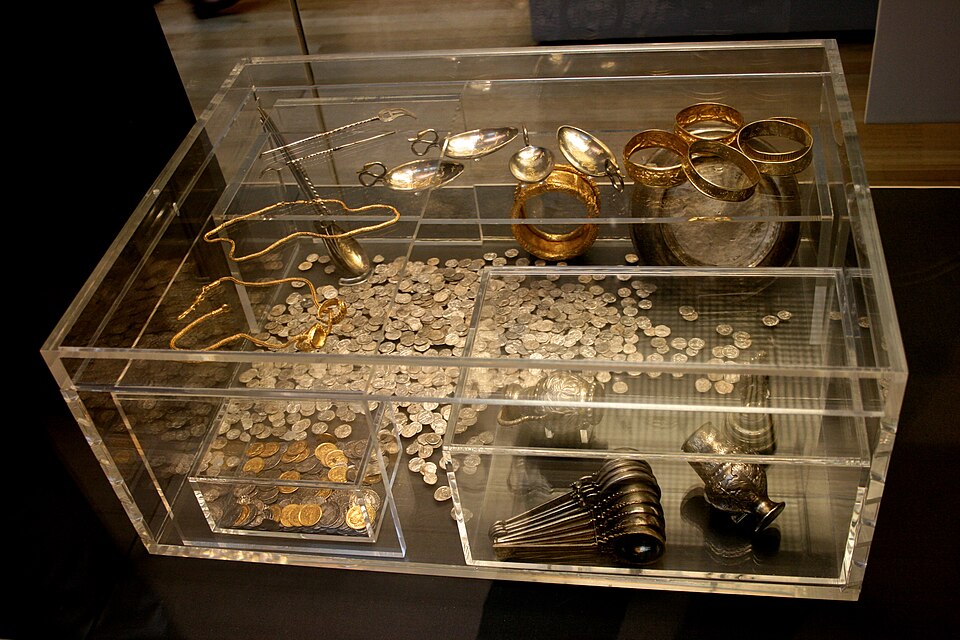
On 16 November 1992, in a farm field southwest of the village of Hoxne in Suffolk, England, tenant farmer Peter Whatling had misplaced a hammer. He asked his friend Eric Lawes, a retired gardener and amateur metal detectorist, to help him find it. Instead, Lawes's detector led him to something far stranger: silver spoons, gold jewellery, and a scatter of gold and silver coins buried beneath the soil.
Lawes and Whatling did the right thing. Rather than digging further, they retrieved only a few items and immediately notified the landowners, Suffolk County Council, and the police. The next day, a team from the Suffolk Archaeological Unit arrived and carried out an emergency excavation, removing the entire hoard in a single day, including large blocks of unbroken material taken away for careful laboratory excavation.
What they uncovered was staggering: 14,865 Roman gold, silver, and bronze coins, along with roughly 200 items of silver tableware and gold jewellery, all once packed inside a wooden chest that had completely decayed in the ground. Items had been sorted by type — ladles and bowls stacked inside one another, other pieces grouped as though once held in a smaller inner box, some wrapped in fabric or bagged. Remnants of the chest's hinges and locks were also recovered.
Because Lawes reported the find so promptly, archaeologists were able to excavate it in situ, largely undisturbed, preserving the original arrangement of objects within their container — a rare and precious piece of context that transforms a treasure hoard from mere loot into a documented archaeological event. Even Whatling's missing hammer turned up in the process; it was later donated to the British Museum.
The find could not stay quiet for long. The Sun newspaper ran a front-page story on 19 November, picturing Lawes with his metal detector and wildly claiming the hoard was worth £10 million. The British Museum, caught off guard, held a press conference the next day to formally announce the discovery. Public interest faded quickly after that, giving museum curators the calm they needed to clean, sort, and stabilise the fragile hoard — a process completed within a month.
More from Archaeology

The Bronze Disc That Rewrote the Sky
Two looters with a metal detector dug up something illegal, invisible in value, and older than Stonehenge's final stones — a map of the heavens buried for over three thousand years.

The Faceless Women of the Ice Age
Long before writing, before cities, before the wheel, someone carved a woman's body into stone and ivory — and left no name, no face, no explanation.

The Pebble That Might Be Human
A palm-sized stone found on a Moroccan riverbank may be humanity's oldest attempt to see itself — or simply a trick of erosion.

The Crown That Vanished: Deshret and the Red Land
A crown worn by kings for three thousand years has never once been found in a tomb — not one. So where did it go?

The Face That Traveled Between Empires
A farm worker's shovel struck stone in 1897 and unearthed a face so striking it would be sold to France, seized as war booty, and finally traded back for a Velázquez.

The Boy in the Dark Tunnel
A schoolboy fell into black water inside an ancient tunnel and surfaced with his fingers brushing letters no one had noticed for 2,600 years.