The Cliff That Taught the World to Read Cuneiform
High on a limestone cliff in western Iran, a Persian king carved his own victory story in three languages — and for two thousand years, no one could read a word of it.
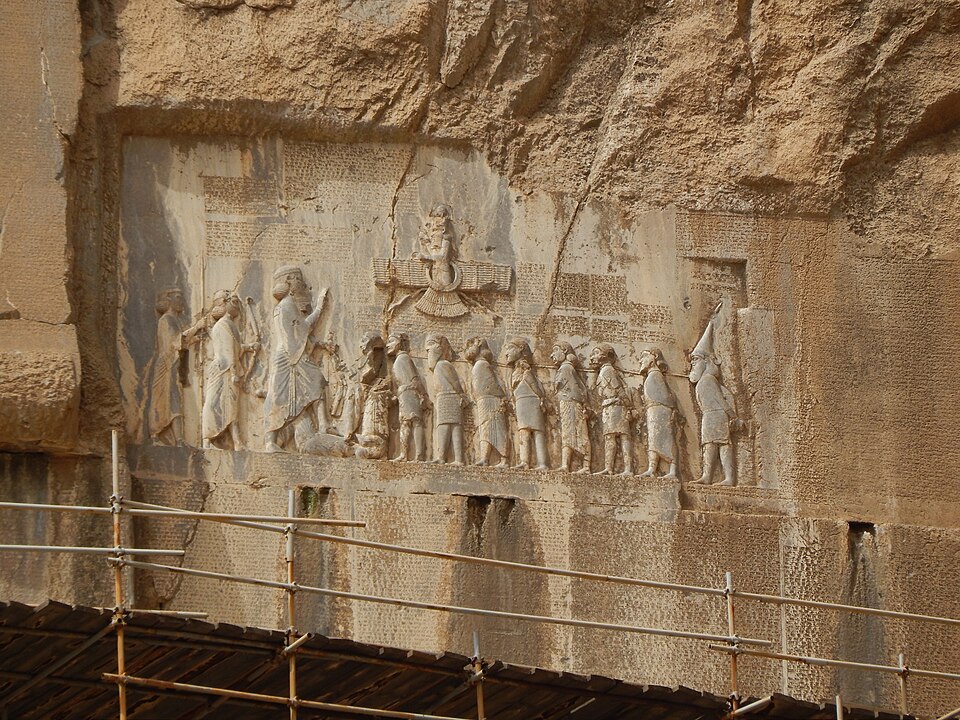
On a rock face 100 meters above an ancient road linking Babylon and Ecbatana, Darius the Great left a message meant to outlast empires. Carved sometime between his coronation in 522 BC and his death in 486 BC, the Behistun inscription stretches 15 meters high and 25 meters wide, its Old Persian text running 414 lines across five columns, its Elamite version 260 lines across eight, and its Babylonian rendering 112 lines more. A copy in Aramaic, dating to the reign of Darius II, later surfaced in Egypt.
The text itself is Darius's autobiography and war record. He begins with his lineage, then recounts nineteen battles fought in a single year — ending in December 521 BC — to crush rebellions that erupted after the death of Cambyses II. According to Darius, impostors across the empire had each falsely claimed the throne, and he credits his victories to 'the grace of Ahura Mazda.'
Above the words looms a life-sized relief: Darius holding a bow, his left foot pressed on the chest of a supine figure believed to be the pretender Gaumata. Two servants stand behind him; nine bound, one-meter figures with ropes around their necks represent conquered peoples. A Faravahar hovers overhead, blessing the king. Curiously, one figure and Darius's beard appear to have been added later — the beard a separate stone block, fixed with iron pins and lead.
After the Achaemenid dynasty fell and Old Persian cuneiform fell out of use, the monument's meaning was lost. Visitors invented fantastical explanations: in 1598, Englishman Robert Sherley thought it Christian in origin; a French general later saw 'Christ and his twelve apostles'; Sir Robert Ker Porter linked it to the Lost Tribes of Israel. In 1604, Italian traveler Pietro della Valle made the first careful drawings.
Real progress came slowly. German surveyor Carsten Niebuhr copied the inscription around 1764 for Frederick V of Denmark, publishing it in 1778. His transcription let Georg Friedrich Grotefend deduce, by 1802, ten of the 37 Old Persian symbols, after noticing the script was alphabetic, unlike Semitic cuneiform, and that a slanted mark separated words.
More from Archaeology

The Bronze Disc That Rewrote the Sky
Two looters with a metal detector dug up something illegal, invisible in value, and older than Stonehenge's final stones — a map of the heavens buried for over three thousand years.

The Faceless Women of the Ice Age
Long before writing, before cities, before the wheel, someone carved a woman's body into stone and ivory — and left no name, no face, no explanation.

The Pebble That Might Be Human
A palm-sized stone found on a Moroccan riverbank may be humanity's oldest attempt to see itself — or simply a trick of erosion.

The Crown That Vanished: Deshret and the Red Land
A crown worn by kings for three thousand years has never once been found in a tomb — not one. So where did it go?

The Face That Traveled Between Empires
A farm worker's shovel struck stone in 1897 and unearthed a face so striking it would be sold to France, seized as war booty, and finally traded back for a Velázquez.

The Boy in the Dark Tunnel
A schoolboy fell into black water inside an ancient tunnel and surfaced with his fingers brushing letters no one had noticed for 2,600 years.