The Colosseum: Rome's Bloody Masterpiece
An oval of stone rose over Rome and swallowed 65,000 roaring spectators — built to celebrate an empire, and named for a giant statue of a hated emperor.
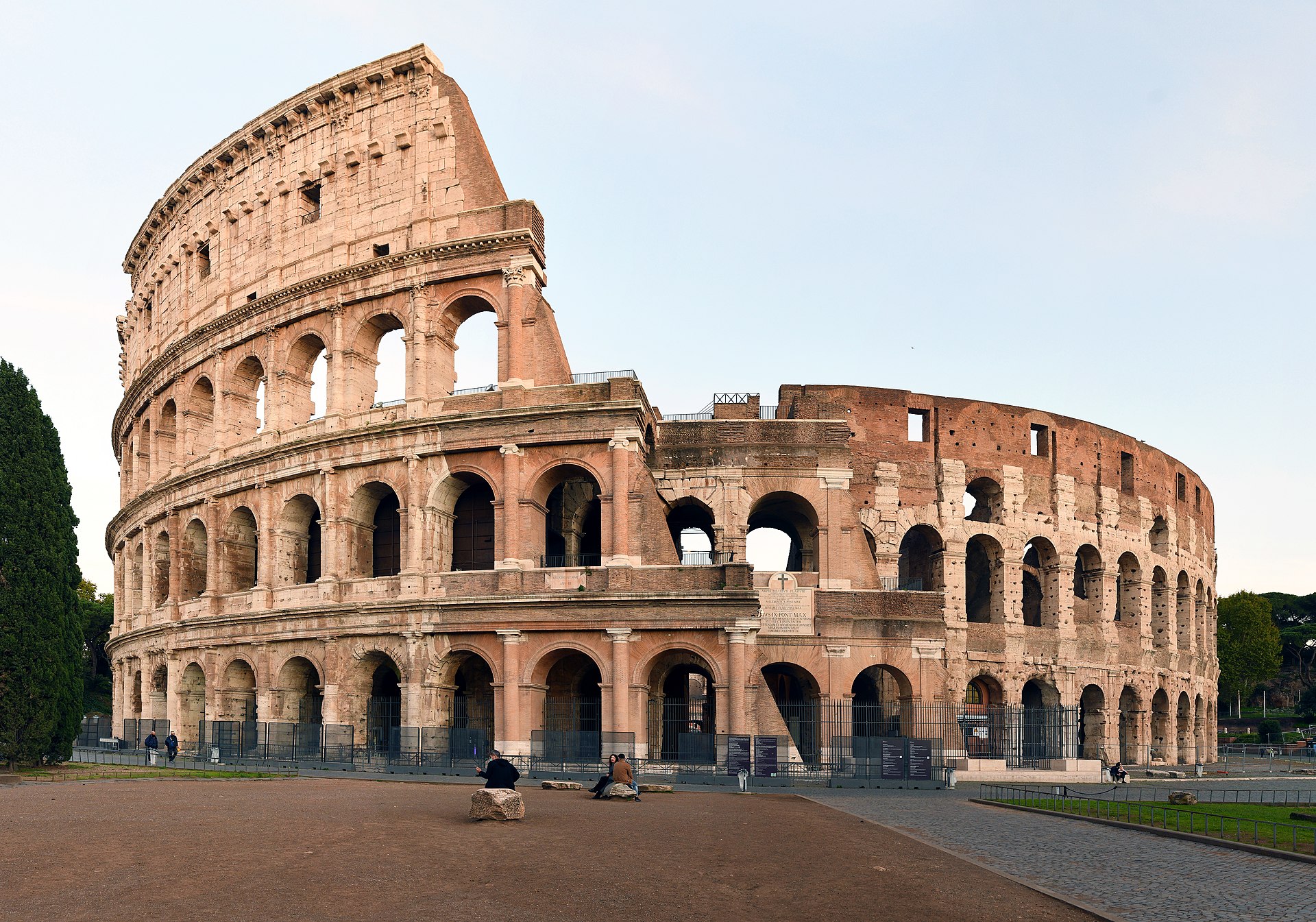
On a flat stretch of valley floor between Rome's hills, just east of the Roman Forum, workers began raising an amphitheatre in AD 72. The order came from Emperor Vespasian, founder of the Flavian dynasty, who wanted a monument that would outshine anything Rome had seen. By AD 80, under his son and successor Titus, the structure was complete enough to open its gates. His brother Domitian later added further modifications, finishing the vision the family had begun.
Built from travertine limestone, volcanic tuff, and brick-faced Roman concrete, the amphitheatre was an engineering marvel for its age. It could hold between 50,000 and 80,000 spectators depending on the era, with historians estimating an average crowd of around 65,000 — a scale that made it the largest amphitheatre the ancient world ever produced, and it remains the largest standing one today.
Inside its elliptical walls, Rome staged spectacles meant to thrill and terrify in equal measure. Gladiators fought for survival, wild animals were hunted down for sport, and executions were carried out before the crowd. Battles from history were re-enacted, dramas drawn from Roman mythology were performed, and for a brief period the arena was even flooded to stage mock naval battles.
The building's name did not come from its own grandeur but from something that once stood beside it: a colossal bronze statue of Nero, styled after the Colossus of Rhodes and depicted as a solar deity. Emperor Hadrian later moved this statue next to the amphitheatre, and over time people began calling the building after it — 'Colosseum,' from the Latin colosseus, meaning gigantic. By around the year 1000, this name had firmly attached itself to the structure, referencing the nearby 'Colossus Solis.'
An eighth-century epigram attributed to a writer now known as Pseudo-Bede tied the statue's fate to Rome's own: as long as the Colossus stood, so would Rome; when it fell, Rome would fall, and the world with it. Even at the time this was written, the word used — the masculine coliseus — applied to the statue itself rather than to the amphitheatre, a distinction that has often been lost. The line is frequently mistranslated or misapplied to the Colosseum rather than the Colossus, a confusion that has lingered in poetry and popular memory ever since, including in Byron's famous verses.
More from Architecture

Stonehenge: The Stones That Refuse to Explain Themselves
For more than 4,500 years, a ring of leaning giants has watched the sun rise and set on the same two days each year — and no one alive can say for certain why.

The Dome That Refused to Fall
Two thousand years ago, Roman engineers poured a dome so vast that no one has dared build a bigger one from unreinforced concrete since. It still stands, open to the sky.

A Minaret Rising Over Kingsland Road
On a busy London street better known for shops and buses, the tallest minaret in Britain quietly reaches into the sky. Its story began not in Sinan's sixteenth-century Istanbul, but in 1990s Hackney.

The Bridge That Was Killed Twice
For 427 years it arched over the Neretva like a stone rainbow. Then, in a matter of days in 1993, it simply ceased to exist.

Hoover Dam: The Concrete That Tamed a River
In the scorched depths of Black Canyon, thousands of men built the largest concrete structure the world had ever seen — and finished it two years early, at a cost of over a hundred lives.

Neuschwanstein: The Castle Built for a Ghost
A king who despised his own palace built the most famous fairy-tale castle on earth — and died before he ever truly lived in it.