The Corroded Box That Held the Cosmos
Sponge divers pulled a lump of green-crusted bronze from a Roman shipwreck — no one guessed it was a machine that could predict eclipses decades in advance.
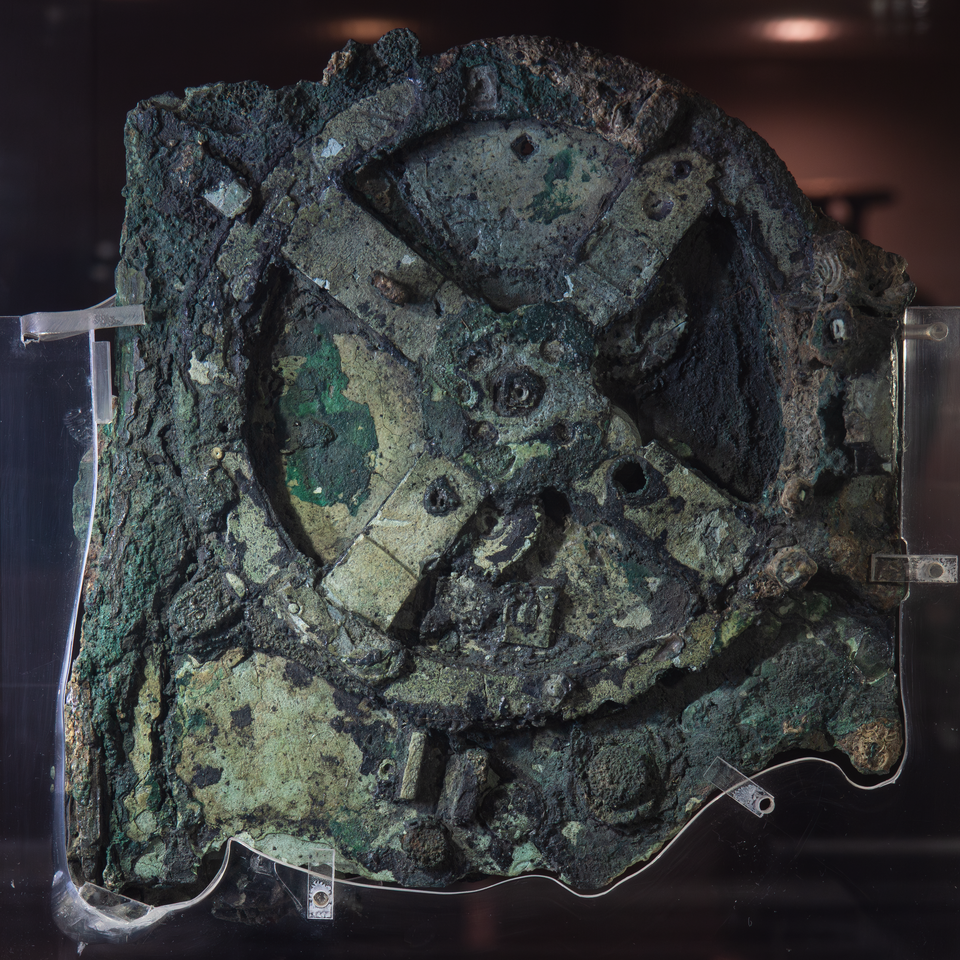
In early 1900, Captain Dimitrios Kontos and a crew of sponge divers from the island of Symi came upon a wreck lying 45 metres deep off Point Glyphadia, near the small Greek island of Antikythera. Over the following two years, expeditions with the Hellenic Royal Navy hauled up bronze and marble statues, pottery, glassware, jewellery, and coins from the sunken Roman cargo ship. Among the treasures was an unremarkable-looking lump of corroded bronze and wood, retrieved in 1901, probably in July.
For two years it sat ignored at the National Archaeological Museum in Athens while staff focused on the more obviously dazzling statues. The seawater had already begun its damage: the bronze had turned into atacamite, a mineral that cracked and shrank as the piece dried, distorting its original shape. Then, on 17 May 1902, archaeologist Valerios Stais — prompted by his cousin, the politician Spyridon Stais, during a museum visit — noticed a gear wheel embedded in one of the rock-like fragments.
Stais suspected it was some kind of astronomical clock, but most scholars dismissed the idea as impossible for the era — the device seemed far too advanced to have been built alongside the other Hellenistic-era finds. German philologist Albert Rehm took the idea seriously, becoming the first to argue it was an astronomical calculator. But real momentum did not arrive until 1951, when British science historian Derek J. de Solla Price, of Yale University, began studying it in earnest.
In 1971, Price and Greek nuclear physicist Charalampos Karakalos used X-ray and gamma-ray imaging on the 82 surviving fragments, publishing their findings in 1974. Decades later, in 2005, a Cardiff University team led by Mike Edmunds applied computer X-ray tomography and high-resolution scanning, revealing faint inscriptions on the crust-encased casing and an astonishing internal structure: 37 meshing bronze gears.
Those gears let the mechanism track the Moon and Sun through the zodiac, predict eclipses, and model the Moon's irregular orbit — moving faster at perigee than at apogee, a phenomenon studied by the 2nd-century-BC astronomer Hipparchus of Rhodes, who may even have advised on the device's construction. Some researchers suspect a missing portion once calculated the positions of the five classical planets; inscriptions deciphered in 2016 revealed numbers tied to the synodic cycles of Venus and Saturn.
More from Archaeology

The Bronze Disc That Rewrote the Sky
Two looters with a metal detector dug up something illegal, invisible in value, and older than Stonehenge's final stones — a map of the heavens buried for over three thousand years.

The Faceless Women of the Ice Age
Long before writing, before cities, before the wheel, someone carved a woman's body into stone and ivory — and left no name, no face, no explanation.

The Pebble That Might Be Human
A palm-sized stone found on a Moroccan riverbank may be humanity's oldest attempt to see itself — or simply a trick of erosion.

The Crown That Vanished: Deshret and the Red Land
A crown worn by kings for three thousand years has never once been found in a tomb — not one. So where did it go?

The Face That Traveled Between Empires
A farm worker's shovel struck stone in 1897 and unearthed a face so striking it would be sold to France, seized as war booty, and finally traded back for a Velázquez.

The Boy in the Dark Tunnel
A schoolboy fell into black water inside an ancient tunnel and surfaced with his fingers brushing letters no one had noticed for 2,600 years.