The Cup That Changes Color With Light
A Roman drinking cup turns from jade green to blood red depending on which way the light strikes it — and for sixteen centuries, no one quite understood why.
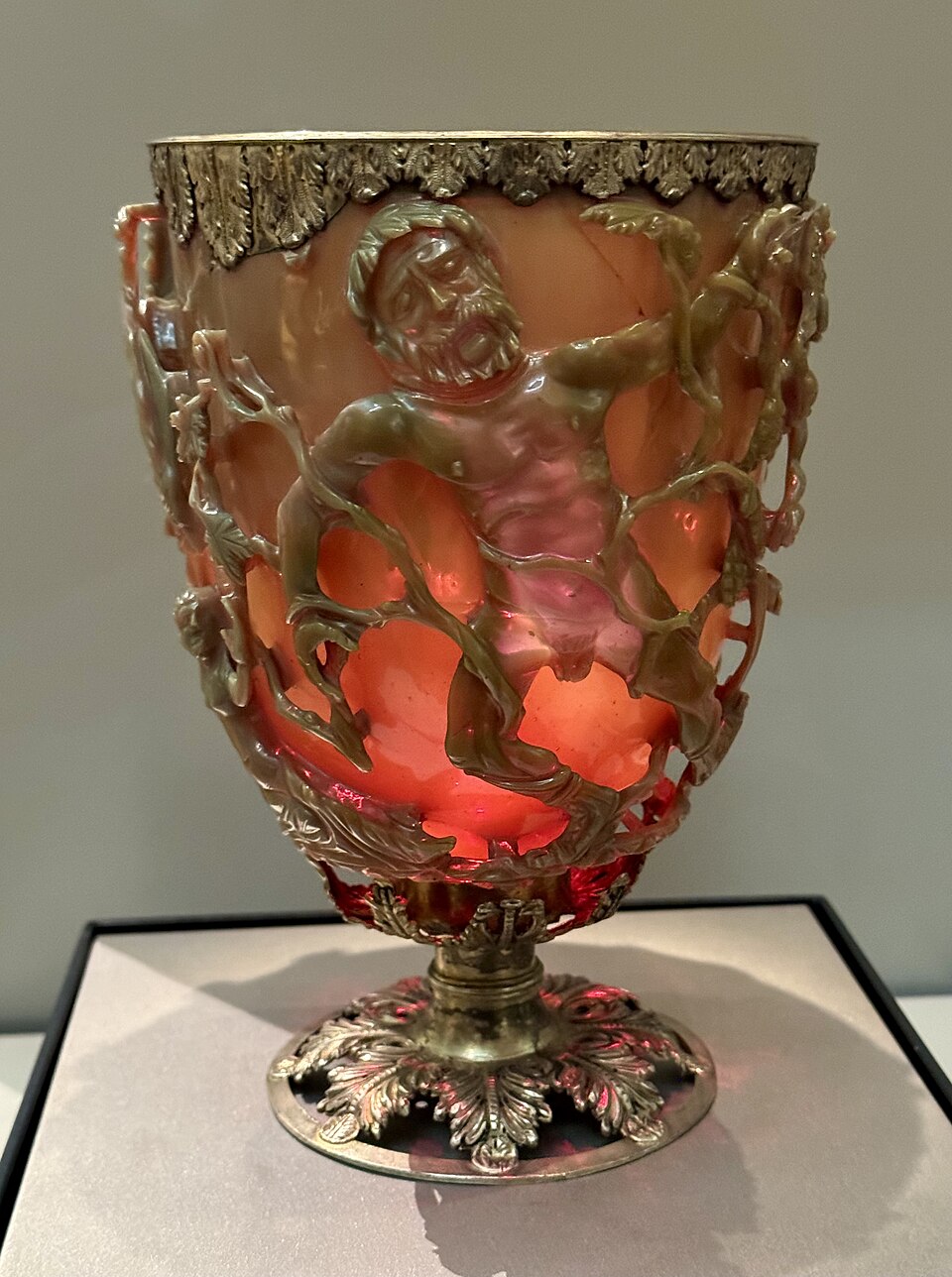
Held up in daylight, the Lycurgus Cup glows a murky jade green. Place a light source inside or behind it, and the same glass ignites into a deep, glowing red. This 4th-century Roman object, now in the British Museum, is the only complete surviving example of a Roman glass technique that produces this dichroic — two-colored — effect, and it does so more dramatically than any other known artifact from antiquity.
The cup is remarkable for a second reason entirely apart from its color-shifting glass. It is a cage cup, or diatretum, a form in which the glassmaker cuts and grinds away material so that only a decorative outer 'cage' remains, seemingly floating just above the vessel's surface. Most surviving cage cups show abstract geometric patterns. The Lycurgus Cup instead depicts a mythical scene: King Lycurgus attacking Ambrosia, a follower of the god Dionysus. In the story, Ambrosia is transformed into a vine that twists around the furious king and ultimately kills him, while Dionysus and two companions look on, taunting him. It is the only well-preserved figural cage cup known to survive.
The secret to the color change lies at the nanoscale. Researchers estimate that the glassmakers' flux contained about 330 parts per million of silver and 40 parts per million of gold, dispersed as colloidal particles roughly 70 nanometers across — far too small to see under an ordinary microscope, visible only via transmission electron microscopy. At that scale the particles interact with light through a phenomenon called surface plasmon resonance: reflected light scatters enough to appear green, while transmitted light lets red wavelengths pass through more than blue ones, producing the fiery red glow.
Those proportions are so minute that it seems implausible the Romans measured them deliberately. The likely explanation is that a much larger batch of glass was doped with higher concentrations of gold and silver, then diluted repeatedly by mixing in more plain glass until the ratio reached these vanishingly small levels. The gold may not even have been added on purpose — it could have arrived as a trace impurity in silver (most Roman silver contains a bit of gold), or as stray gold dust or leaf residue in a workshop that also handled precious metals.
The cutting itself was a feat of patience and risk. Behind the main figures, the glassmaker hollowed the interior far beyond the surrounding surface so the figures would be roughly the same thickness as the rest of the cup, ensuring even color when lit from within — a unique feature among surviving cage cups, thought to have been added as an afterthought. Around Lycurgus's torso, the glass shows an unusual shift in color, possibly an accident of the original manufacture that the cutter exploited deliberately, making the king's rage appear to glow. After the long grinding process, the surface was finished through flame polishing, a final step that could easily have destroyed the entire object.
More from Archaeology

The Bronze Disc That Rewrote the Sky
Two looters with a metal detector dug up something illegal, invisible in value, and older than Stonehenge's final stones — a map of the heavens buried for over three thousand years.

The Faceless Women of the Ice Age
Long before writing, before cities, before the wheel, someone carved a woman's body into stone and ivory — and left no name, no face, no explanation.

The Pebble That Might Be Human
A palm-sized stone found on a Moroccan riverbank may be humanity's oldest attempt to see itself — or simply a trick of erosion.

The Crown That Vanished: Deshret and the Red Land
A crown worn by kings for three thousand years has never once been found in a tomb — not one. So where did it go?

The Face That Traveled Between Empires
A farm worker's shovel struck stone in 1897 and unearthed a face so striking it would be sold to France, seized as war booty, and finally traded back for a Velázquez.

The Boy in the Dark Tunnel
A schoolboy fell into black water inside an ancient tunnel and surfaced with his fingers brushing letters no one had noticed for 2,600 years.