The Empire Built on an Island of Reeds
On unpromising islets in a shallow lake, a wandering tribe built a city of 300,000 people — and a mistaken belief in a returning god would help bring it all down.
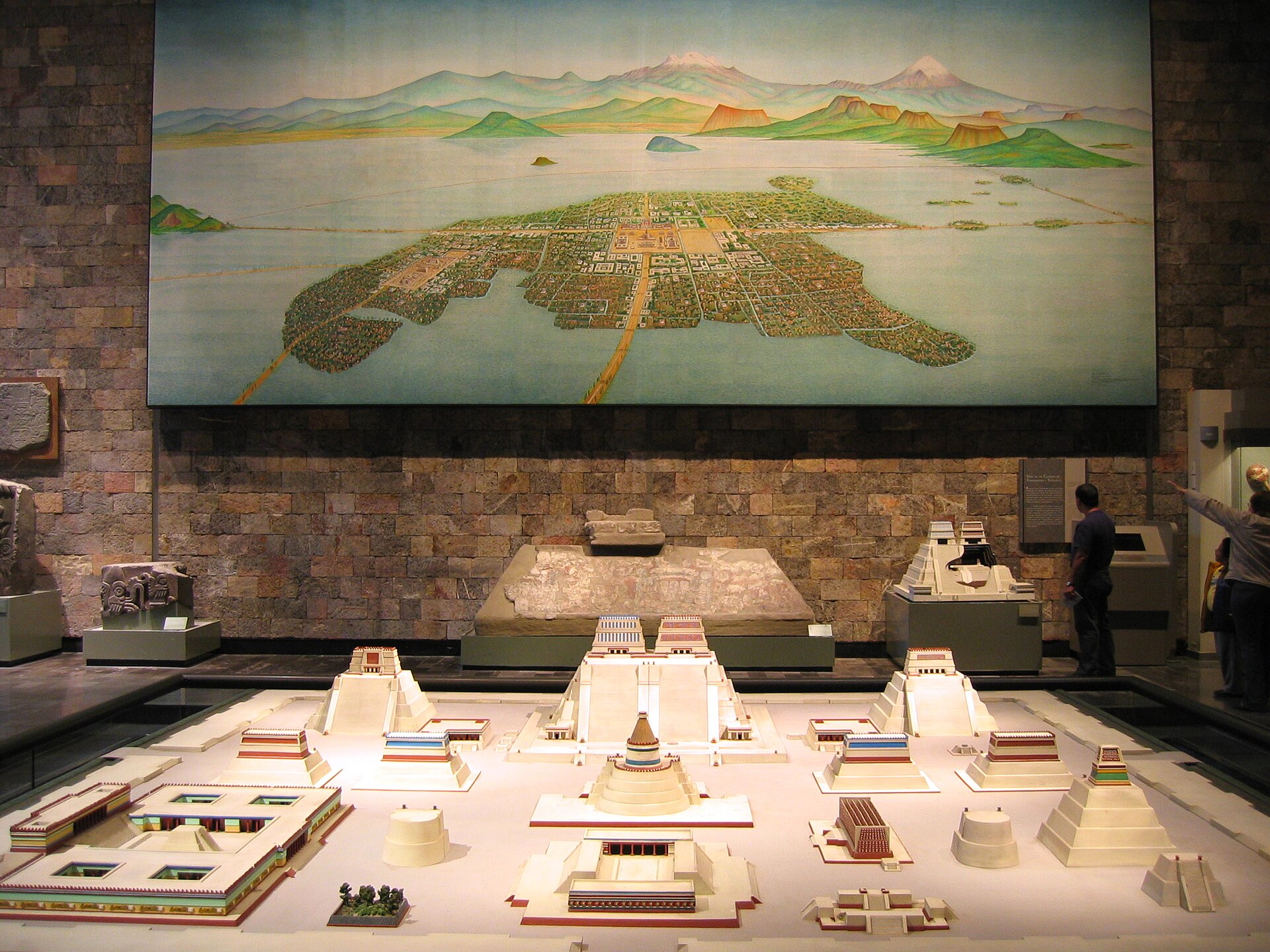
Around 1250, the Valley of Mexico was crowded with rival city-states — Chalco, Xochimilco, Tlacopan, Culhuacan, Azcapotzalco — each jostling for dominance around the shores of Lake Texcoco. The Mexica, a semi-nomadic Nahuatl-speaking people, arrived to find most of the land already claimed. By about 1248 they had settled at Chapultepec, a hill on the lake's western shore known for its many springs, before founding their own city around 1300 on a set of islets in the lake itself, near a temple to the god Huitzilopochtli.
That city was Tenochtitlan. Its buildings stood behind walls called Coatepantli, two and a half to three meters high, entered through four gates. At its heart rose the Great Temple, containing two shrines side by side: one to Huitzilopochtli, god of war, and one to Tlaloc, god of rain. By the 1500s, this city on the water had grown to roughly 300,000 people — a scale that stunned the Europeans who would later see it.
Tenochtitlan did not rule alone. In 1427, it joined with Texcoco and Tlacopan to form an alliance aimed at defeating the Tepanec state of Azcapotzalco, which had until then dominated the valley. This Triple Alliance succeeded, and from 1428 the three city-states governed the Valley of Mexico and its surrounding territory together — though Texcoco and Tlacopan were soon relegated to junior partners while Tenochtitlan became the dominant power.
What is often called the Aztec Empire was never a conventional territorial empire holding land through garrisons. Instead, it worked through client city-states, installing friendly rulers, arranging marriage alliances between ruling families, and spreading an imperial ideology. Subject states paid taxes rather than tribute to the emperor, the Huey Tlatoani, an economic arrangement that limited trade between outlying regions and kept them dependent on Tenochtitlan for luxury goods.
More from History

The Morning Bingham Climbed to Machu Picchu
On a cold July morning in 1911, an American historian scrambled up a jungle-choked ridge above the Urubamba River — and by afternoon, a forgotten Inca citadel would belong to the world.

The Last Half-Hour of the Hindenburg
It was already half a day late, and the public had been told to keep away — but at seven o'clock that evening, the Hindenburg finally turned toward its mooring mast for the last time.

The Last Hours of Pompeii: August 24, 79 AD
By noon it was just another hot day beside the Bay of Naples. By evening, an entire mountain had rewritten the fate of thousands.

The Longest Walk: Mandela's Last Steps to Freedom
After 27 years behind bars, a 71-year-old man had to relearn how to walk out of a prison gate — into a waiting world of cameras, crowds, and a country holding its breath.

The Document Lincoln Signed on the First Day of 1863
On a single January morning, a president's pen would change the legal status of more than three million people — if the ink held and his hand did not shake.

The Day of the Dream: August 28, 1963
Two hundred and fifty thousand people converged on the National Mall that morning — by nightfall, one voice from the steps of the Lincoln Memorial would echo for generations.