The Faces the Desert Kept: Secrets of the Tarim Mummies
In a desert that swallows rivers whole, a red-haired man in tartan leggings has waited three thousand years to tell his story — but his DNA speaks a language no one expected.
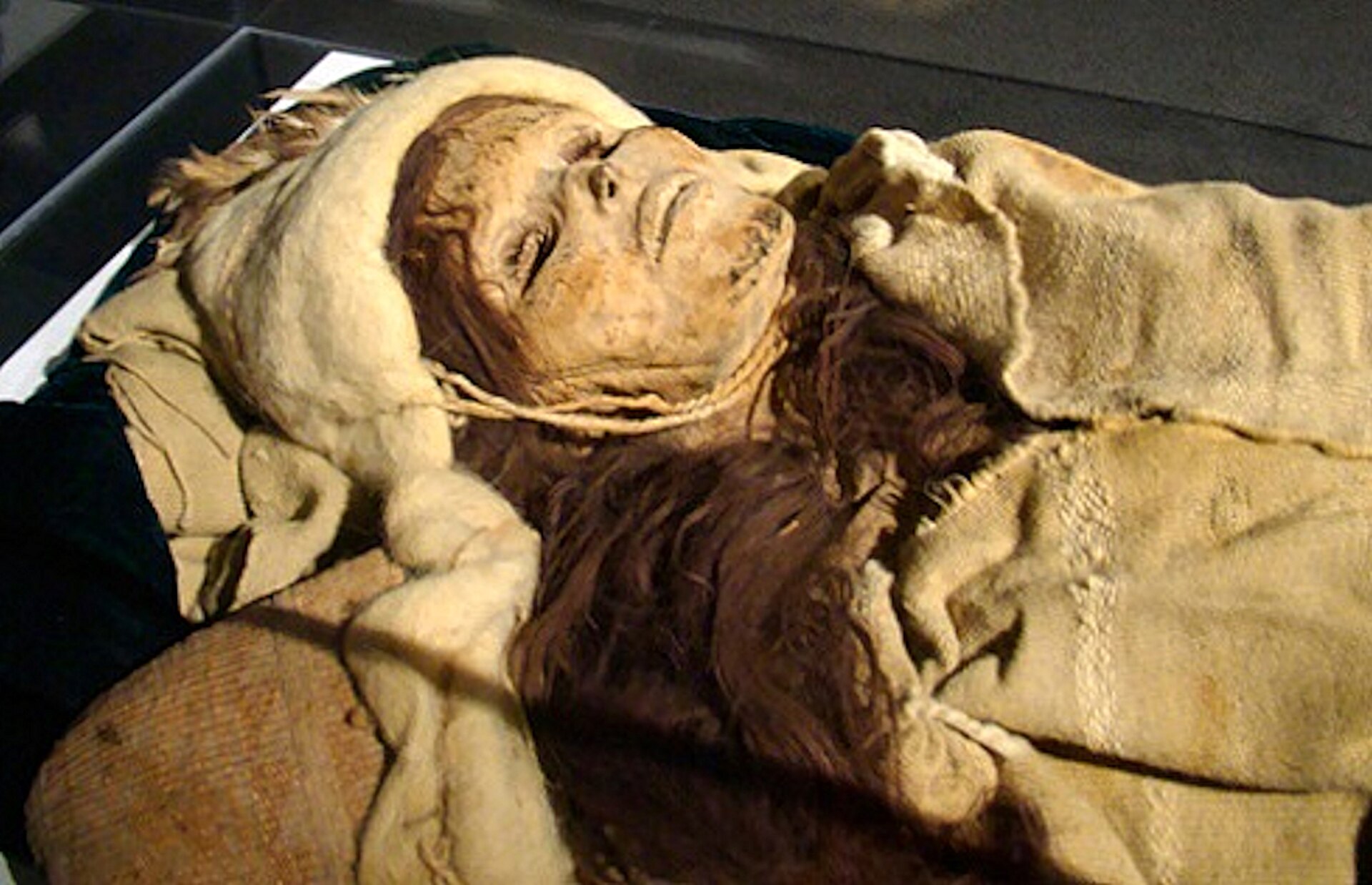
When European explorers like Sven Hedin, Albert von Le Coq, and Sir Aurel Stein pushed into the deserts of Central Asia at the start of the twentieth century, they stumbled upon something the sand had preserved almost too well: human bodies, desiccated but intact, their hair still curling in braids of blond, red, and deep brown. These were the Tarim mummies, found scattered across the eastern and southern edges of the Tarim Basin — near Lop Nur, Subeshi close to Turpan, Loulan, Kumul, and along the southern rim at Khotan, Niya, and Cherchen.
The oldest of these bodies date back to around 2000 BCE, when the now-desertified basin was still a freshwater environment, dotted with riverine oases. The people who lived there were agropastoral, tending herds and crops along the shifting waters of what would become the Taklamakan Desert. For decades, researchers assumed these early inhabitants must have descended from Bronze Age steppe populations to the west — the Afanasievo herders or the Bactria-Margiana Archaeological Complex. But genetic analysis published by Zhang and colleagues in 2021 overturned that assumption: the earliest mummies, dated between 2135 and 1623 BCE, carried about 72 percent Ancient North Eurasian ancestry and 28 percent Ancient Northeast Asian ancestry, with no trace of Western Steppe-related genes at all. They were a genetically isolated population that simply borrowed farming and herding practices from their neighbors.
That isolation didn't last. A 2025 study by the same team examined a Late Bronze Age site in the far west of the basin, dated to 1600–1400 BCE, and found its inhabitants overwhelmingly descended from the Sintashta and Andronovo cultures, with smaller contributions from the BMAC (10 percent) and the earlier Tarim population (12 percent). Nearly every individual there carried Y-DNA haplogroup R-M17 — a striking contrast to the isolated founders of centuries before.
Among the most vivid finds is Chärchän Man, sometimes called the 'Ur-David,' a tall, red-haired man from around 1000 BCE, buried in a red twill tunic and tartan leggings. Beside him lay his one-year-old son, brown hair peeking from beneath a red-and-blue felt cap, two small stones placed over his closed eyes. The 'Hami Mummy,' a 'red-headed beauty' dated to roughly 1400–800 BCE, was unearthed at Qizilchoqa. At Subeshi, archaeologists found the so-called 'Witches of Subeshi,' fourth- or third-century BCE burials marked by tall black felt conical hats nearly two feet long — and, in the same cemetery, a man whose abdomen bore the traces of surgery, its incision closed with sutures made of horsehair.
The textiles told their own story. Elizabeth Wayland Barber, examining Chärchän Man's tartan-patterned cloth, noted its resemblance to fragments recovered from salt mines tied to the Hallstatt culture in Europe. Textile specialist Irene Good identified the diagonal twill weave as evidence of a sophisticated loom, calling it the easternmost known example of that particular weaving technique — a thread, quite literally, connecting the Tarim Basin to far western craft traditions, even if the people themselves were not directly descended from those populations.
More from Archaeology

The Bronze Disc That Rewrote the Sky
Two looters with a metal detector dug up something illegal, invisible in value, and older than Stonehenge's final stones — a map of the heavens buried for over three thousand years.

The Faceless Women of the Ice Age
Long before writing, before cities, before the wheel, someone carved a woman's body into stone and ivory — and left no name, no face, no explanation.

The Pebble That Might Be Human
A palm-sized stone found on a Moroccan riverbank may be humanity's oldest attempt to see itself — or simply a trick of erosion.

The Crown That Vanished: Deshret and the Red Land
A crown worn by kings for three thousand years has never once been found in a tomb — not one. So where did it go?

The Face That Traveled Between Empires
A farm worker's shovel struck stone in 1897 and unearthed a face so striking it would be sold to France, seized as war booty, and finally traded back for a Velázquez.

The Boy in the Dark Tunnel
A schoolboy fell into black water inside an ancient tunnel and surfaced with his fingers brushing letters no one had noticed for 2,600 years.