The Flame of Red Square: Saint Basil's Cathedral
A tsar wanted a monument to victory that would look like nothing built before or since — and legend says he blinded the man who gave it to him.
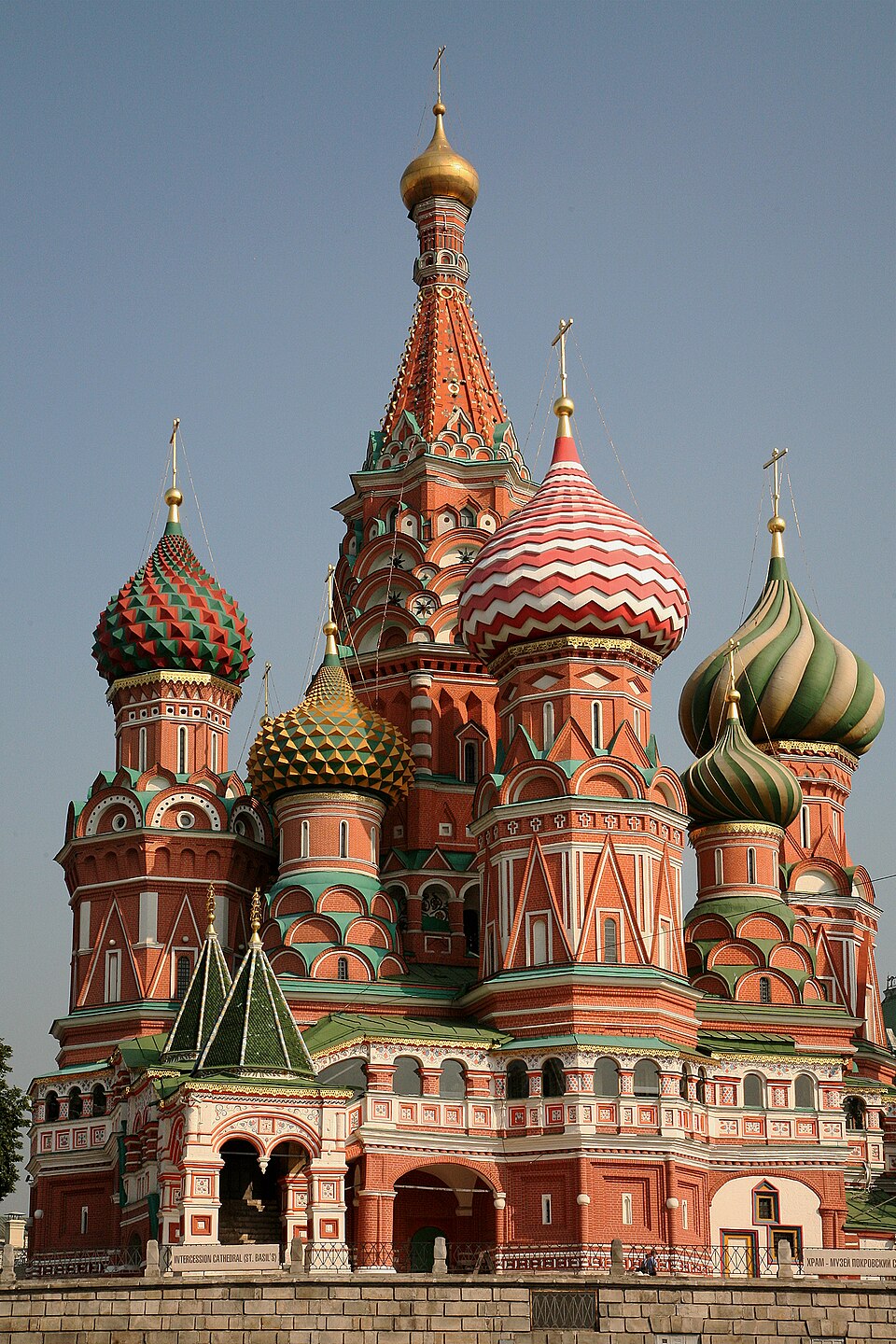
Rising from the edge of Red Square like a bonfire frozen mid-flare, Saint Basil's Cathedral has puzzled and delighted visitors for over four and a half centuries. Officially the Cathedral of the Intercession of the Most Holy Theotokos on the Moat, it owes its everyday name to a barefoot holy fool buried within its walls. Eight brightly colored domes cluster around a ninth, central dome, together forming one of the most recognized silhouettes on earth, though the site's origins were far more modest than its final form suggests.
Before the cathedral existed, this ground was a bustling marketplace outside the Kremlin's Saviour's Gate, anchored by the old white-stone Trinity Church. Ivan the Terrible, waging war against the khanates of Kazan and Astrakhan, began marking each victory with a small wooden memorial church beside Trinity Church. By the end of his Astrakhan campaign in the 1550s, seven wooden churches clustered around the site. In 1555, Ivan ordered something far grander: a single stone cathedral to replace them all, commemorating his conquests in permanent form.
Construction ran from 1555 to 1561, an extraordinary undertaking for its time — dedicating a church explicitly to a military triumph was, historians note, a genuine innovation in Muscovy. Building it just outside the Kremlin walls was also a political gesture, favoring the common people of the posad over the hereditary boyars who lived within the fortress. The identity of the architect remains uncertain; tradition names two men, Barma and Postnik, though many researchers believe these names refer to a single figure, Postnik Yakovlev.
That uncertainty gave rise to one of the cathedral's most enduring legends: that Ivan the Terrible had the architect blinded so he could never build anything so magnificent again. Most historians dismiss this as myth, since the same architect is later recorded working on the Cathedral of the Annunciation and the walls of the Kazan Kremlin well into the 1560s. The story likely migrated from an account of an earlier tsar, Ivan III, blinding the builder of a different fortress entirely.
The cathedral's interior grew organically over the following decades. Originally called Trinity Church after its easternmost sanctuary, it contained eight chapels arranged around the central ninth one dedicated to the Intercession, and it burned down in 1583 before being rebuilt by 1593. A tenth chapel was added in 1588 over the grave of Basil the Blessed, the venerated local fool for Christ who died in the 1550s — the very chapel that eventually gave the whole structure its popular name. Another holy fool, Ivan the Blessed, was buried on the grounds in 1589, and a further sanctuary honoring him was built in 1672.
More from Architecture

Stonehenge: The Stones That Refuse to Explain Themselves
For more than 4,500 years, a ring of leaning giants has watched the sun rise and set on the same two days each year — and no one alive can say for certain why.

The Dome That Refused to Fall
Two thousand years ago, Roman engineers poured a dome so vast that no one has dared build a bigger one from unreinforced concrete since. It still stands, open to the sky.

A Minaret Rising Over Kingsland Road
On a busy London street better known for shops and buses, the tallest minaret in Britain quietly reaches into the sky. Its story began not in Sinan's sixteenth-century Istanbul, but in 1990s Hackney.

The Bridge That Was Killed Twice
For 427 years it arched over the Neretva like a stone rainbow. Then, in a matter of days in 1993, it simply ceased to exist.

Hoover Dam: The Concrete That Tamed a River
In the scorched depths of Black Canyon, thousands of men built the largest concrete structure the world had ever seen — and finished it two years early, at a cost of over a hundred lives.

Neuschwanstein: The Castle Built for a Ghost
A king who despised his own palace built the most famous fairy-tale castle on earth — and died before he ever truly lived in it.