The Footprints in the Ash: Laetoli's 3.7-Million-Year Walk
Frozen mid-stride in volcanic ash for millions of years, a set of footprints would one day rewrite the story of how humans learned to walk.
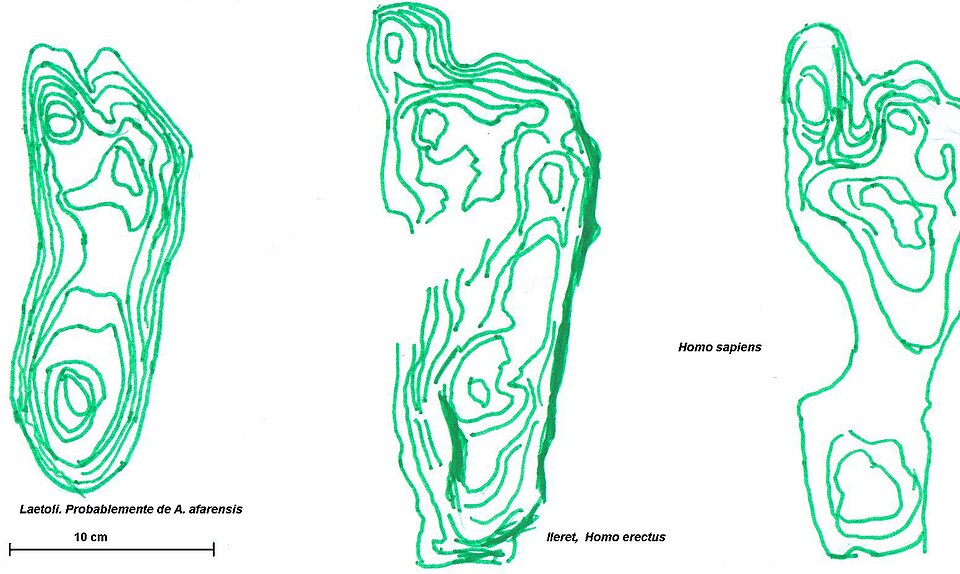
In 1976, on a stretch of dusty ground in the Enduleni ward of Ngorongoro District in Tanzania's Arusha Region, paleoanthropologist Mary Leakey and her team noticed something extraordinary embedded in ancient volcanic ash: a trail of footprints, unmistakably hominin, stretching 75 feet (24 meters) across the ground at a location that came to be called Site G. By 1978, the site had been fully excavated, revealing one of the most significant discoveries in the study of human origins.
The footprints were dated to roughly 3.7 million years ago, placing them within the Upper Laetolil Beds, layers of volcanic tuff that geologists identified using potassium-argon dating and stratigraphy; that upper unit of the Laetolil Beds has itself been dated to a broader range of 3.6 to 3.8 million years ago. At the time of discovery, the prints represented the oldest known evidence of bipedalism—walking upright on two legs—in hominins. Though older Ardipithecus ramidus fossils were later found suggesting bipedal traits, the Laetoli prints remained a landmark because they showed, in astonishingly direct physical form, exactly how an ancient relative of humans moved across the earth.
The story of Laetoli's discovery stretches back further than 1976, though. In 1935, a local man named Sanimu persuaded archaeologist Louis Leakey to investigate the region, leading to the collection of mammalian fossils, including a tooth later identified in 1979 by P. Andrews and T. White as the site's first hominin fossil. German archaeologist Ludwig Kohl-Larsen carried out extensive study of the site in 1938 and 1939, uncovering hominin premolars, molars, and incisors. Interest faded until 1974, when George Dove's discovery of a hominin premolar drew Mary Leakey back to the site—setting the stage for the footprint find two years later.
Geologically, the footprints were preserved through a remarkable sequence of events: soft rain fell on a fresh layer of volcanic ash roughly 15 centimeters thick, cementing it just enough to hold impressions before it hardened into rock. Researchers originally suspected the nearby Sadiman volcano, some 20 kilometers away, as the source of the ash, though a 2011 study by Zaitsev and colleagues cast doubt on that connection, showing Sadiman was not the source of the Laetoli Footprints Tuff.
Determining exactly which species left the tracks has proven difficult, but researchers have tentatively settled on Australopithecus afarensis. That conclusion rests on detailed anatomical work: Tim D. White and Gen Suwa of the University of California reconstructed the foot skeleton of a female A. afarensis, while Russell Tuttle of the University of Chicago conducted comparative footprint analysis, examining step length, stride length, stride width, and foot angle against those of humans and other bipedal creatures such as bears and primates. Tuttle's conclusion was striking: the gait was far more human-like than ape-like.
More from Archaeology

The Bronze Disc That Rewrote the Sky
Two looters with a metal detector dug up something illegal, invisible in value, and older than Stonehenge's final stones — a map of the heavens buried for over three thousand years.

The Faceless Women of the Ice Age
Long before writing, before cities, before the wheel, someone carved a woman's body into stone and ivory — and left no name, no face, no explanation.

The Pebble That Might Be Human
A palm-sized stone found on a Moroccan riverbank may be humanity's oldest attempt to see itself — or simply a trick of erosion.

The Crown That Vanished: Deshret and the Red Land
A crown worn by kings for three thousand years has never once been found in a tomb — not one. So where did it go?

The Face That Traveled Between Empires
A farm worker's shovel struck stone in 1897 and unearthed a face so striking it would be sold to France, seized as war booty, and finally traded back for a Velázquez.

The Boy in the Dark Tunnel
A schoolboy fell into black water inside an ancient tunnel and surfaced with his fingers brushing letters no one had noticed for 2,600 years.