The Forest of Columns: Córdoba's Shifting Sanctuary
A thousand striped arches march into the dark like a forest turned to stone — and at its heart sits a Renaissance cathedral, grown from within a mosque that never fully disappeared.
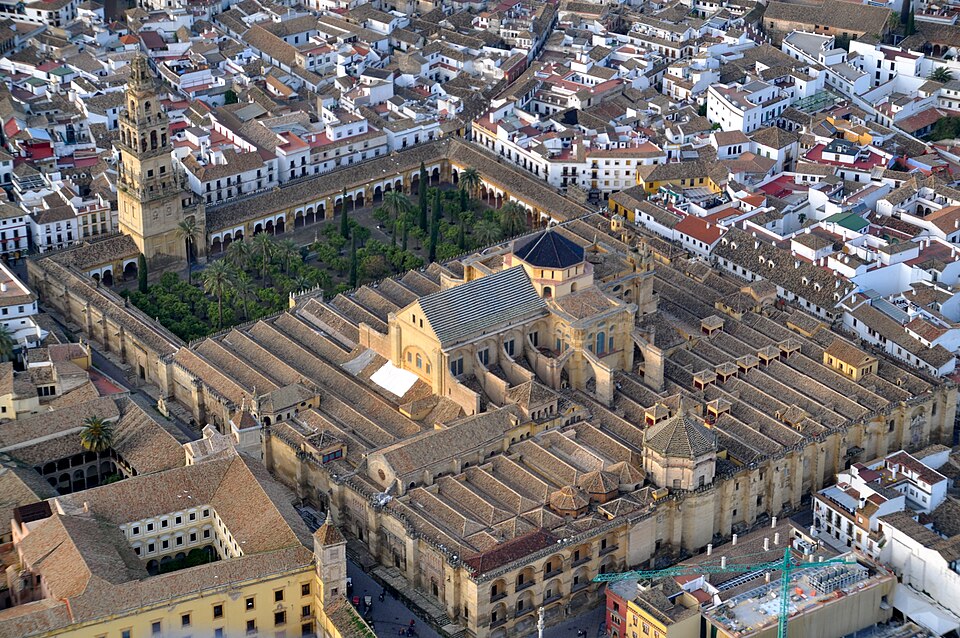
Walk into the building the Spanish simply call the Mezquita, and the first sensation is disorientation: rows upon rows of red-and-white striped horseshoe arches stretch in every direction, supported by hundreds of columns, some of granite salvaged from older buildings. There is no single vanishing point, no altar drawing the eye forward — only repetition, rhythm, and shadow. Then, without warning, the forest opens onto a blaze of Gothic vaulting and Baroque gilding: a full Renaissance cathedral nave, inserted directly into the middle of the structure centuries after the columns were first raised.
The story begins in 785, when Abd al-Rahman I, founder of the Umayyad Emirate of Córdoba, ordered the construction of a great mosque on a site traditionally said to have held a Visigothic church dedicated to Saint Vincent of Saragossa. According to the traditional account, Christians and Muslims had shared the site after the Umayyad conquest of Hispania, until Abd al-Rahman purchased the Christian half for a hundred thousand dinars, demolished the existing structure, and began his mosque — while permitting Christians to build replacement churches outside the city walls. Modern archaeologists debate this narrative fiercely; while fragments of a Late Roman or Visigothic building have been found on the site, no one has pinpointed exactly where a church or the first mosque stood, and some scholars argue no convincing evidence of a church — no cemetery, no Christian iconography — has ever surfaced.
Whatever stood there before, the mosque itself rose fast: construction begun in 785 was completed within a year, essentially by 786, producing a hall roughly 75 by 100 meters. It did not stay that size for long. Successive Umayyad rulers kept expanding it. In 833, Abd al-Rahman II added aisles to the east and west, pushing the total number of aisles to eleven. Abd al-Rahman III added a minaret, completed in 958. His son al-Hakam II went further still, adding eleven more aisles and eleven more arches around 961, which brought the building's total length to roughly 47.5 meters, and installing a lavishly decorated new mihrab and maqsurah, finished in 971 — additions carried out carefully in the original style, so as not to disrupt the coherence of the whole.
By the time these expansions were complete, the mosque had become an almost unbelievable structure: about 175 meters long and 134 meters wide, encircled by a thick wall over 12 meters high. One frequently cited count, drawn from the scholar İlhan Özkeçeci, puts the number of columns at 1,293, making it among the most column-dense religious structures ever built; other accounts, describing the columns that support the arches themselves, cite a figure of 850. Nineteen parallel aisles ran in one direction, crossed at right angles by thirty-six more, creating a grid of shadow and light that seemed to repeat infinitely. The double-tiered arches, a feature unique to this building, allowed the roof to rise higher while keeping the columns short, reusing spans of Roman and Visigothic material.
The mihrab, a horseshoe-shaped niche framed by extraordinary columns, and the adjoining minbar — inlaid with ivory, precious stones, and gold nails — represented the artistic peak of the al-Hakam II era, with Kufic inscriptions in gold set against deep blue backgrounds lining the walls nearby. This was not simply a place of prayer; it was a declaration, in stone and calligraphy, of Umayyad Córdoba's wealth and religious authority in the western Mediterranean.
More from Architecture

Stonehenge: The Stones That Refuse to Explain Themselves
For more than 4,500 years, a ring of leaning giants has watched the sun rise and set on the same two days each year — and no one alive can say for certain why.

The Dome That Refused to Fall
Two thousand years ago, Roman engineers poured a dome so vast that no one has dared build a bigger one from unreinforced concrete since. It still stands, open to the sky.

A Minaret Rising Over Kingsland Road
On a busy London street better known for shops and buses, the tallest minaret in Britain quietly reaches into the sky. Its story began not in Sinan's sixteenth-century Istanbul, but in 1990s Hackney.

The Bridge That Was Killed Twice
For 427 years it arched over the Neretva like a stone rainbow. Then, in a matter of days in 1993, it simply ceased to exist.

Hoover Dam: The Concrete That Tamed a River
In the scorched depths of Black Canyon, thousands of men built the largest concrete structure the world had ever seen — and finished it two years early, at a cost of over a hundred lives.

Neuschwanstein: The Castle Built for a Ghost
A king who despised his own palace built the most famous fairy-tale castle on earth — and died before he ever truly lived in it.