The Grave That Rewrote the Bronze Age
In October 1972, an excavator operator digging in an industrial zone near Varna struck something that would rewrite the timeline of human civilization: gold older than Egypt's pyramids, older than Mesopotamia's ziggurats.
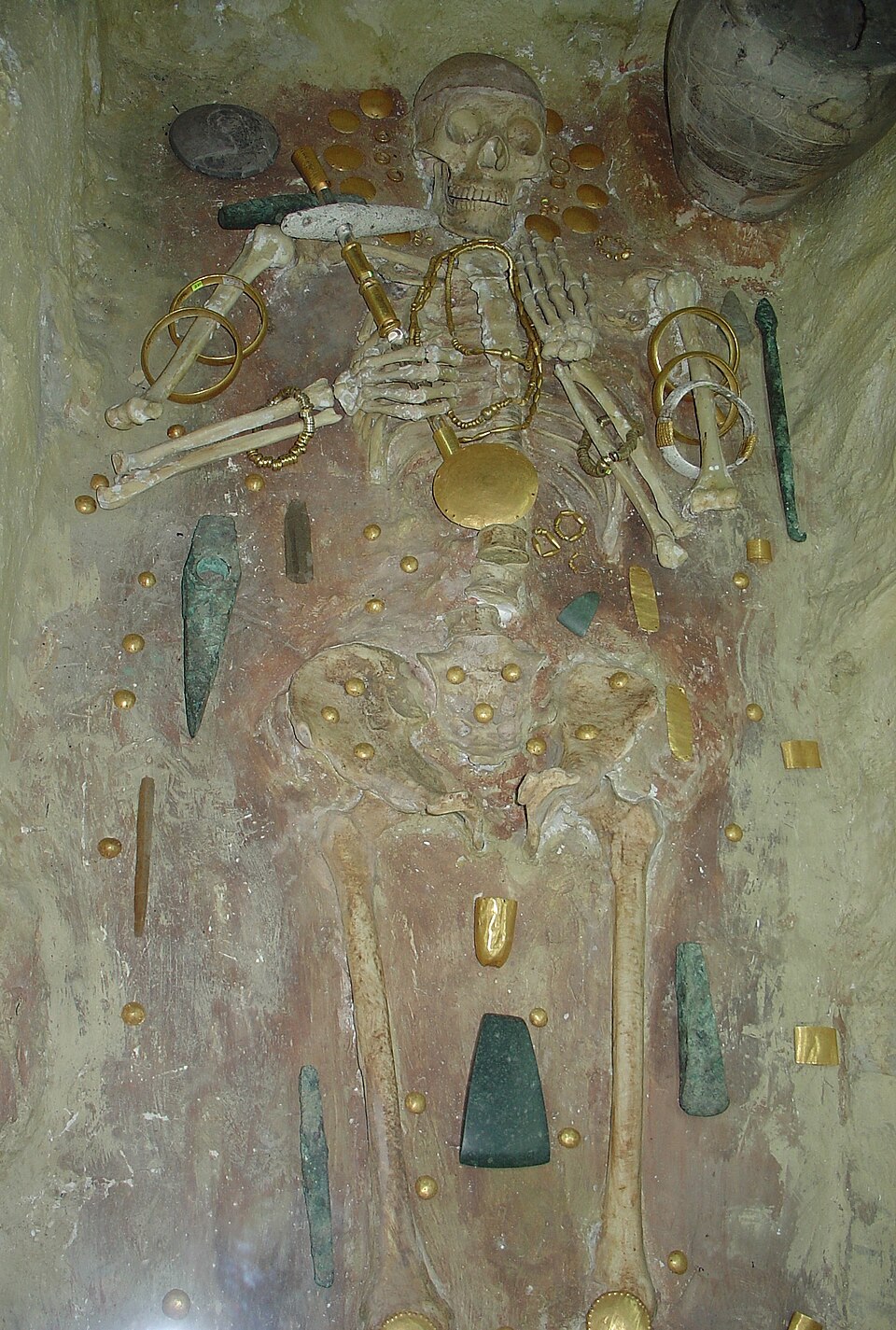
Raycho Marinov was simply operating heavy machinery in the western industrial zone of Varna, Bulgaria, when his excavator bucket turned up something unexpected. He had no way of knowing he'd stumbled onto one of the most important archaeological discoveries of the twentieth century. Local residents summoned Dimitar Zlatarski, founder of the Dalgopol Historical Museum, who immediately grasped the magnitude of the find and contacted the Varna Historical Museum. After the necessary paperwork was signed, excavation was handed over to a team led jointly by Mihail Lazarov, who directed the work from 1972 to 1976, and Ivan Ivanov, who directed it from 1972 to 1991.
What emerged from the ground over the following decades was staggering. Archaeologists eventually uncovered 294 graves, containing sophisticated metallurgy in gold and copper, roughly 600 pieces of pottery (some painted with gold), high-quality flint and obsidian blades, beads, and shells. And yet even now, about 30 percent of the estimated necropolis remains unexcavated — meaning the site may still hold secrets.
Radiocarbon dating conducted in 2006 placed the graves between 4569 and 4340 BC, tying them to the Chalcolithic Varna culture, a local branch of what is sometimes called the KGKVI cultural complex. This made the Varna gold — dated broadly from 4600 to 4200 BC — the oldest known worked gold in the world, and by far the largest and most diverse trove of its kind. Other Bulgarian sites, like Hotnitsa, Durankulak, and Provadia-Solnitsata, have yielded comparably ancient gold, but none rival Varna in sheer volume.
The burial rites themselves revealed a complex culture. Some skeletons lay crouched, others straight. Strikingly, some graves held no bodies at all — cenotaphs, symbolic graves filled only with grave goods. These empty graves turned out to be the richest in gold. In total, roughly 3,000 gold artifacts weighing about six kilograms were recovered from the necropolis. Grave 43 alone contained more gold than had been found anywhere else in the world from that entire epoch combined. Once thought to belong to a prince, it is now believed to be the resting place of a smith.
Three of the symbolic graves contained masks made of unbaked clay, an eerie detail suggesting elaborate funerary symbolism. According to researcher Slavchev, three particular graves held gold objects accounting for more than half the total weight of gold found across the entire cemetery — and each of these three graves also contained a scepter, a marker of supreme secular or religious authority.
More from Archaeology

The Bronze Disc That Rewrote the Sky
Two looters with a metal detector dug up something illegal, invisible in value, and older than Stonehenge's final stones — a map of the heavens buried for over three thousand years.

The Faceless Women of the Ice Age
Long before writing, before cities, before the wheel, someone carved a woman's body into stone and ivory — and left no name, no face, no explanation.

The Pebble That Might Be Human
A palm-sized stone found on a Moroccan riverbank may be humanity's oldest attempt to see itself — or simply a trick of erosion.

The Crown That Vanished: Deshret and the Red Land
A crown worn by kings for three thousand years has never once been found in a tomb — not one. So where did it go?

The Face That Traveled Between Empires
A farm worker's shovel struck stone in 1897 and unearthed a face so striking it would be sold to France, seized as war booty, and finally traded back for a Velázquez.

The Boy in the Dark Tunnel
A schoolboy fell into black water inside an ancient tunnel and surfaced with his fingers brushing letters no one had noticed for 2,600 years.