The Great Sphinx: Guardian of the Sands
For thousands of years it has faced the rising sun without blinking, carved from living rock and carrying a riddle no one has fully answered: who built it, and why does it wear a pharaoh's face?
On the Giza Plateau, on the west bank of the Nile, a colossal figure lies stretched across the desert floor, its body that of a lion, its face that of a man. This is the Great Sphinx of Giza, the largest and most famous sphinx ever carved, positioned southeast of the Great Pyramids and facing due east toward the rising sun. Most Egyptologists agree its head bears the likeness of the pharaoh Khafre, dating its creation to somewhere between 2600 and 2500 BC, though a small minority of geologists have pointed to water erosion patterns around the enclosure as evidence the monument might be far older, a claim that remains contested and lacks broad support among specialists.
No one recorded what the ancient Egyptians originally called their sphinx statues. But nearly a thousand years after its carving, around 1400 BC, the pharaoh Thutmose IV had a stele inscribed near the Sphinx naming three aspects of the sun deity worshipped at the time: Khepera-Re-Atum. This suggests the monument had already become bound up with solar worship long before it acquired the name history remembers it by.
The word 'sphinx' itself is Greek, tied by folk etymology to sphingo, meaning 'to squeeze' or 'to strangle' — a nod to how lions kill their prey. But the historian Susan Wise Bauer has argued the term may actually be a Greek corruption of the Egyptian shesep-ankh, meaning 'living image,' a reference not to the beast but to the statue itself, carved from living rock rather than assembled from separate blocks.
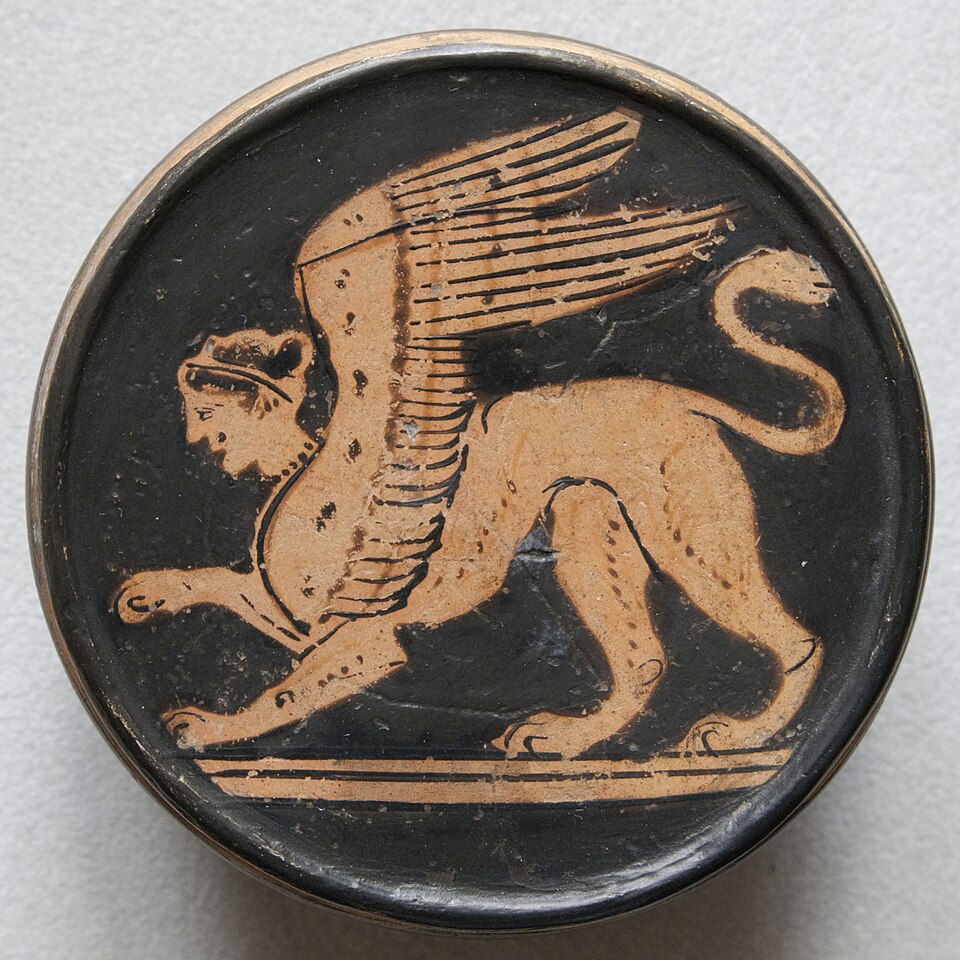
In Egyptian tradition, the sphinx was almost always male — an androsphinx — and wingless, unlike its Greek or Mesopotamian cousins. It represented strength and ferocity, frequently modeled on a pharaoh's own features to emphasize his kinship with the powerful lioness deity Sekhmet. The Great Sphinx was not alone in this role: a granite sphinx bearing the face of Hatshepsut now resides in New York's Metropolitan Museum of Art, while an alabaster sphinx from Memphis sits in that city's open-air museum. At Thebes, nine hundred ram-headed sphinxes, or criosphinxes, once lined temple approaches in honor of the god Amon, each paired at Karnak with a full statue of the pharaoh — their combined purpose, tradition held, was to hold back the forces of evil.
In March 2023, archaeologists working at the Dendera Temple Complex uncovered a limestone sphinx with a slight grin and dimpled cheeks, believed to depict the Roman emperor Claudius — proof that the sphinx as a form endured for millennia after its Old Kingdom origins, adapting to new rulers and new empires.
More from Architecture

Stonehenge: The Stones That Refuse to Explain Themselves
For more than 4,500 years, a ring of leaning giants has watched the sun rise and set on the same two days each year — and no one alive can say for certain why.

The Dome That Refused to Fall
Two thousand years ago, Roman engineers poured a dome so vast that no one has dared build a bigger one from unreinforced concrete since. It still stands, open to the sky.

A Minaret Rising Over Kingsland Road
On a busy London street better known for shops and buses, the tallest minaret in Britain quietly reaches into the sky. Its story began not in Sinan's sixteenth-century Istanbul, but in 1990s Hackney.

The Bridge That Was Killed Twice
For 427 years it arched over the Neretva like a stone rainbow. Then, in a matter of days in 1993, it simply ceased to exist.

Hoover Dam: The Concrete That Tamed a River
In the scorched depths of Black Canyon, thousands of men built the largest concrete structure the world had ever seen — and finished it two years early, at a cost of over a hundred lives.

Neuschwanstein: The Castle Built for a Ghost
A king who despised his own palace built the most famous fairy-tale castle on earth — and died before he ever truly lived in it.