The Greek Who Sailed Off the Edge of the Known World
In about 325 BC, while Alexander the Great was conquering Asia, a lone Greek merchant-scholar slipped past a naval blockade and sailed into a sea no Mediterranean sailor had ever charted. He came back describing a sun that never set — and almost no one believed him.
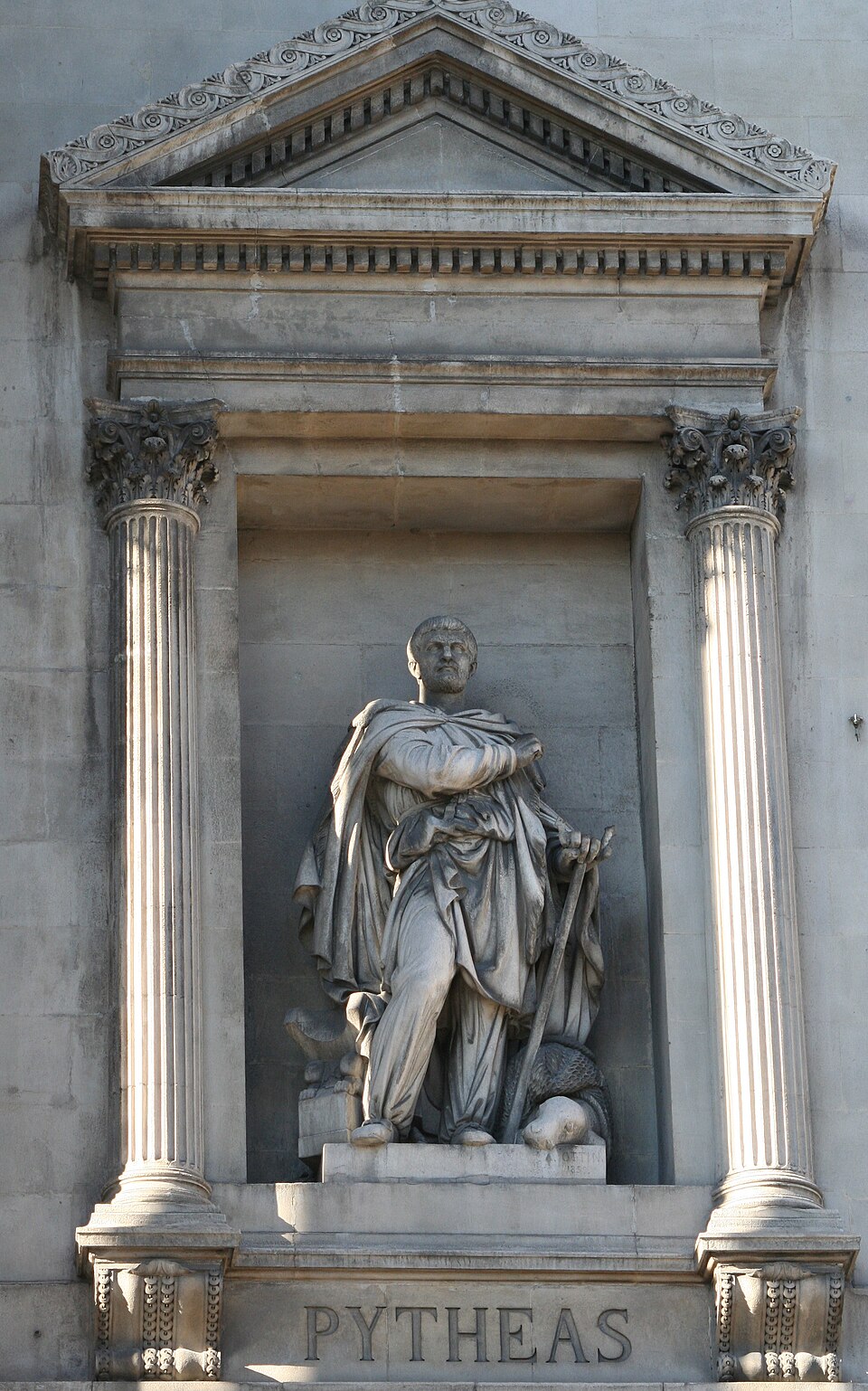
Pytheas of Massalia, a Greek colony on the site of modern Marseille, was born around 350 BC and made his voyage of exploration to Northern Europe in about 325 BC. He was a geographer, explorer and astronomer, and unlike the conquerors of his age who moved armies across continents, Pytheas moved alone, or with a small crew, toward the blank spaces at the top of the map. His account of that voyage, called On the Ocean, does not survive as a complete text. Everything we know about it comes secondhand, filtered through later writers — Strabo, Pliny the Elder, Diodorus of Sicily — who quoted, paraphrased, or argued with him centuries after he lived.
The biggest obstacle to Pytheas's journey wasn't the ocean itself but politics. The Carthaginians controlled the Strait of Gibraltar and had closed it to ships of other nations, effectively locking the Mediterranean world away from the Atlantic. How Pytheas got past this blockade is still debated. Some scholars have suggested he traveled overland to reach the mouth of the Loire or the Garonne, avoiding the strait entirely. Others think he hugged the coastline and sailed mostly at night, or simply caught the blockade during a lapse. A different theory notes that by his era, Massalia and Carthage may have been on decent terms, especially after a 348 BC treaty between Carthage and Rome eased regional tensions — perhaps giving a Massaliote trader like Pytheas room to slip through.
However he got out, once beyond the strait Pytheas became the first documented Mediterranean mariner to reach the British Isles. He didn't just touch land — he circumnavigated and explored a considerable part of Britain, becoming the first known Greek to systematically describe the Celtic and Germanic tribes he encountered along Europe's northern coasts. This alone would have made him a remarkable figure in Greek geography, which at the time had only hazy, secondhand notions of anything north of Gaul.
But Pytheas kept going. He is the first person on historical record to describe the midnight sun — the phenomenon, at high latitudes in summer, of the sun never fully setting. He also became the first known Greek scientific observer to describe the Arctic and polar ice, regions that had previously existed in Mediterranean imagination mostly as vague legend, tied to old reports of a land of perpetual snow and darkness known as the country of the Hyperboreans.
It was on this voyage that Pytheas introduced a name that would haunt geographers for two thousand years: Thule, a distant northern land whose exact location remains disputed to this day, with candidates ranging from Norway to Iceland to the Shetlands. He also made a genuinely original scientific contribution, offering what is now recognized as the earliest known account proposing that the moon caused the tides — a theoretical leap far ahead of what any predecessor is recorded as claiming.
More from Explorations

Humboldt: The Man Who Measured the World
A Prussian noble's son, once mocked as a sickly child, would climb a volcano to a world-record height and rewrite how humanity understood nature itself.

The Man Who Named Canada
A Breton mariner planted a wooden cross on a foreign shore and claimed a kingdom he did not understand — then spent a winter frozen into its river, praying a stranger's remedy would save his men.

Sixty Ships Into the Unknown: Hanno's Voyage Down the African Coast
A Carthaginian fleet of sixty ships and thousands of settlers vanished past the Pillars of Hercules to found cities on an unmapped coast — and came home with the skins of hairy, hostile 'gorillas' as proof of how far they had gone.

HMS Challenger: The Voyage That Charted the Deep
A stripped-down warship, its guns torn out to make room for microscopes, set sail from Portsmouth to answer a question no one had ever properly asked: what lies at the bottom of the sea?

Scott's Last Expedition: The Letters Written at the End of the World
Five men reached the bottom of the world only to find a Norwegian flag already planted there. What followed was not glory, but a slow, frozen unraveling that the world would remember for a century.

Marco Polo: In the Court of Kublai Khan
A fifteen-year-old boy meets the father he barely knew — and is soon swept toward the richest court on Earth. Twenty-four years later, he returns home with tales so vast that Venice simply calls him 'Mister Millions'.