The Grooved Stones of Ottosdal
Miners pulled them from three-billion-year-old rock — perfectly rounded, ridged like tiny planets. Some claimed they couldn't be natural. Geologists disagreed.
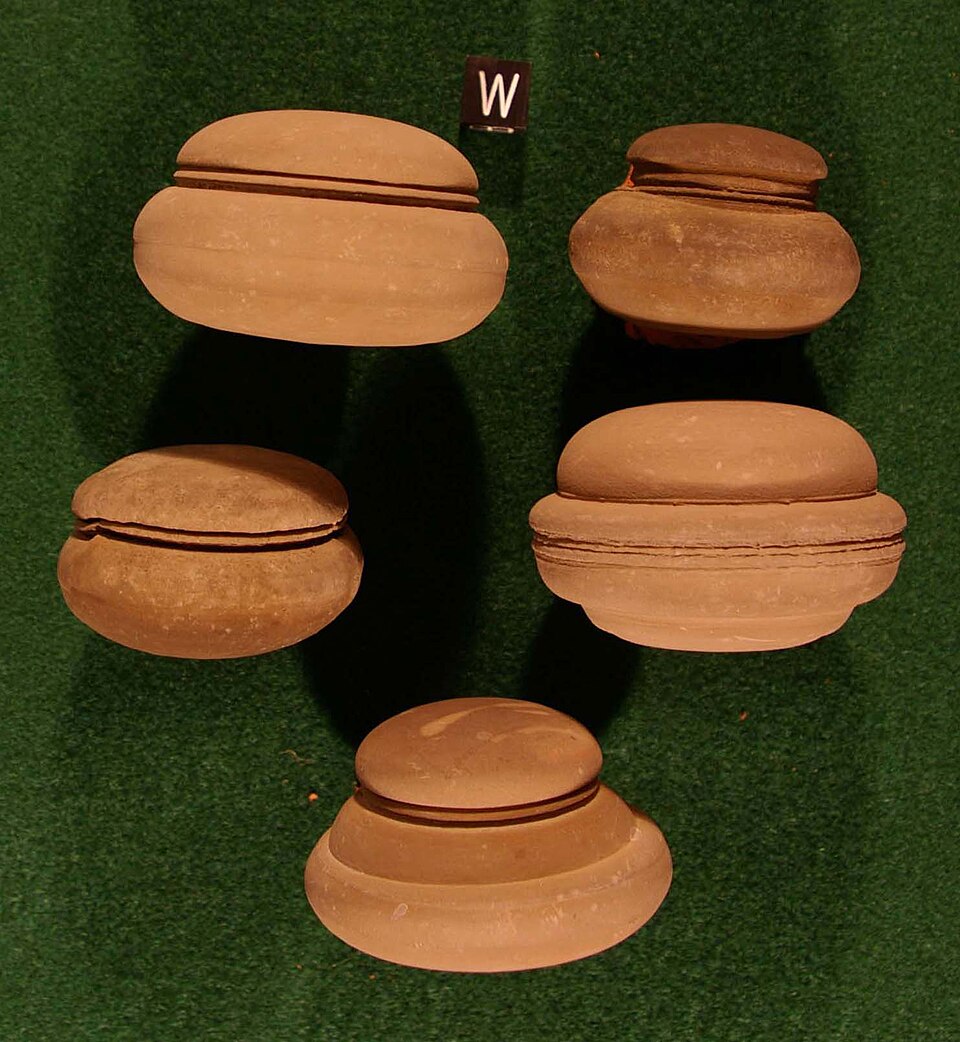
In the shale pits near Ottosdal, South Africa, workers at Wonderstone Ltd. kept turning up strange little objects while mining pyrophyllite: small spheres and discs, some no bigger than a coin, others up to ten centimeters across, often fused together in clusters. Their surfaces sometimes carried neat, parallel grooves running around their middles like the lines of latitude on a globe. To rockhounds and miners who collected them, they looked almost too precise to be accidents of nature.
That sense of impossibility caught the attention of writers and pseudoscientists, who began citing the Klerksdorp spheres in books and articles as out-of-place artifacts — objects so ancient and so symmetrical that only intelligent hands, they argued, could have shaped them. The spheres, after all, sat in pyrophyllite deposits dated to roughly three billion years old, long before anything resembling human civilization existed on Earth.
Geologists who actually studied the objects reached a very different conclusion. Paul Heinrich examined specimens under the microscope and with X-ray diffraction, finding that they were composed of hematite or wollastonite mixed with small amounts of hematite and goethite, colored dark reddish brown to dusky red. Every specimen he cut open showed a strikingly well-defined radial internal structure, fanning out from one or more central points — a pattern with a clear mineralogical explanation, not a manufactured one.
Other researchers, including Bruce Cairncross, Louis Taylor Nel, and Andrea Agangi, studied spheres still embedded in pristine, unweathered pyrophyllite and found them made of diagenetic pyrite, with a metallic luster and pale brass-yellow color. Pyrite of this kind occurs throughout the rock as fine grains, centimeter-sized spheroids, and layers within thin beds of carbonaceous shale — the very material locally known as wonderstone.
The geologic setting explains how such objects could form. The shales bearing these spheres occur as lenses within the roughly 1.5-kilometer-thick Syferfontein Formation, itself part of the far larger, 2.7-kilometer-thick Dominion Group, which fills ancient failed rift basins on the Kaapvaal craton. Evidence such as massive amygdaloidal lavas without pillow structures, high-temperature ignimbrites, and preserved ancient soils shows this was a terrestrial environment, not a marine one. The carbon-rich shales likely accumulated in a volcanically active, acidic lake roughly three billion years ago, resting atop several meters of sandstone that graded upward from coarse, pebbly layers into fine carbonaceous mud.
More from Archaeology

The Bronze Disc That Rewrote the Sky
Two looters with a metal detector dug up something illegal, invisible in value, and older than Stonehenge's final stones — a map of the heavens buried for over three thousand years.

The Faceless Women of the Ice Age
Long before writing, before cities, before the wheel, someone carved a woman's body into stone and ivory — and left no name, no face, no explanation.

The Pebble That Might Be Human
A palm-sized stone found on a Moroccan riverbank may be humanity's oldest attempt to see itself — or simply a trick of erosion.

The Crown That Vanished: Deshret and the Red Land
A crown worn by kings for three thousand years has never once been found in a tomb — not one. So where did it go?

The Face That Traveled Between Empires
A farm worker's shovel struck stone in 1897 and unearthed a face so striking it would be sold to France, seized as war booty, and finally traded back for a Velázquez.

The Boy in the Dark Tunnel
A schoolboy fell into black water inside an ancient tunnel and surfaced with his fingers brushing letters no one had noticed for 2,600 years.