The Hill That Rewrote History
Long before the wheel, before pottery, before a single brick city, hunter-gatherers on a limestone ridge in southeastern Turkey raised carved stone pillars taller than a man. What they built there upends everything we thought we knew about civilization's beginnings.
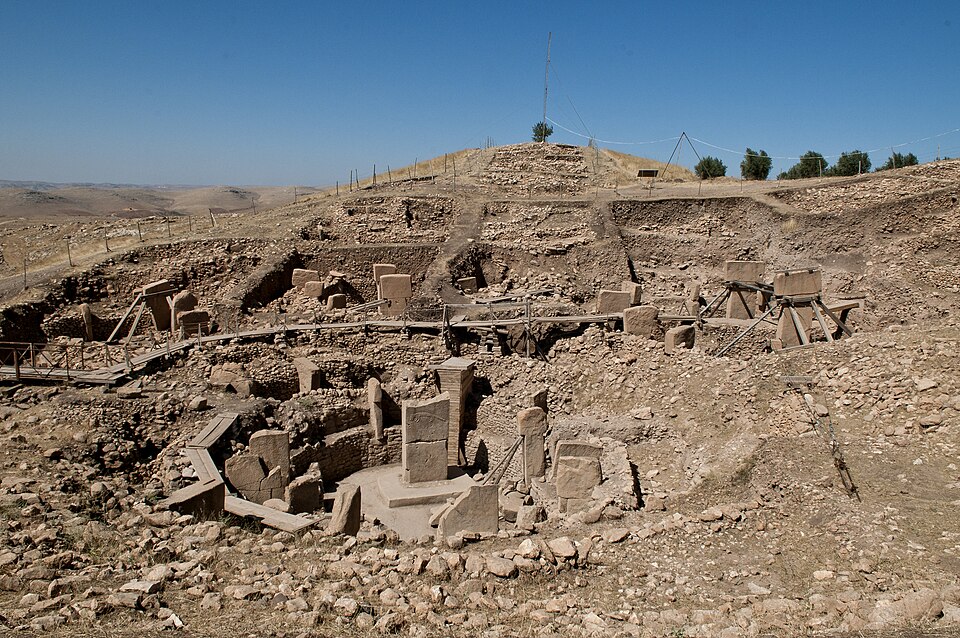
On a windswept plateau overlooking the Harran plain, near the village of Örencik in Şanlıurfa Province, lies a mound that doesn't look like much at first glance — just a rise in the earth, 15 meters high, spread across roughly eight hectares. But beneath that unassuming hill, Göbekli Tepe holds circular structures ringed with massive T-shaped stone pillars, among the oldest known megaliths on Earth. People first used this site around 9500 BCE, and occupation continued until at least 8000 BCE, placing it firmly in the Pre-Pottery Neolithic, the era before farming and pottery had fully taken hold in southwest Asia.
The pillars themselves are extraordinary. Many bear anthropomorphic details — carved arms, hands, clothing — alongside sculptural reliefs of wild animals: boars, foxes, snakes, wild ducks, vultures, and bulls appear again and again across the stones. Some archaeologists believe these dense compositions tell a story or carry a message lost to us now, a symbolic language etched in limestone by people who left no writing behind.
What makes Göbekli Tepe so significant is not just its age, but the puzzle it poses. The Neolithic Revolution — the shift from hunting and gathering to farming — has long been tied to the rise of permanent settlements. But Göbekli Tepe was built on a rocky mountaintop with no clear evidence, at least initially, of agricultural cultivation. That fact fueled decades of debate: did farming make people settle down, or did settling down eventually lead to farming? Recent findings have complicated the picture further, revealing domestic structures, extensive cereal processing, a water supply, and everyday tools — suggesting an actual settlement rather than a sanctuary visited only by nomads.that population once lived here, not just gathered here for rituals.
The site's builders solved a real engineering problem: water. They carved channels and cisterns into the bedrock beneath the plateau, a rainwater harvesting system capable of holding at least 150 cubic meters. The surrounding landscape, wetter than today, was open steppe grassland thick with wild cereals — einkorn, wheat, barley — and grazing herds of wild sheep, goats, gazelle, and equids. Charcoal recovered at the site shows people burned pistachio and almond wood, since no substantial forest grew nearby.
More from Archaeology

The Bronze Disc That Rewrote the Sky
Two looters with a metal detector dug up something illegal, invisible in value, and older than Stonehenge's final stones — a map of the heavens buried for over three thousand years.

The Faceless Women of the Ice Age
Long before writing, before cities, before the wheel, someone carved a woman's body into stone and ivory — and left no name, no face, no explanation.

The Pebble That Might Be Human
A palm-sized stone found on a Moroccan riverbank may be humanity's oldest attempt to see itself — or simply a trick of erosion.

The Crown That Vanished: Deshret and the Red Land
A crown worn by kings for three thousand years has never once been found in a tomb — not one. So where did it go?

The Face That Traveled Between Empires
A farm worker's shovel struck stone in 1897 and unearthed a face so striking it would be sold to France, seized as war booty, and finally traded back for a Velázquez.

The Boy in the Dark Tunnel
A schoolboy fell into black water inside an ancient tunnel and surfaced with his fingers brushing letters no one had noticed for 2,600 years.