The Horns of Hattin: How Saladin Broke the Kingdom of Jerusalem
Under a merciless July sun, an army marched toward water it would never reach — and marched instead into annihilation.
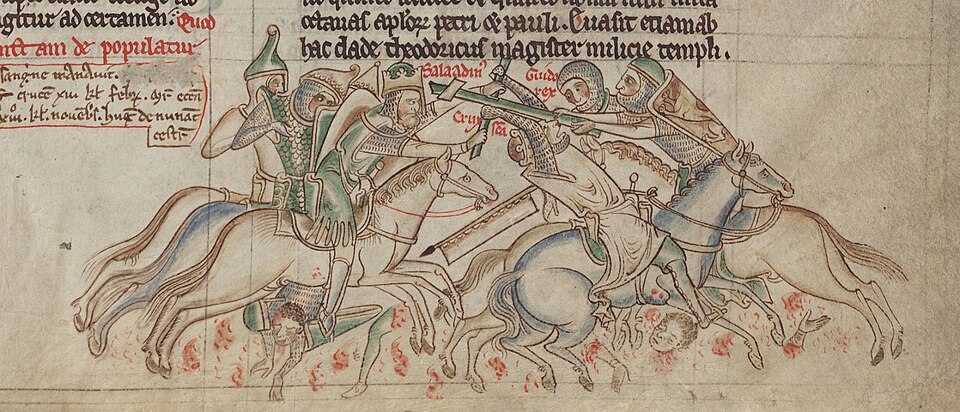
On 4 July 1187, near a dead volcano shaped like two horns outside Tiberias, the Crusader states of the Levant met their reckoning. The battle would be remembered as Hattin, or the Horns of Hattin, for the double-peaked hill that dominated the battlefield beside the ancient Roman road linking the Jordan fords, the Sea of Galilee, and the Mediterranean coast. What happened there in a single day would decide the fate of Jerusalem for a generation.
The roots of the disaster ran deep into the fractured politics of the Kingdom of Jerusalem. Guy of Lusignan had become king in 1186 through his wife Sibylla, backed by a 'court faction' that included the reckless Raynald of Châtillon and Gerard of Ridefort, master of the Knights Templar. Opposing them stood Raymond III of Tripoli, former regent for the child-king Baldwin V, who favored caution toward the rising power of Saladin. Rumors swirled that Raymond had struck a private bargain with the sultan — true or not, they poisoned trust at the worst possible moment.
Saladin himself had spent decades building toward this confrontation. Since becoming vizier of Egypt in 1169, he had seized Damascus in 1174 and Aleppo in 1183, uniting his subjects under Sunni Islam and the promise of holy war against the Franks. He honored a truce with the Crusaders in 1185, but in 1187 Raynald of Châtillon shattered it by raiding a Muslim Hajj caravan. Saladin swore vengeance and sent his son Al-Afdal and the emir Gökböri raiding near Acre. When Gerard de Ridefort's Templars clashed with Gökböri at the Battle of Cresson in May 1187, the Christians lost roughly 150 knights and 300 foot soldiers — a wound to morale and manpower that would echo at Hattin.
In late May, Saladin gathered the largest army he had ever commanded on the Golan Heights: some 40,000 men, including about 12,000 regular cavalry, reinforced unexpectedly by the Druze community of Sarahmul under Jamal ad-Din Hajji. He crossed the Jordan on 30 June and laid siege to Tiberias, trapping Raymond's wife, Eschiva of Bures, inside its walls. Raymond, extraordinarily, urged Guy not to intervene, arguing Saladin's troops could not stay long from their homes. The Knights Hospitaller agreed. But Gerard de Ridefort pressed for battle, and Guy — having already spent Henry II of England's donations to raise this army — chose to march.
The Crusader force, some 18,000 to 20,000 strong with 1,200 knights drawn from Jerusalem, Tripoli, and Antioch, assembled at La Saphorie before advancing toward Tiberias. Saladin, positioned with the Jordan River at his back, let them come. Harassed constantly by skirmishers and denied any water source, the Crusaders crawled forward under the July sun until they reached a ridge overlooking the Sea of Galilee at dusk on 3 July — with Saladin's army standing squarely between them and the water. They passed the night in agony, dying of thirst within sight of the lake they could not reach.
More from History

The Morning Bingham Climbed to Machu Picchu
On a cold July morning in 1911, an American historian scrambled up a jungle-choked ridge above the Urubamba River — and by afternoon, a forgotten Inca citadel would belong to the world.

The Last Half-Hour of the Hindenburg
It was already half a day late, and the public had been told to keep away — but at seven o'clock that evening, the Hindenburg finally turned toward its mooring mast for the last time.

The Last Hours of Pompeii: August 24, 79 AD
By noon it was just another hot day beside the Bay of Naples. By evening, an entire mountain had rewritten the fate of thousands.

The Longest Walk: Mandela's Last Steps to Freedom
After 27 years behind bars, a 71-year-old man had to relearn how to walk out of a prison gate — into a waiting world of cameras, crowds, and a country holding its breath.

The Document Lincoln Signed on the First Day of 1863
On a single January morning, a president's pen would change the legal status of more than three million people — if the ink held and his hand did not shake.

The Day of the Dream: August 28, 1963
Two hundred and fifty thousand people converged on the National Mall that morning — by nightfall, one voice from the steps of the Lincoln Memorial would echo for generations.