The Hundred Years' War: England and France's Century of Blood
For 116 years, five generations of kings bled two kingdoms white over a single question: who truly owned the crown of France?
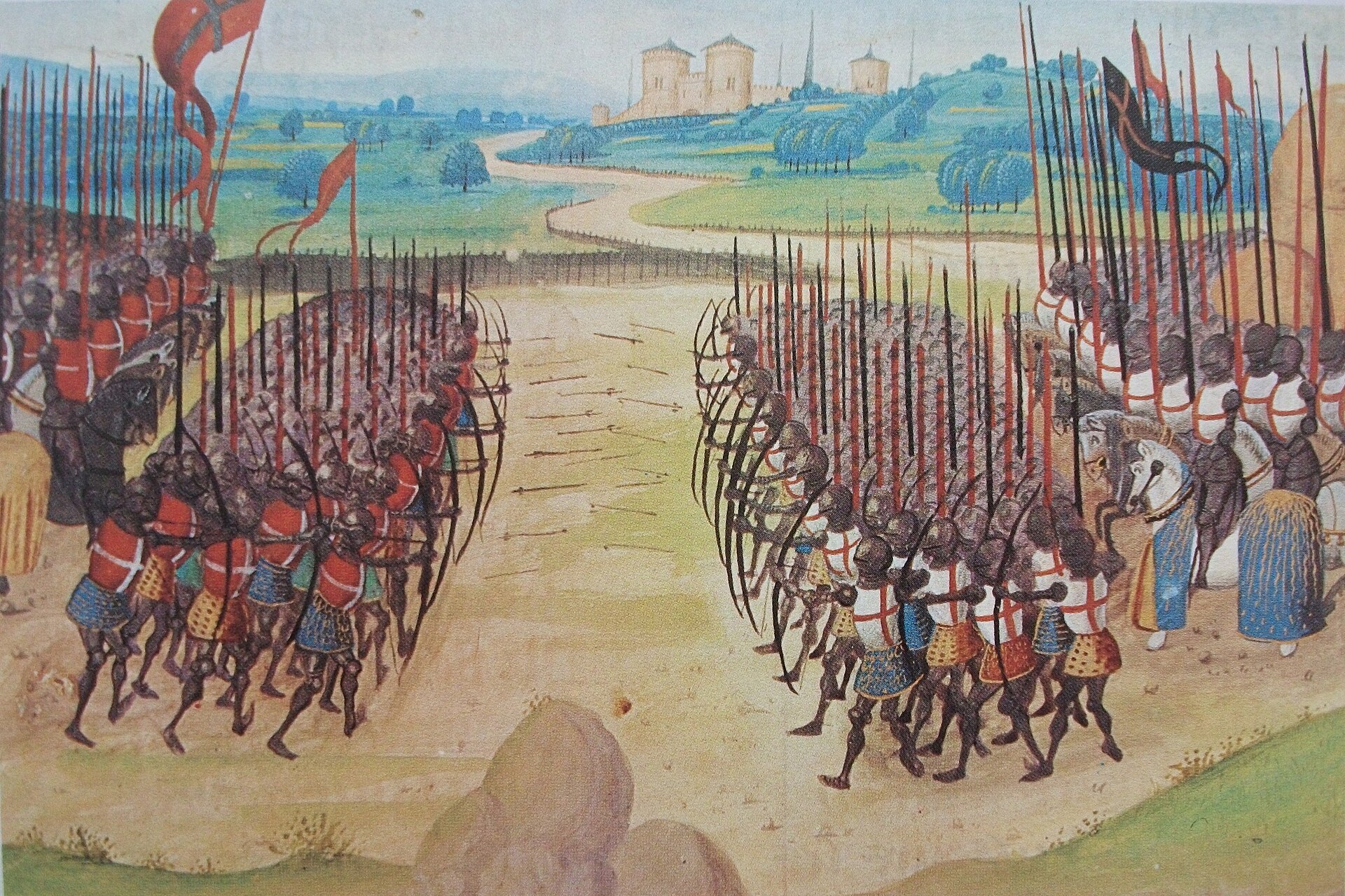
In 1328, King Charles IV of France died without a son or brother, leaving the Capetian dynasty — the longest-reigning royal line in medieval Europe — without a direct heir. His closest male relative was his nephew, Edward III of England, whose mother Isabella was Charles's sister. Isabella claimed the throne for her son, but French nobles invoked a 1317 ruling that women could not inherit the crown, and by extension, could not pass on a claim they never held. An assembly of barons instead crowned Philip, Count of Valois, a patrilineal cousin of Charles. Edward protested, then submitted, doing homage for his French territory of Gascony.
The underlying tension ran far deeper than a succession dispute. Since the Norman Conquest of 1066, English kings had held lands within France — making them, awkwardly, vassals of the French crown. Gascony, valuable for its salt and wine, sat at the heart of this friction. In May 1337, King Philip's Great Council decided to seize Gascony back into royal hands. Edward responded by renewing his claim to the French throne itself — this time by force. The Hundred Years' War had begun.
The early decades, known as the Edwardian phase, belonged to England. Edward III and his son, Edward the Black Prince, delivered stunning victories at Crécy in 1346 and Poitiers in 1356. At Poitiers, the English captured King John II of France outright. Humiliated and depleted, France ceded vast territory to England under the Treaty of Brétigny in 1360.
But fortune turned. Under King Charles V and his brilliant commander Bertrand du Guesclin, France avoided open battle in favor of methodical sieges, clawing back nearly all the ceded lands by 1374. Compounding the chaos, the Black Death tore through Europe between 1347 and 1351, killing an estimated 6 to 12 million people in France — 30 to 60 percent of the population — and roughly 2 to 3 million in England. Labor shortages, economic collapse, and social upheaval followed on both sides of the Channel, weakening royal authority and prolonging the conflict's stalemate.
The war's final and most dramatic act, the Lancastrian phase, opened when England's Henry V exploited the mental illness of France's Charles VI and a bitter French civil war between the Armagnac and Burgundian factions. Henry's forces crushed the French at Agincourt in 1415 and again at Verneuil in 1424, seizing Normandy and forcing the Treaty of Troyes in 1420 — which named Henry's own son, the future Henry VI of England, heir to the French throne itself.
More from History

The Morning Bingham Climbed to Machu Picchu
On a cold July morning in 1911, an American historian scrambled up a jungle-choked ridge above the Urubamba River — and by afternoon, a forgotten Inca citadel would belong to the world.

The Last Half-Hour of the Hindenburg
It was already half a day late, and the public had been told to keep away — but at seven o'clock that evening, the Hindenburg finally turned toward its mooring mast for the last time.

The Last Hours of Pompeii: August 24, 79 AD
By noon it was just another hot day beside the Bay of Naples. By evening, an entire mountain had rewritten the fate of thousands.

The Longest Walk: Mandela's Last Steps to Freedom
After 27 years behind bars, a 71-year-old man had to relearn how to walk out of a prison gate — into a waiting world of cameras, crowds, and a country holding its breath.

The Document Lincoln Signed on the First Day of 1863
On a single January morning, a president's pen would change the legal status of more than three million people — if the ink held and his hand did not shake.

The Day of the Dream: August 28, 1963
Two hundred and fifty thousand people converged on the National Mall that morning — by nightfall, one voice from the steps of the Lincoln Memorial would echo for generations.