The Iron Lady Paris Once Hated
Paris's most beloved landmark was once denounced as a monstrosity, a giant lamppost meant to be torn down after twenty years. It's still standing — and still broadcasting.
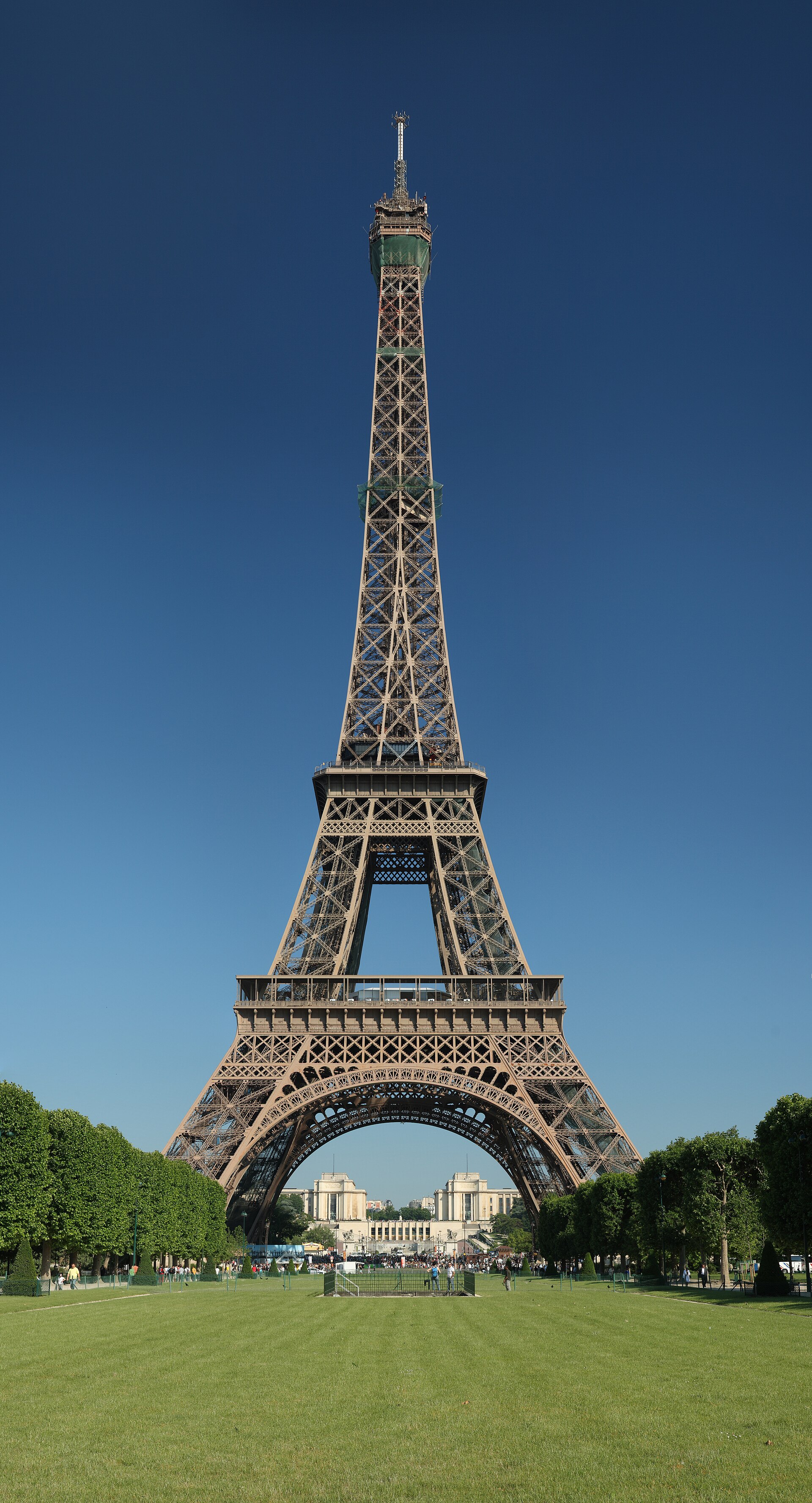
In May 1884, working quietly at home, an engineer named Maurice Koechlin sketched an idea he described as a great pylon: four lattice girders standing apart at the base and converging at the top, bound together by metal trusses. His employer, Gustave Eiffel, wasn't immediately impressed, but he let the idea grow. Koechlin and fellow engineer Émile Nouguier brought in Stephen Sauvestre, head of the company's architecture department, who added decorative arches, a glass pavilion, and other embellishments that softened the design's raw industrial look.
Eiffel bought the rights to the patent the three men had filed and began pushing the project publicly. On 30 March 1885, he told the Société des Ingénieurs Civils that the tower would symbolise not just modern engineering but the century of Industry and Science, a monument built as an expression of France's gratitude to the Revolution of 1789. The timing mattered: 1889 marked the centennial of that Revolution, and Paris wanted a centerpiece worthy of it for the Exposition Universelle.
The real break came in 1886, when a new government budget and a competition worded so specifically — a 300-metre four-sided metal tower on the Champ de Mars — made Eiffel's design nearly inevitable. A contract signed on 8 January 1887 gave Eiffel 1.5 million francs, a fraction of the estimated 6.5 million franc cost, but granted him all commercial revenue from the tower for the exhibition and the following twenty years. Construction proceeded from 1887 to 1889: 3,000 workers assembled 18,038 iron pieces using 2.5 million rivets over 26 months, remarkably without a single fatality. Costs ultimately reached 7,739,401 francs and 31 centimes, a million over Eiffel's own estimate — though 1.9 million visitors in the five months before the official opening recovered three-quarters of it by year's end.
Not everyone welcomed it. Many of Paris's leading artists and writers saw the tower as a scar on the city's skyline, comparing it to a giant lamppost or a factory chimney, and circulated petitions signed by prominent cultural figures demanding it be stopped. Eiffel pressed on regardless, and today the same structure once condemned as ugly is widely considered one of the world's most beautiful pieces of architecture, nicknamed locally 'la dame de fer' — the Iron Lady — for its wrought-iron construction.
At 330 metres including its broadcast aerial, the tower became the tallest human-made structure on Earth during construction, surpassing the Washington Monument, and held that record for 41 years until the Chrysler Building rose in 1930. Its base spans 125 metres per side, and it offers three public levels, with the top observation deck at 276 metres — the highest public platform in the European Union. Reaching it on foot means climbing roughly 600 steps across two staircases, though a lift usually carries visitors to the summit, where Eiffel once kept a private apartment furnished by Jean Lachaise and reportedly hosted guests such as Thomas Edison.
More from Architecture

Stonehenge: The Stones That Refuse to Explain Themselves
For more than 4,500 years, a ring of leaning giants has watched the sun rise and set on the same two days each year — and no one alive can say for certain why.

The Dome That Refused to Fall
Two thousand years ago, Roman engineers poured a dome so vast that no one has dared build a bigger one from unreinforced concrete since. It still stands, open to the sky.

A Minaret Rising Over Kingsland Road
On a busy London street better known for shops and buses, the tallest minaret in Britain quietly reaches into the sky. Its story began not in Sinan's sixteenth-century Istanbul, but in 1990s Hackney.

The Bridge That Was Killed Twice
For 427 years it arched over the Neretva like a stone rainbow. Then, in a matter of days in 1993, it simply ceased to exist.

Hoover Dam: The Concrete That Tamed a River
In the scorched depths of Black Canyon, thousands of men built the largest concrete structure the world had ever seen — and finished it two years early, at a cost of over a hundred lives.

Neuschwanstein: The Castle Built for a Ghost
A king who despised his own palace built the most famous fairy-tale castle on earth — and died before he ever truly lived in it.