The Kings Who Came Ashore
A sandbank on a remote Scottish island once hid a chamber of walrus-ivory kings, queens, and berserker warriors — and no one knows quite how they got there.
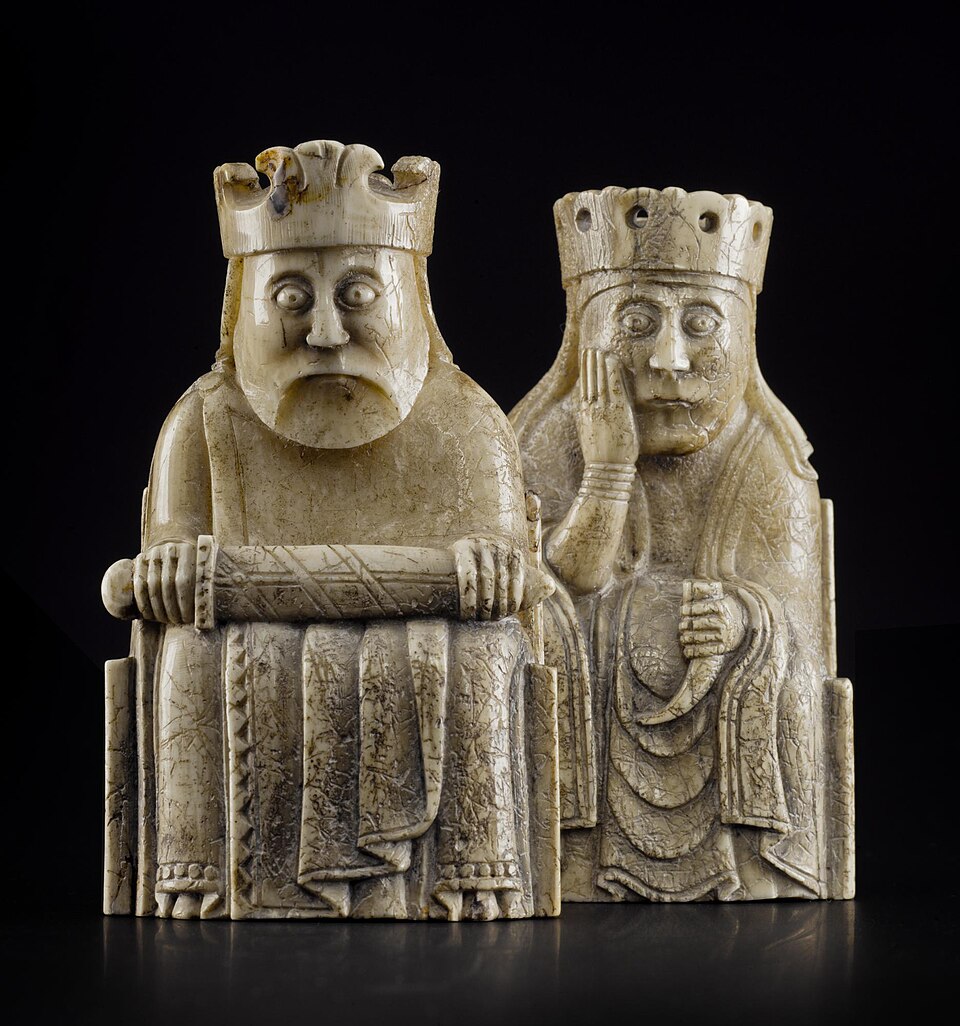
In 1831, on the windswept west coast of the Isle of Lewis in Scotland's Outer Hebrides, a hoard was uncovered that would become one of the most recognizable relics of the medieval world. Most accounts place the find at Uig Bay, though researchers at National Museums Scotland believe Mealista, six miles further south along the same parish, is the more likely spot. The discovery was first credited only to an unnamed local peasant; not until 1863 was the finder named as Malcolm MacLeod, from the nearby township of Pennydonald.
What he found was a hoard of 94 objects: 78 chess pieces, 14 tablemen for games like backgammon, and a single belt buckle. Carved mostly from walrus ivory, with a few pieces made from whale teeth, they had likely been made between 1150 and 1200 AD, commonly believed to have originated in Trondheim, Norway — though some scholars argue for Icelandic or even local Hebridean workshops. The leading theory holds that they were part of a merchant's traveling wares, buried or lost long before reaching a buyer.
The chess pieces themselves consist of 8 kings, 8 queens, 16 bishops, 15 knights, 13 warders standing in for rooks, and 19 pawns — more pawns than a single set requires, hinting that the hoard may represent pieces from at least five separate sets. Researchers Caldwell, Hall, and Wilkinson have grouped the figures by facial features into five workshops, with nine pieces defying classification altogether; two of these, a king and a warder, may have been carved elsewhere entirely as replacements.
Every back-rank piece is a fully realized human figure. Knights sit atop small horses, gripping spears and shields. The warders stand as soldiers, four of them rendered as wild-eyed berserkers biting their shields in battle fury. Kings sit enthroned with crowns and swords; queens sit enthroned too, crowns on their heads, right hands raised thoughtfully to their faces. Bishops — seven seated, nine standing — hold croziers, some also gripping books.
The pawns, by contrast, are abstract: cylinders and tombstone-like shapes, perhaps modeled on boundary markers. This mixture of lifelike nobility and geometric pawns is unique among surviving medieval sets, raising the possibility that the pawns never belonged with the figural pieces at all. The fourteen tablemen found alongside them are oddly plain for their era, when such pieces were usually carved in relief — suggesting they may have been left unfinished.
More from Archaeology

The Bronze Disc That Rewrote the Sky
Two looters with a metal detector dug up something illegal, invisible in value, and older than Stonehenge's final stones — a map of the heavens buried for over three thousand years.

The Faceless Women of the Ice Age
Long before writing, before cities, before the wheel, someone carved a woman's body into stone and ivory — and left no name, no face, no explanation.

The Pebble That Might Be Human
A palm-sized stone found on a Moroccan riverbank may be humanity's oldest attempt to see itself — or simply a trick of erosion.

The Crown That Vanished: Deshret and the Red Land
A crown worn by kings for three thousand years has never once been found in a tomb — not one. So where did it go?

The Face That Traveled Between Empires
A farm worker's shovel struck stone in 1897 and unearthed a face so striking it would be sold to France, seized as war booty, and finally traded back for a Velázquez.

The Boy in the Dark Tunnel
A schoolboy fell into black water inside an ancient tunnel and surfaced with his fingers brushing letters no one had noticed for 2,600 years.