The Last Wonder Standing
Two million blocks of stone, stacked with a precision that still baffles engineers — and no one recorded how it was done.
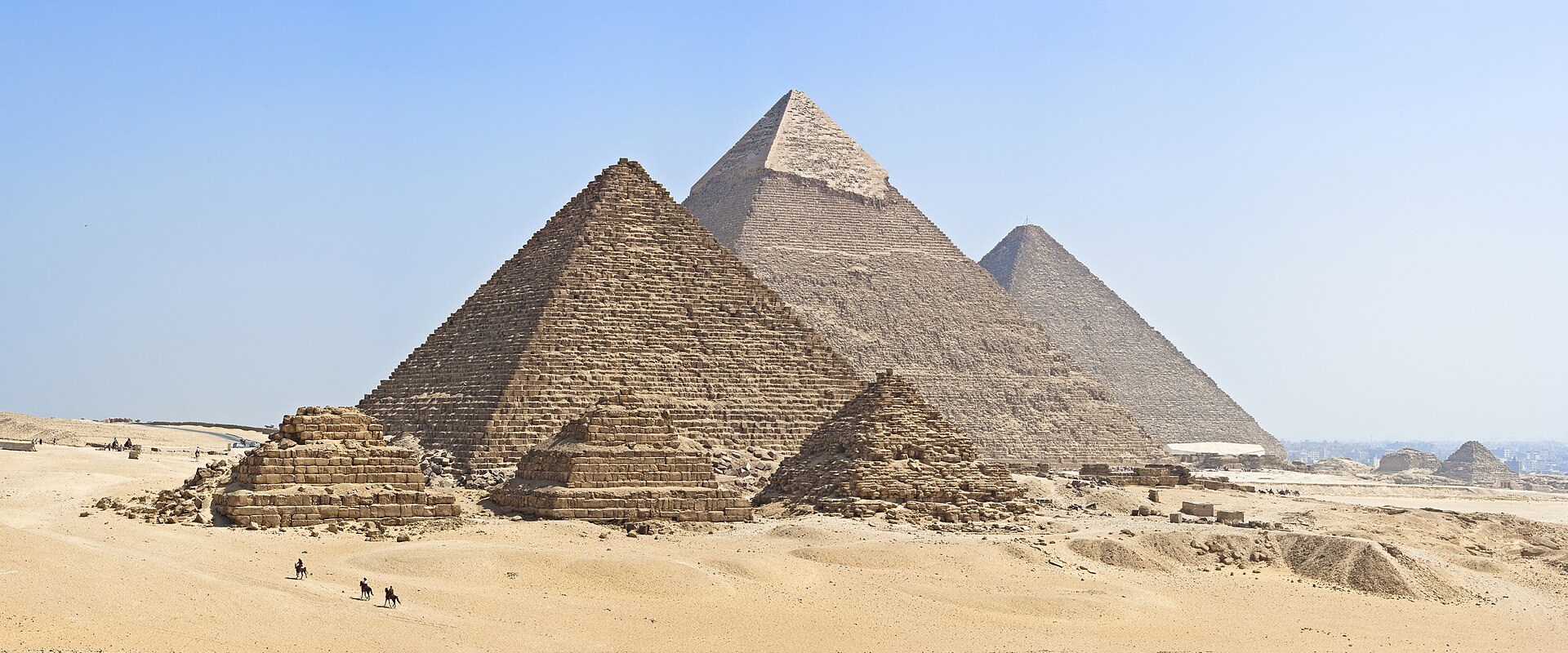
On the edge of the Western Desert, about 9 kilometers from the Nile and 13 kilometers from Cairo's city center, three pyramids rise from the Giza plateau like a riddle carved in limestone. They were built during Egypt's Fourth Dynasty, roughly between 2600 and 2500 BC, and they remain the most recognizable monuments the ancient world ever produced. Long before the pyramids existed, though, the plateau already had visitors: jars from the Maadi culture, dated as early as 3800 BC, were found near the Great Pyramid, hinting at a settlement that predated the monuments by more than a thousand years.
The largest of the three, the Great Pyramid, was built for King Khufu between roughly 2580 and 2560 BC. Its complex once included a valley temple — now buried beneath the village of Nazlet el-Samman — connected by a causeway to a mortuary temple beside the pyramid. Three smaller queens' pyramids stood nearby, along with boat pits. Two of them held actual ships when excavated; one, the Khufu ship, was restored and displayed for years at the Giza Solar Boat Museum before its move to the Grand Egyptian Museum.
A few hundred meters southwest stands the pyramid of Khafre, Khufu's successor. Though it looks taller than the Great Pyramid, it is actually smaller in both height and volume — an illusion created by its higher position on the plateau and its steeper angle. Khafre's complex included a valley temple where excavators, starting with Mariette in 1860 and continuing through Sieglin, Junker, Reisner, and Hassan, uncovered several statues of the king. His pyramid still bears a cap of its original polished casing stones at the summit, a rare surviving glimpse of how the Great Pyramid must once have gleamed.
Farther southwest lies the smallest of the trio, the pyramid of Menkaure, completed around 2510 BC. Its valley temple yielded statues of the king, and a smaller ante-temple was added during the Fifth Dynasty. Of the three major pyramids, Menkaure's is the only one visible today entirely stripped of its original limestone casing.
Guarding the eastern side of the complex is the Great Sphinx, dated to Khafre's reign; Egyptologists broadly agree its face was carved in his likeness. Centuries later, during the New Kingdom, Amenhotep II dedicated a temple beside it to the god Hauron-Haremakhet, a structure later rulers continued to expand.
More from Architecture

Stonehenge: The Stones That Refuse to Explain Themselves
For more than 4,500 years, a ring of leaning giants has watched the sun rise and set on the same two days each year — and no one alive can say for certain why.

The Dome That Refused to Fall
Two thousand years ago, Roman engineers poured a dome so vast that no one has dared build a bigger one from unreinforced concrete since. It still stands, open to the sky.

A Minaret Rising Over Kingsland Road
On a busy London street better known for shops and buses, the tallest minaret in Britain quietly reaches into the sky. Its story began not in Sinan's sixteenth-century Istanbul, but in 1990s Hackney.

The Bridge That Was Killed Twice
For 427 years it arched over the Neretva like a stone rainbow. Then, in a matter of days in 1993, it simply ceased to exist.

Hoover Dam: The Concrete That Tamed a River
In the scorched depths of Black Canyon, thousands of men built the largest concrete structure the world had ever seen — and finished it two years early, at a cost of over a hundred lives.

Neuschwanstein: The Castle Built for a Ghost
A king who despised his own palace built the most famous fairy-tale castle on earth — and died before he ever truly lived in it.