The Longest Day: Hour by Hour on the Normandy Sands
Before dawn had fully broken over the Channel, 24,000 men were already falling from the sky into occupied France — and the sea behind them was black with 4,226 ships.
Shortly after midnight on 6 June 1944, the sky over Normandy filled with the roar of transport aircraft carrying American, British, and Canadian airborne troops. Strong winds and dense German anti-aircraft fire scattered many of the paratroopers far from their intended drop zones near Caen and Carentan, but the confusion did not unravel the plan entirely — by the following evening these scattered units had regrouped and dug in.
While the airborne troops fought to orient themselves in the darkness, an immense naval force was already crossing the Channel. Under the command of the Scottish-born British admiral Bertram Ramsay, 4,226 transport ships escorted by 722 warships carried the first five assault divisions toward the coast between Cherbourg and Pas-de-Calais, the stretch of Atlantic Wall fortifications the Germans had spent months reinforcing.
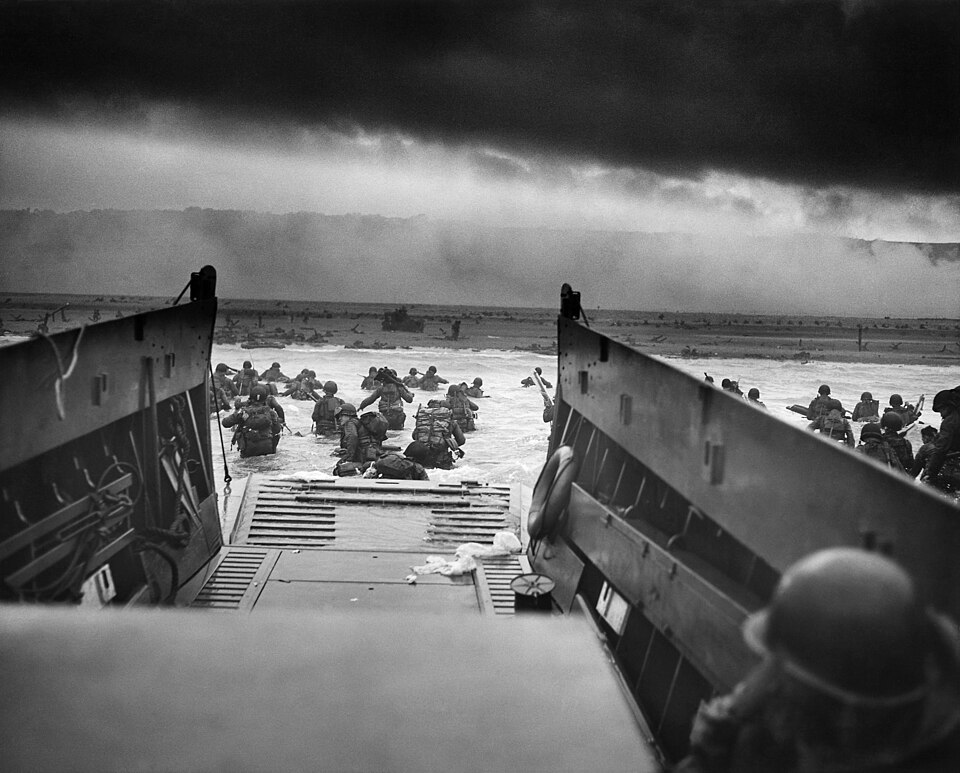
Extensive aerial and naval bombardment opened the morning, softening the coastal defenses before the amphibious assault began around 06:30. The eighty-kilometre target coastline had been divided into five sectors: Utah, Omaha, Gold, Juno, and Sword. Strong winds pushed many landing craft east of where they were meant to touch down, a problem felt most sharply at Utah and Omaha.
At Omaha, men waded ashore beneath high cliffs into a storm of gunfire from emplacements positioned to sweep the beach. The sand itself was seeded with mines and obstacles — wooden stakes, metal tripods, barbed wire — that made the work of the beach-clearing teams agonizingly slow and dangerous. It was here that the heaviest casualties of the day were suffered.
Farther along the coast, at Gold, Juno, and Sword, the fighting took a different shape: soldiers cleared fortified towns house by house, while specialised tanks were used to disable two major gun emplacements at Gold. At Saint-Aubin, Courseulles, Arromanches, Saint-Laurent, and Saint-Martin-de-Varreville, assault troops pushed inland against determined resistance.
More from History

The Morning Bingham Climbed to Machu Picchu
On a cold July morning in 1911, an American historian scrambled up a jungle-choked ridge above the Urubamba River — and by afternoon, a forgotten Inca citadel would belong to the world.

The Last Half-Hour of the Hindenburg
It was already half a day late, and the public had been told to keep away — but at seven o'clock that evening, the Hindenburg finally turned toward its mooring mast for the last time.

The Last Hours of Pompeii: August 24, 79 AD
By noon it was just another hot day beside the Bay of Naples. By evening, an entire mountain had rewritten the fate of thousands.

The Longest Walk: Mandela's Last Steps to Freedom
After 27 years behind bars, a 71-year-old man had to relearn how to walk out of a prison gate — into a waiting world of cameras, crowds, and a country holding its breath.

The Document Lincoln Signed on the First Day of 1863
On a single January morning, a president's pen would change the legal status of more than three million people — if the ink held and his hand did not shake.

The Day of the Dream: August 28, 1963
Two hundred and fifty thousand people converged on the National Mall that morning — by nightfall, one voice from the steps of the Lincoln Memorial would echo for generations.