The Lost Artisans of the Moche Valleys
Long before any single emperor ruled Peru's north coast, a scattering of desert kingdoms painted their gods, their wars, and their pleasures onto clay — then vanished, leaving only mud pyramids to explain them.
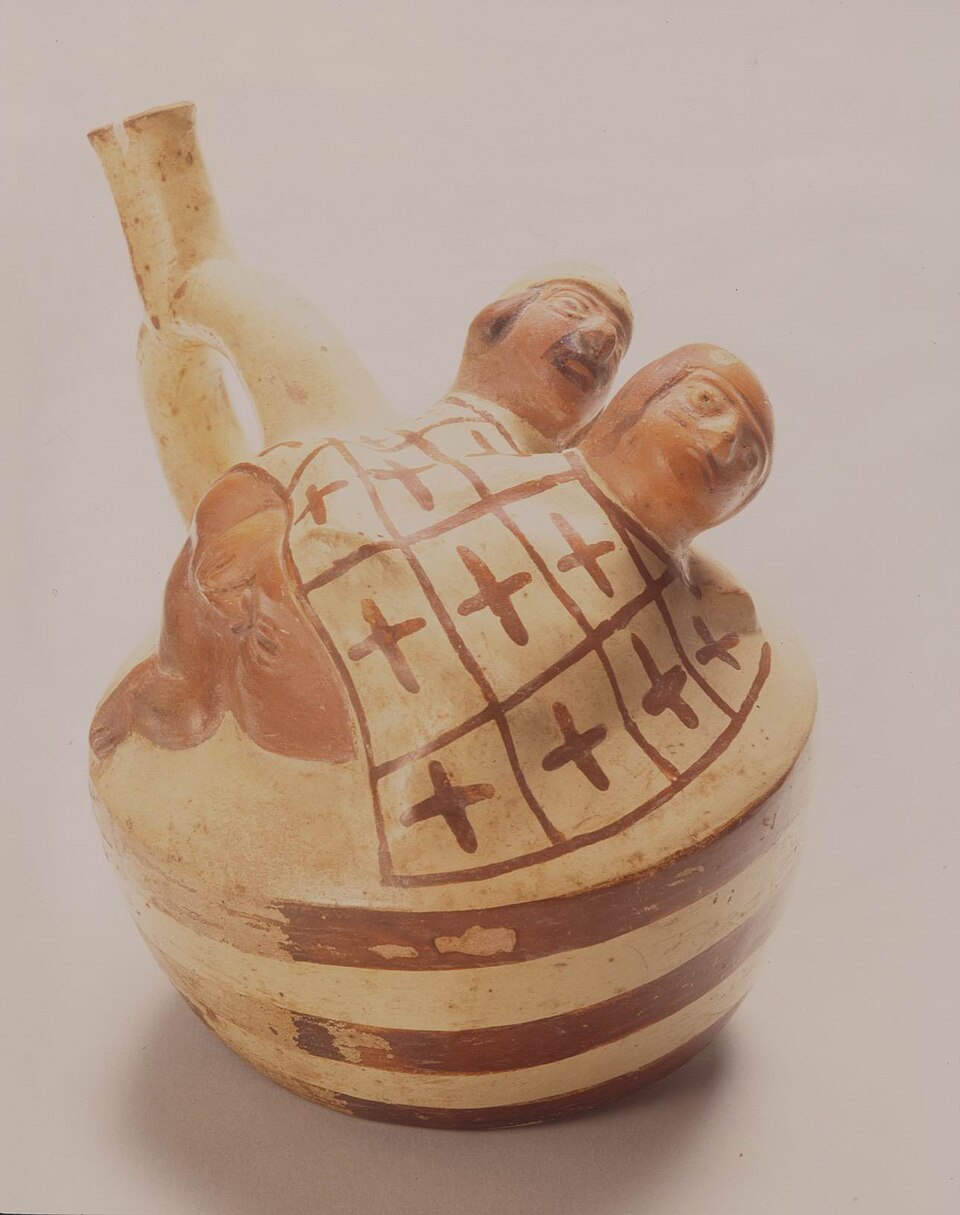
On the arid coastline of northern Peru, where rivers cut green ribbons through 250 miles of desert, a civilization rose around 100 AD that left behind no written word, only images. The Moche, as archaeologists now call them, did not build a single empire. Instead they formed a network of autonomous polities bound by shared iconography, ceremony, and craft, flourishing until around 800 AD during what scholars term the Regional Development Epoch.
Their world was built on water. Moche engineers dug sophisticated irrigation canals to pull river water into the desert, feeding the crops that sustained dense populations along valleys such as Chicama, Moche, Virú, Jequetepeque, and Lambayeque. Upon this agricultural base rose monumental adobe structures, elaborate metalwork in gold, and some of the most vivid painted ceramics in the ancient Americas.
Those ceramics are windows into a startlingly candid society. Moche potters depicted hunting and fishing scenes, warfare and prisoner-taking, sexual encounters, and elaborate sacrificial ceremonies. Their art also captured a subtler idea: the significance of stillness. Alongside images of movement and procession, Moche iconography emphasized 'liminal spaces' — sunken steps, ramps, thresholds — where figures paused, as if crossing between worlds.
Historians divide Moche history into three broad phases: an Early period (100–300 AD) when the culture emerged, likely evolving from earlier Cupisnique and Salinar traditions; a Middle period (300–600 AD) of expansion and flourishing; and a Late period (500–800 AD) marked by urban concentration before eventual collapse.
The heartland of the Southern Moche region lay in the Chicama and Moche valleys, where the massive Huaca del Sol once stood as the largest pre-Columbian structure in Peru. Sixteenth-century Spanish conquistadors tore into its graves searching for gold, destroying much of the pyramid. Its neighbor, Huaca de la Luna, survived far better, preserving interior murals rich with color. There, a long painted procession of warriors and prisoners abruptly turns ninety degrees upon reaching a special structure called 'recinto 1' — an elaborately decorated building on a raised platform, another example of Moche fascination with liminal thresholds.
More from History

The Morning Bingham Climbed to Machu Picchu
On a cold July morning in 1911, an American historian scrambled up a jungle-choked ridge above the Urubamba River — and by afternoon, a forgotten Inca citadel would belong to the world.

The Last Half-Hour of the Hindenburg
It was already half a day late, and the public had been told to keep away — but at seven o'clock that evening, the Hindenburg finally turned toward its mooring mast for the last time.

The Last Hours of Pompeii: August 24, 79 AD
By noon it was just another hot day beside the Bay of Naples. By evening, an entire mountain had rewritten the fate of thousands.

The Longest Walk: Mandela's Last Steps to Freedom
After 27 years behind bars, a 71-year-old man had to relearn how to walk out of a prison gate — into a waiting world of cameras, crowds, and a country holding its breath.

The Document Lincoln Signed on the First Day of 1863
On a single January morning, a president's pen would change the legal status of more than three million people — if the ink held and his hand did not shake.

The Day of the Dream: August 28, 1963
Two hundred and fifty thousand people converged on the National Mall that morning — by nightfall, one voice from the steps of the Lincoln Memorial would echo for generations.