The Man Who Named an Icebound Land 'Green'
Exiled twice for killing men, a red-haired outlaw sailed into the unknown—and returned with a story clever enough to fill fourteen ships with settlers.
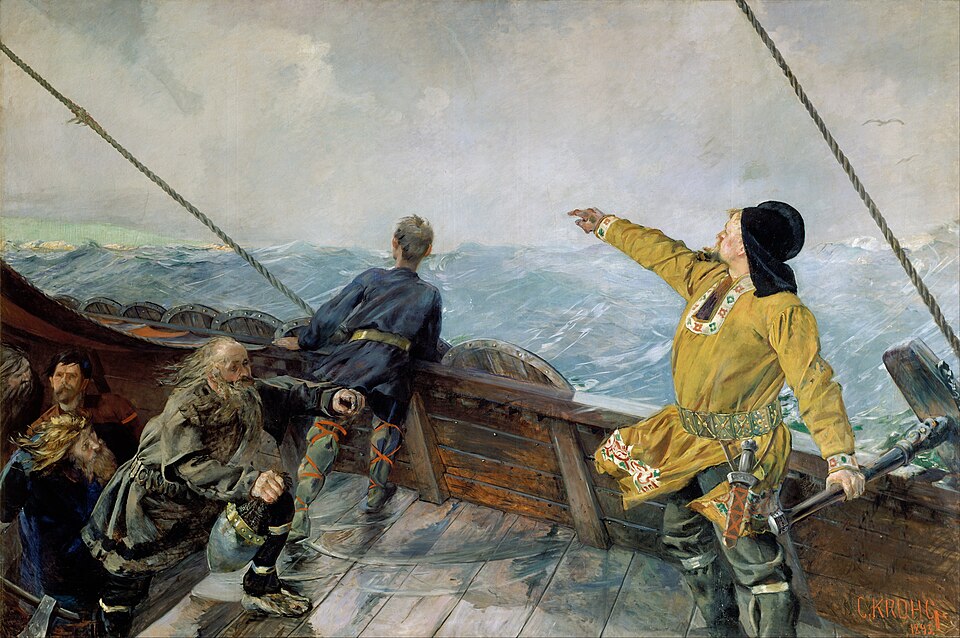
Erik Thorvaldsson was born around 950 in the Jæren district of Rogaland, Norway, the son of Thorvald Asvaldsson. His father's life was already marked by violence: banished from Norway for manslaughter, Thorvald sailed west with his family, including a ten-year-old Erik, and settled in Hornstrandir, in northwestern Iceland, where he died before 970. The red hair and beard that would define his son's name were, by most accounts, the simple origin of the epithet 'the Red.'
After his father's death, Erik married Þjódhild Jorundsdottir, daughter of Jorundur Ulfsson and Þorbjorg Gilsdottir, and built a farm called Eiríksstaðir in Haukadalr. Together they had at least three sons—Leif, Thorvald, and Thorstein—and, according to some sagas, a daughter named Freydís. Leif converted to Christianity, as did Þjódhild, who even commissioned Greenland's first church; Erik never did, remaining devoted to the old Norse gods, a divide the sagas say strained the marriage enough that Þjódhild withheld intimacy from her husband.
Violence followed Erik as it had his father. When his thralls caused a landslide on a farm belonging to a man named Valthjof, Valthjof's kinsman, Eyjolf the Foul, killed the thralls in retaliation; Erik answered by killing Eyjolf the Foul along with Hrafn the Dueller. For killing both men he was banished from Haukadalr around 982. He moved to Brokey and Öxney, where a dispute over inherited ceremonial pillars—left with a man named Thorgest—escalated into another deadly fight, killing Thorgest's sons and several others. The feud drew in allies on both sides until it was settled at the Thorsnes assembly: Erik and his supporters were outlawed from Iceland for three years.
That exile became the turning point of his life. Around 982, Erik sailed toward a little-known landmass that an earlier outlaw, Snæbjörn galti, had failed to settle years before. Rounding the island's southern tip—later named Cape Farewell—he worked up the western coast until he found stretches of ice-free land that looked, remarkably, fit for farming and settlement.
Erik was not the first Norseman to see this land. Gunnbjörn Ulfsson had glimpsed it nearly a century earlier after being blown off course, and Snæbjörn galti had tried and failed to colonize it. But Erik was the one who made it stick. He spent his three exiled years exploring—wintering first at Eiriksey, then near Eiriksholmar, and in his final summer pushing north to Snaefell and Hrafnsfjord.
More from Explorations

Humboldt: The Man Who Measured the World
A Prussian noble's son, once mocked as a sickly child, would climb a volcano to a world-record height and rewrite how humanity understood nature itself.

The Man Who Named Canada
A Breton mariner planted a wooden cross on a foreign shore and claimed a kingdom he did not understand — then spent a winter frozen into its river, praying a stranger's remedy would save his men.

Sixty Ships Into the Unknown: Hanno's Voyage Down the African Coast
A Carthaginian fleet of sixty ships and thousands of settlers vanished past the Pillars of Hercules to found cities on an unmapped coast — and came home with the skins of hairy, hostile 'gorillas' as proof of how far they had gone.

HMS Challenger: The Voyage That Charted the Deep
A stripped-down warship, its guns torn out to make room for microscopes, set sail from Portsmouth to answer a question no one had ever properly asked: what lies at the bottom of the sea?

Scott's Last Expedition: The Letters Written at the End of the World
Five men reached the bottom of the world only to find a Norwegian flag already planted there. What followed was not glory, but a slow, frozen unraveling that the world would remember for a century.

Marco Polo: In the Court of Kublai Khan
A fifteen-year-old boy meets the father he barely knew — and is soon swept toward the richest court on Earth. Twenty-four years later, he returns home with tales so vast that Venice simply calls him 'Mister Millions'.