The Man Who Sailed to India
Thousands of sailors had died trying to reach the Indies by sea. In May 1498, one Portuguese nobleman finally stepped ashore in India — and rewrote the map of world trade.
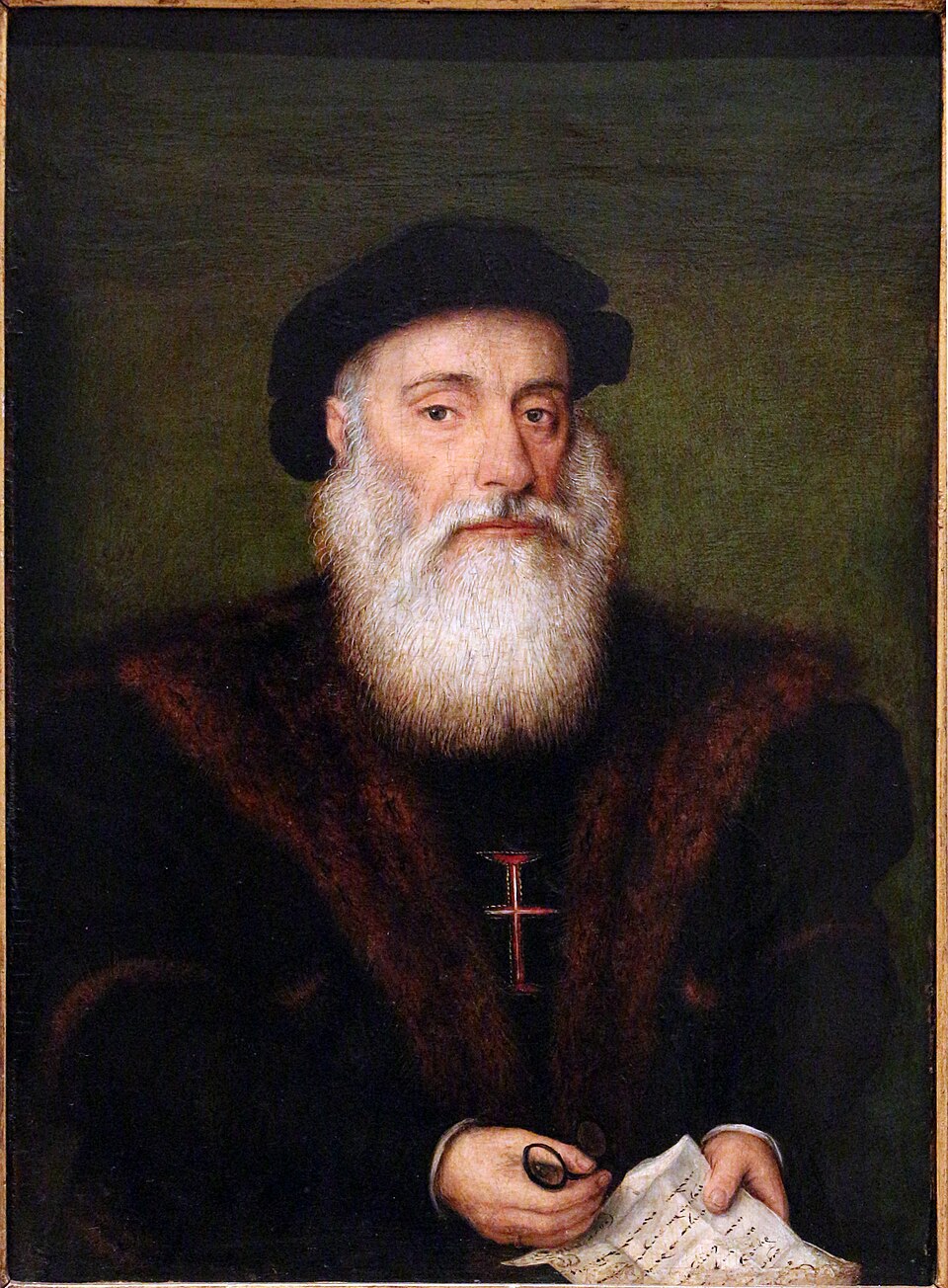
Vasco da Gama was born in Sines, a small seaport on Portugal's Alentejo coast, sometime in the 1460s (some sources say 1469). He was the third of five sons of Estêvão da Gama, a knight and civil governor of Sines under the Order of Santiago, and Isabel Sodré, whose family had English roots and ties to the household of the Duke of Viseu. Little is documented of his youth, though historian Teixeira de Aragão suggests he may have studied in Évora, possibly gaining early knowledge of mathematics and navigation there.
Around 1480, da Gama followed his father into the Order of Santiago, whose master was Prince John — soon to become King John II of Portugal. As John II's fortunes rose, so did the da Gama family's standing. In 1492, the king trusted Vasco with a delicate task: seizing French ships at Setúbal and in the Algarve in retaliation for attacks on Portuguese shipping. He carried it out swiftly and effectively.
By then, Portugal had spent decades pushing exploration down the African coast, a project begun by Prince Henry the Navigator earlier in the 15th century. After Henry's death in 1460, the crown briefly lost interest, licensing the African trade to a merchant consortium led by Fernão Gomes. That effort expanded Portuguese knowledge of the Gulf of Guinea and its trade in gold, ivory, pepper, and slaves. When John II took the throne in 1481, he pursued these ambitions more systematically, building royal power partly through control of this overseas enterprise.
Bartolomeu Dias had already rounded the Cape of Good Hope before da Gama, proving that a sea route to Asia around Africa was possible. It fell to Vasco da Gama, commissioned under King Manuel I, to complete the journey. His first voyage, from 1497 to 1499, became the first to link Europe and Asia by an ocean route — sailing around the southern tip of Africa and across the Indian Ocean, aided by a pilot from Malindi in present-day Kenya, to reach Kozhikode (Calicut) on the Malabar coast of India.
He landed at Kozhikode on 20 May 1498, ending decades of failed attempts, shipwrecks, and lost lives in the search for a direct route to the Indies. The achievement meant Portugal could bypass the Mediterranean and the Arab-controlled overland trade networks that had long connected Europe to Asian goods. Da Gama's outward and return voyages were, at the time, the longest ocean voyages ever completed.
More from Explorations

Humboldt: The Man Who Measured the World
A Prussian noble's son, once mocked as a sickly child, would climb a volcano to a world-record height and rewrite how humanity understood nature itself.

The Man Who Named Canada
A Breton mariner planted a wooden cross on a foreign shore and claimed a kingdom he did not understand — then spent a winter frozen into its river, praying a stranger's remedy would save his men.

Sixty Ships Into the Unknown: Hanno's Voyage Down the African Coast
A Carthaginian fleet of sixty ships and thousands of settlers vanished past the Pillars of Hercules to found cities on an unmapped coast — and came home with the skins of hairy, hostile 'gorillas' as proof of how far they had gone.

HMS Challenger: The Voyage That Charted the Deep
A stripped-down warship, its guns torn out to make room for microscopes, set sail from Portsmouth to answer a question no one had ever properly asked: what lies at the bottom of the sea?

Scott's Last Expedition: The Letters Written at the End of the World
Five men reached the bottom of the world only to find a Norwegian flag already planted there. What followed was not glory, but a slow, frozen unraveling that the world would remember for a century.

Marco Polo: In the Court of Kublai Khan
A fifteen-year-old boy meets the father he barely knew — and is soon swept toward the richest court on Earth. Twenty-four years later, he returns home with tales so vast that Venice simply calls him 'Mister Millions'.