The Mary Rose: A Tudor Warship's Long Voyage Home
She sank in minutes before her king's eyes — and rose again 437 years later, carrying a sealed world of Tudor life inside her timbers.
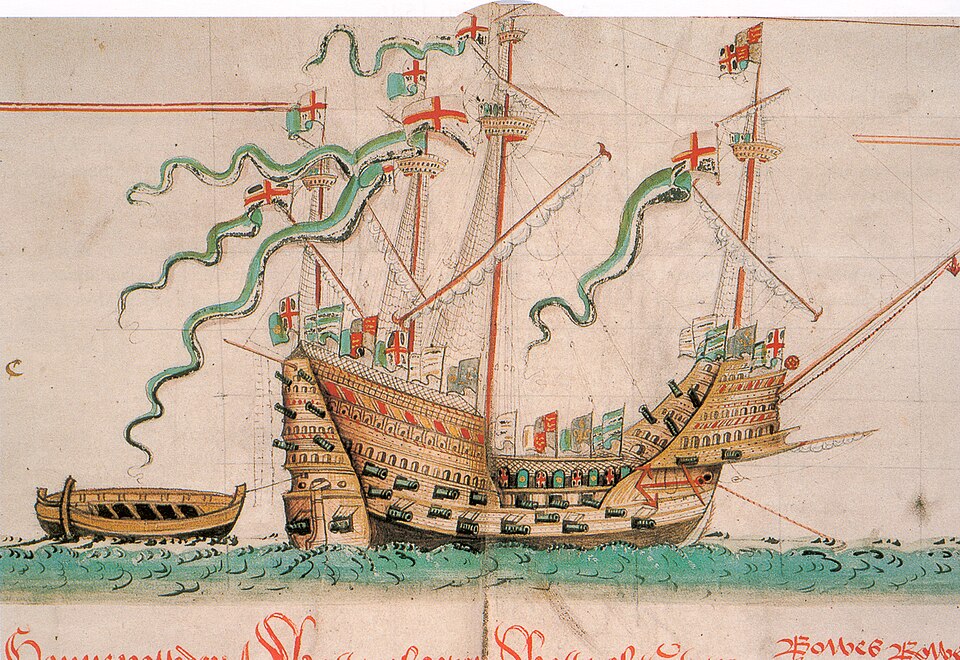
On 19 July 1545, King Henry VIII stood watching from the shore as his flagship led an attack against a French invasion fleet in the Solent, the strait north of the Isle of Wight. Within moments, the Mary Rose, one of the largest ships in the English navy, heeled over and sank off Spithead. The precise cause remains disputed to this day, tangled in conflicting testimonies and incomplete evidence from the time.
The ship's story had begun 34 years earlier, in a very different England. The nation was recovering from dynastic wars — first against France, then the Wars of the Roses between York and Lancaster, which ended with Henry VII founding the Tudor dynasty. Between 1422 and 1509, the crown had built only six ships. When Henry VIII inherited the throne, his navy consisted of just two sizeable carracks, Regent and Sovereign.
That changed quickly. Weeks after Henry married Catherine of Aragon in 1509 and joined an anti-French alliance with Ferdinand II of Aragon, Pope Julius II, and Emperor Maximilian, two large new ships were ordered: the Mary Rose, around 500 tons, and the Peter Pomegranate, around 450 tons. It remains unclear whether Henry VIII himself or his father set the plans in motion, but the young king oversaw the project personally, later commissioning even larger ships like the 1000-ton Henry Grace à Dieu.
Construction began on 29 January 1510 in Portsmouth, and the Mary Rose was launched in July 1511. Building her demanded extraordinary resources — an estimated 600 mostly large oak trees, representing about 16 hectares of woodland. After launch, she was towed to London for rigging, decking, armaments, and decoration with painted and gilded flags and banners.
For over three decades, the Mary Rose served in wars against France, Scotland, and Brittany, standing among the earliest purpose-built sailing warships. She carried new heavy guns capable of firing through recently invented gun-ports, and after a substantial rebuild in 1536, she became one of the first ships able to fire a broadside — though the line-of-battle tactics that would later define naval warfare had not yet been developed.
More from Archaeology

The Bronze Disc That Rewrote the Sky
Two looters with a metal detector dug up something illegal, invisible in value, and older than Stonehenge's final stones — a map of the heavens buried for over three thousand years.

The Faceless Women of the Ice Age
Long before writing, before cities, before the wheel, someone carved a woman's body into stone and ivory — and left no name, no face, no explanation.

The Pebble That Might Be Human
A palm-sized stone found on a Moroccan riverbank may be humanity's oldest attempt to see itself — or simply a trick of erosion.

The Crown That Vanished: Deshret and the Red Land
A crown worn by kings for three thousand years has never once been found in a tomb — not one. So where did it go?

The Face That Traveled Between Empires
A farm worker's shovel struck stone in 1897 and unearthed a face so striking it would be sold to France, seized as war booty, and finally traded back for a Velázquez.

The Boy in the Dark Tunnel
A schoolboy fell into black water inside an ancient tunnel and surfaced with his fingers brushing letters no one had noticed for 2,600 years.