The Migration Period: A Time of Shifting Borders and Empires
In the shadow of the Western Roman Empire's collapse, hundreds of thousands moved across Europe, reshaping its future. From the steppes of Asia to the coasts of Britain, the Migration Period was a time of upheaval, but also of new beginnings.
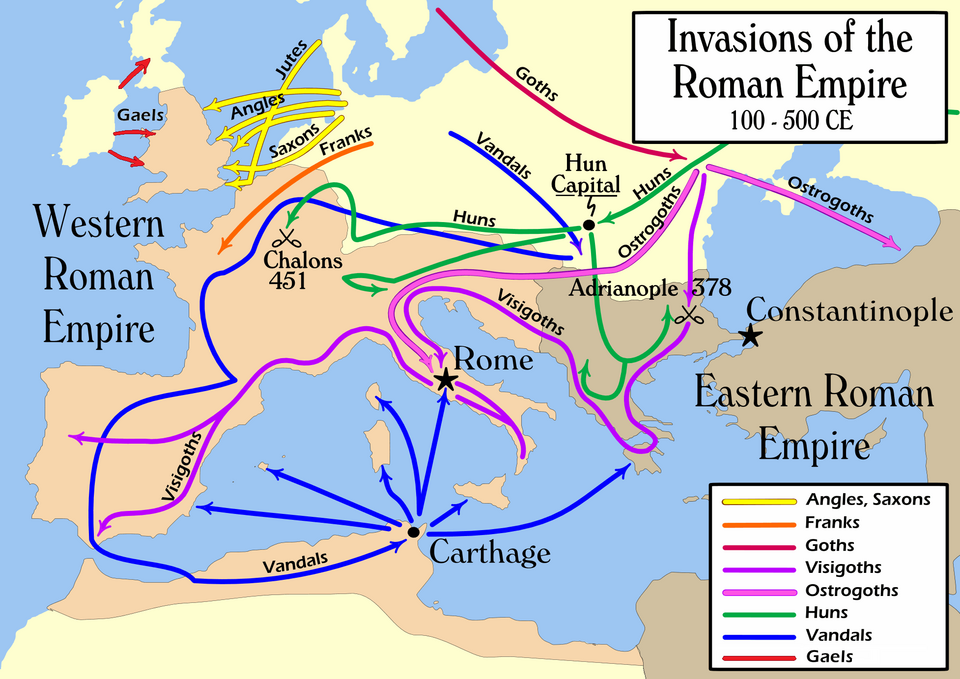
The Migration Period, spanning roughly from 300 to 600 AD, was a time of massive movement across Europe. Tribes such as the Goths, Vandals, and Franks began to shift their territories as Roman control broke down, driven by a mix of factors whose role and significance historians still debate. These migrations were not just about survival; they were about the reorganization of entire regions. The Roman Empire, once a unifying force, was now fragmented, and its borders were being redrawn by those who had once been its subjects.
The Huns, originating from the steppes of Asia, played a pivotal role in starting this movement. Their invasion of Europe in about 375 AD triggered a wave of migration that would reshape the continent. The Tervingi, fleeing the Huns, crossed the Danube into Roman territory in 376—a crossing that modern estimates suggest brought 90,000 to 200,000 people into the Empire—marking the beginning of a new chapter in European history. This migration was not just a single event but a series of movements that would continue for centuries.
As central power broke down in the Western Roman Empire, the Roman military became more important, yet it came to be dominated by men of barbarian origin. In the 4th century, the Empire settled a very large group of Goths as foederati, or treaty-bound allies, within the Roman Balkans, while the Franks were settled south of the Rhine in Roman Gaul. These arrangements were temporary solutions, but they sowed the seeds for future conflict. The Romans could no longer control the very people they had come to rely on as soldiers.
The Rhine crossing of 406 AD was one of the most dramatic events of this period. A particularly large and unexpected coalition of Vandals, Alans, and Suebi—estimated at up to 200,000 people—crossed the river in a single movement. This event was a turning point, showing how the balance of power was shifting. The Romans could no longer maintain their borders, and the migrating tribes were moving into the heart of the Empire, challenging its authority.
In Gaul, the Franks—a fusion of western Germanic tribes whose leaders had been aligned with Rome since the 3rd century—entered Roman lands gradually during the 5th century. After the consolidation of power under Childeric, his son Clovis's decisive victory over Syagrius in 486 established the Franks as rulers of northern Roman Gaul. This was not an immediate conquest but a slow, strategic process. Fending off challenges from the Alemanni, Burgundians, and Visigoths, the Frankish kingdom became the nucleus of what would later become France and Germany.
More from History

The Morning Bingham Climbed to Machu Picchu
On a cold July morning in 1911, an American historian scrambled up a jungle-choked ridge above the Urubamba River — and by afternoon, a forgotten Inca citadel would belong to the world.

The Last Half-Hour of the Hindenburg
It was already half a day late, and the public had been told to keep away — but at seven o'clock that evening, the Hindenburg finally turned toward its mooring mast for the last time.

The Last Hours of Pompeii: August 24, 79 AD
By noon it was just another hot day beside the Bay of Naples. By evening, an entire mountain had rewritten the fate of thousands.

The Longest Walk: Mandela's Last Steps to Freedom
After 27 years behind bars, a 71-year-old man had to relearn how to walk out of a prison gate — into a waiting world of cameras, crowds, and a country holding its breath.

The Document Lincoln Signed on the First Day of 1863
On a single January morning, a president's pen would change the legal status of more than three million people — if the ink held and his hand did not shake.

The Day of the Dream: August 28, 1963
Two hundred and fifty thousand people converged on the National Mall that morning — by nightfall, one voice from the steps of the Lincoln Memorial would echo for generations.