The Morning the World Woke to War
At 4:45 on a September morning, the guns of a German battleship broke the peace over a Polish peninsula — and by nightfall, a continent had crossed a line it could never uncross.
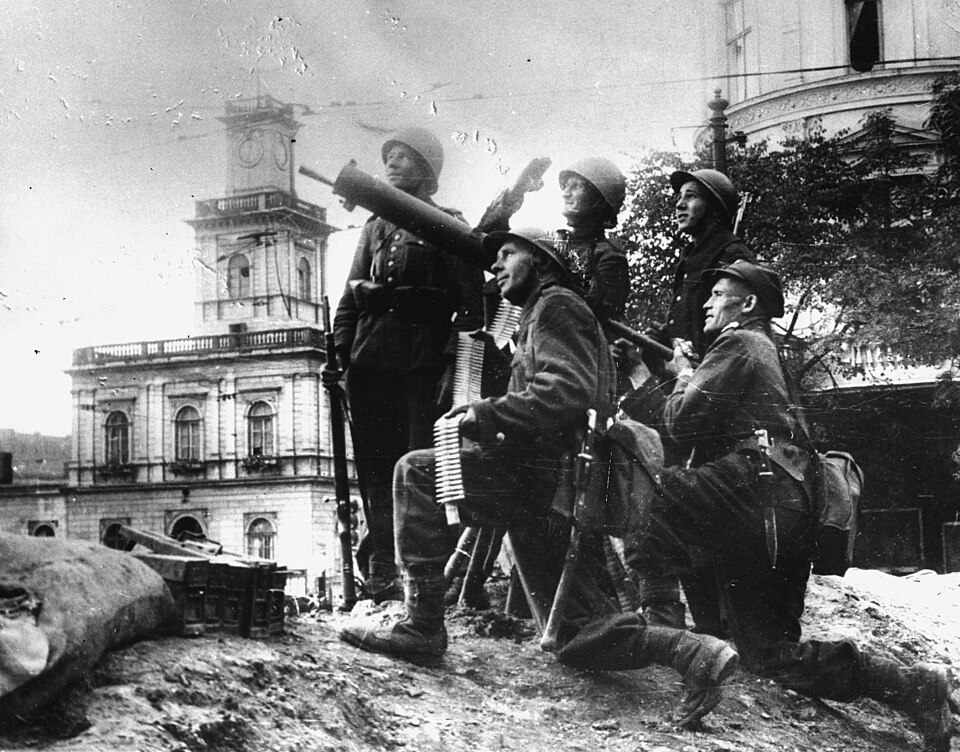
The first of September, 1939, began before dawn, in darkness that still smelled of late summer. Along Poland's western border, German troops were already moving into position, following a night in which agents in German uniforms had staged an attack on a German radio station at Gleiwitz, a fabricated pretext to justify what was about to happen. Germany would call the coming campaign its 1939 Defensive War, insisting that Poland had struck first — a claim invented to cast the invasion as self-defense rather than conquest.
At 4:45 in the morning, the German battleship Schleswig-Holstein, anchored near Danzig on what was ostensibly a courtesy visit, opened fire near Westerplatte. The shells were the first shots of the invasion, and of the Second World War, though almost no one watching that thin dawn light over the Baltic yet understood the scale of what had begun.
Within the same early hours, German forces crossed into Poland from the north, west, and south, with Slovak troops moving alongside them from the south as well. The Wehrmacht advanced on a broad front, pushing toward Polish positions that had been built close to the German-Polish border — positions that would soon prove untenable against the speed and weight of the attack.
As the morning wore on, Polish forces near the frontier began to feel the pressure of an assault that had come without any declaration of war. Reports of German columns crossing at multiple points arrived in quick succession, and Polish commanders, following their prepared plans, began ordering withdrawals from the exposed forward positions toward more defensible lines to the east.
By the middle of the day, the shape of the invasion was becoming clear across Poland's frontier zones: this was not a border skirmish but a coordinated, multi-directional assault. German aircraft moved over Polish territory as ground troops pressed forward, and the pace of the advance already outstripped what Polish defensive planning had anticipated.
More from History

The Morning Bingham Climbed to Machu Picchu
On a cold July morning in 1911, an American historian scrambled up a jungle-choked ridge above the Urubamba River — and by afternoon, a forgotten Inca citadel would belong to the world.

The Last Half-Hour of the Hindenburg
It was already half a day late, and the public had been told to keep away — but at seven o'clock that evening, the Hindenburg finally turned toward its mooring mast for the last time.

The Last Hours of Pompeii: August 24, 79 AD
By noon it was just another hot day beside the Bay of Naples. By evening, an entire mountain had rewritten the fate of thousands.

The Longest Walk: Mandela's Last Steps to Freedom
After 27 years behind bars, a 71-year-old man had to relearn how to walk out of a prison gate — into a waiting world of cameras, crowds, and a country holding its breath.

The Document Lincoln Signed on the First Day of 1863
On a single January morning, a president's pen would change the legal status of more than three million people — if the ink held and his hand did not shake.

The Day of the Dream: August 28, 1963
Two hundred and fifty thousand people converged on the National Mall that morning — by nightfall, one voice from the steps of the Lincoln Memorial would echo for generations.