The Myth of the Death Match: What Gladiator Combat Really Meant
Popular imagination insists every gladiator fight ended in a corpse being dragged out by hooks. The record tells a stranger, more calculated story.
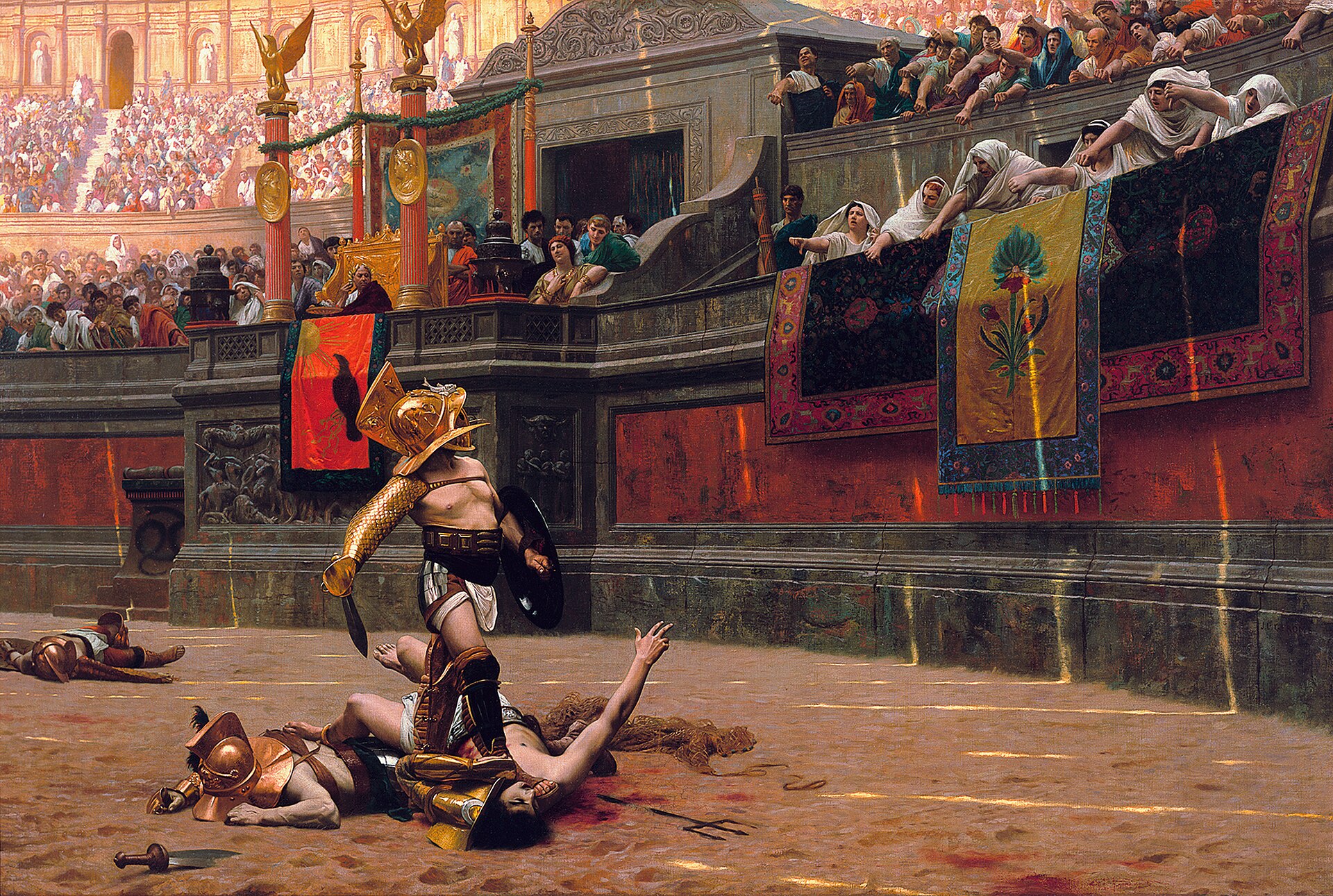
The image is stubborn: two men enter the sand, and only one leaves alive. It has been repeated in countless retellings of Rome's arenas, cementing the belief that a gladiator's every appearance was a guaranteed death sentence. But the actual practice of the games, as recorded in the surviving accounts, was more structured, more commercial, and more survivable than the myth suggests.
Consider the ritual itself. Gladiators marched into the arena through the so-called Life Gate, calling out to the imperial podium with words tradition remembers as 'Ave Caesar! Morituri Salutamus' — a salute from those about to die. That phrase alone has fed the myth of certain death. Yet the very next step in the ritual undercuts it: when a gladiator was wounded, it was the emperor or whoever presided over the games who decided his fate with a thumbs-up or thumbs-down gesture. A decision implies an alternative — the fighter could be spared as easily as condemned.
The existence of that gesture is itself proof that defeat did not automatically mean death. If every bout were scripted to end in a killing, there would be no need for a presiding official to judge each fallen fighter's fate mid-show. The mechanism only makes sense in a world where survival was a real, negotiated possibility — one bought by good performance, popular favor, or the mood of the crowd.
Money reinforces this picture. Gladiators were valuable property, trained for years in schools known as ludi. Game organizers exploited rivalries between these schools and advertised the records of famous fighters to sell tickets. A surviving games program lists two combatants, each already boasting three prior victories from the Neronian gladiator school at Capua, before their bout against each other. Fighters who died in every match could not accumulate such records; the entire promotional system depended on gladiators returning to fight again and again.
One preserved bout even shows the reality plainly: of the two veteran fighters advertised, one — Pugnax — won, while his opponent Murranus died. That single documented pairing already dismantles the notion that both combatants were fated to die; only one did, and the other lived to be advertised in future programs.
More from History

The Morning Bingham Climbed to Machu Picchu
On a cold July morning in 1911, an American historian scrambled up a jungle-choked ridge above the Urubamba River — and by afternoon, a forgotten Inca citadel would belong to the world.

The Last Half-Hour of the Hindenburg
It was already half a day late, and the public had been told to keep away — but at seven o'clock that evening, the Hindenburg finally turned toward its mooring mast for the last time.

The Last Hours of Pompeii: August 24, 79 AD
By noon it was just another hot day beside the Bay of Naples. By evening, an entire mountain had rewritten the fate of thousands.

The Longest Walk: Mandela's Last Steps to Freedom
After 27 years behind bars, a 71-year-old man had to relearn how to walk out of a prison gate — into a waiting world of cameras, crowds, and a country holding its breath.

The Document Lincoln Signed on the First Day of 1863
On a single January morning, a president's pen would change the legal status of more than three million people — if the ink held and his hand did not shake.

The Day of the Dream: August 28, 1963
Two hundred and fifty thousand people converged on the National Mall that morning — by nightfall, one voice from the steps of the Lincoln Memorial would echo for generations.