The Night the Ocean Sea Ended
Somewhere in the dark before dawn on October 12, 1492, a lookout's cry ended weeks of doubt — and opened a world Europe did not know existed.
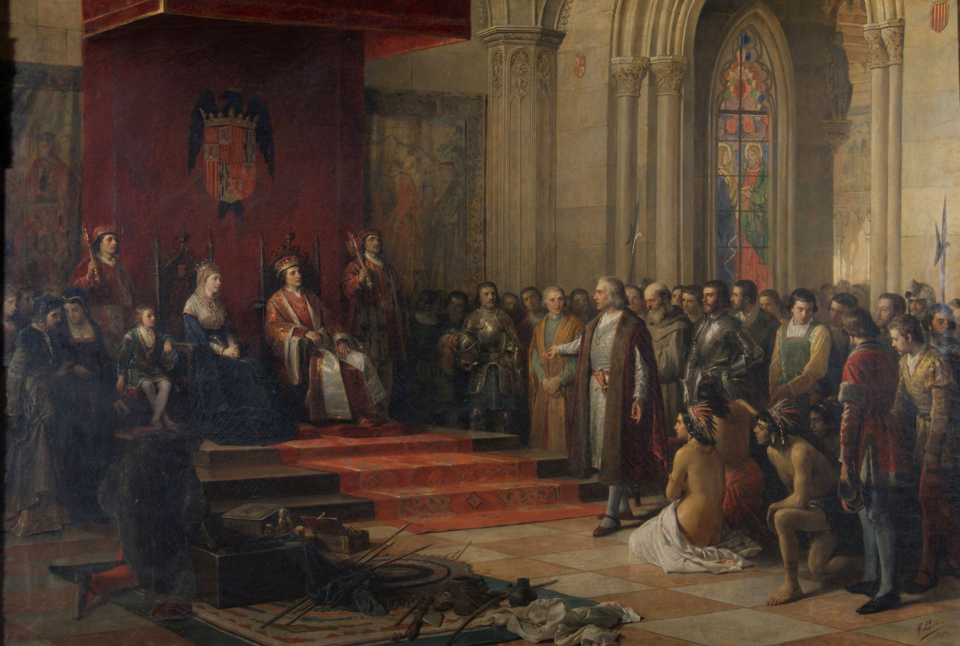
By the autumn of 1492, Christopher Columbus and his crews had been sailing west across the Atlantic — what Europeans of his era believed was a single, uninterrupted Ocean Sea — for weeks, following a plan he and his brother Bartholomew had refined through the 1480s to reach the Indies by heading directly west rather than around Africa. The voyage was funded by the newly unified Spanish crown of Isabella of Castile and Ferdinand of Aragon, whose kingdom had only that same year completed the Reconquista by conquering Granada, freeing resources and ambition for overseas ventures aimed at bypassing Portugal's lock on African and Indian Ocean trade routes.
Columbus sailed convinced that a westward crossing would bring him to India, China, Japan, and the fabled Spice Islands — the source, he believed, of silks and spices that had once flowed to Europe along overland routes now threatened since the fall of Constantinople to the Ottomans in 1453. His confidence had been bolstered years earlier by a map sent to him around 1481 by the Florentine cosmographer Paolo dal Pozzo Toscanelli, which showed the ocean crossing as unbroken except for the mythical island of Antillia, and by conversations in 1484 on La Gomera in the Canary Islands, where inhabitants of El Hierro spoke of islands supposedly lying to the west.
None of this made the wait easier as the ships pressed on through open water with no landmark to confirm the theory. Weeks at sea on an ocean assumed by many Europeans to be a single vast, featureless expanse meant that every day without land tested the resolve of everyone aboard, sailors and captain alike, with nothing but calculation, rumor, and belief to sustain the course westward.
Then, in the dark hours of October 12, 1492, that tension broke. Land was sighted — the moment at the heart of this entire expedition, the point toward which every westward day had been building since the ships had left Spain. It was the instant when theory became geography, when a plan sketched from Toscanelli's map and island rumors from La Gomera turned into solid ground beneath approaching keels.
Columbus, certain he had reached the outer islands of Asia, believed he had arrived at the Indies — the vast region encompassing what Europeans then understood as southern and eastern Asia. That conviction, mistaken as it was, proved so durable that it left a permanent mark on the map: the islands of the Caribbean and the Bahamas would carry the name 'West Indies' for centuries afterward, a linguistic fossil of what Columbus believed he had found on that day.
More from History

The Morning Bingham Climbed to Machu Picchu
On a cold July morning in 1911, an American historian scrambled up a jungle-choked ridge above the Urubamba River — and by afternoon, a forgotten Inca citadel would belong to the world.

The Last Half-Hour of the Hindenburg
It was already half a day late, and the public had been told to keep away — but at seven o'clock that evening, the Hindenburg finally turned toward its mooring mast for the last time.

The Last Hours of Pompeii: August 24, 79 AD
By noon it was just another hot day beside the Bay of Naples. By evening, an entire mountain had rewritten the fate of thousands.

The Longest Walk: Mandela's Last Steps to Freedom
After 27 years behind bars, a 71-year-old man had to relearn how to walk out of a prison gate — into a waiting world of cameras, crowds, and a country holding its breath.

The Document Lincoln Signed on the First Day of 1863
On a single January morning, a president's pen would change the legal status of more than three million people — if the ink held and his hand did not shake.

The Day of the Dream: August 28, 1963
Two hundred and fifty thousand people converged on the National Mall that morning — by nightfall, one voice from the steps of the Lincoln Memorial would echo for generations.