The Order That Vanished in Fire
Nine knights swore poverty and vowed to protect pilgrims — within two centuries their order commanded castles, fleets, and the trust of kings, until a single Friday sealed their fate.
In 1119, in the ruins of a captured Jerusalem, a French knight named Hugues de Payens approached King Baldwin II with a modest proposal: a monastic order to guard Christian pilgrims traveling the dangerous roads from Jaffa into the interior of the Holy Land, where bandits routinely slaughtered travelers by the hundreds. Baldwin and Patriarch Warmund agreed, granting the new order quarters in a wing of the royal palace on the Temple Mount, inside the captured Al-Aqsa Mosque — a site believed to sit above the ruins of Solomon's Temple. From this address came their name: the Poor Fellow-Soldiers of Christ and of the Temple of Solomon.
At first there were only nine knights, among them Godfrey de Saint-Omer and André de Montbard, bound by ties of blood and marriage, with no money and no independent means of survival. Their emblem — two knights sharing a single horse — was a deliberate symbol of poverty, not decoration.
That poverty did not last. Bernard of Clairvaux, the Cistercian abbot and nephew of founding knight André de Montbard, championed the order in his letter In Praise of the New Knighthood. At the Council of Troyes in 1129, church leaders formally endorsed the Templars. Pope Innocent II made the first papal donation at the Council of Pisa in 1135, and in 1139 his bull Omne Datum Optimum freed the order from local laws and taxes, answerable only to the pope. Donations, land, and noble sons poured in from across Christendom.
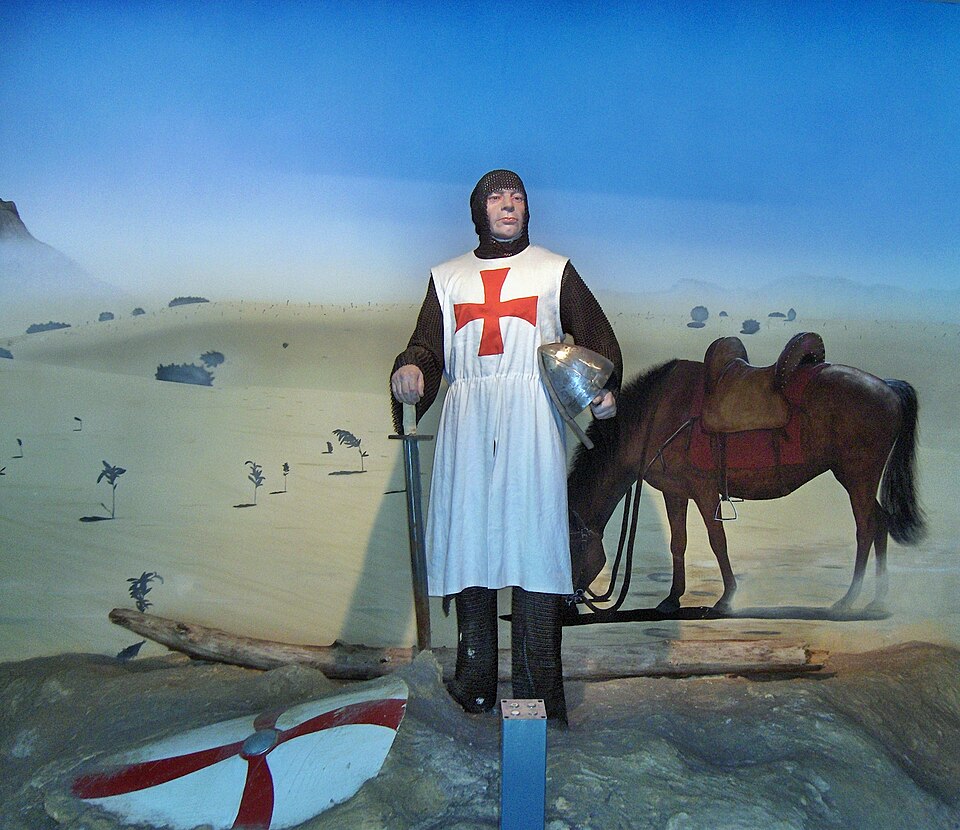
The knights themselves, in white mantles marked with a red cross, became some of the most feared fighters of the Crusades, often serving as shock troops who charged enemy lines ahead of the main army. At the Battle of Montgisard in 1177, roughly 500 Templar knights helped a few thousand infantry defeat Saladin's force of more than 26,000. Yet combatants were a minority — as much as 90% of members worked in support roles, running an economic network that stretched across Europe and the Holy Land.
More from Treasures

The Legend of the Nazi Gold Train
Somewhere beneath the hills of Poland, rumor insists, a train loaded with looted treasure vanished into a tunnel and was never seen again. The story survives because the plunder behind it was terrifyingly real.

The Treasure List Carved in Copper
While every other Dead Sea Scroll was written on parchment or papyrus, one was hammered into metal — a list of buried gold and silver that no one has ever found.

The Diamond That Vanished for a Century
For decades, treasure hunters and novelists spun theories about a lost 137-carat gem — sold, recut, melted into legend. It was sitting in a Quebec bank vault the entire time.

Gold, Ghosts, and the Mountain That Keeps Its Secret
For over a century, treasure hunters have vanished into a jagged Arizona range chasing a fortune that may never have existed at all. What they left behind was not gold, but one of America's most enduring legends.

The King Who Buried a River
When Rome finally cornered the Dacian king, it wasn't a sword that gave up his secret — it was a traitor's whisper about a riverbed.

The Fortune Dutch Schultz Took to His Grave
He asked New York's mob bosses for permission to kill a federal prosecutor — and when they said no, he disobeyed them anyway. It was a decision that would end his life and leave behind a fortune that has never been found.