The Silver Scrolls of Ketef Hinnom
In a tomb full of ash and forgotten rifles, a thirteen-year-old volunteer's stray discovery would rewrite the timeline of the Bible itself.
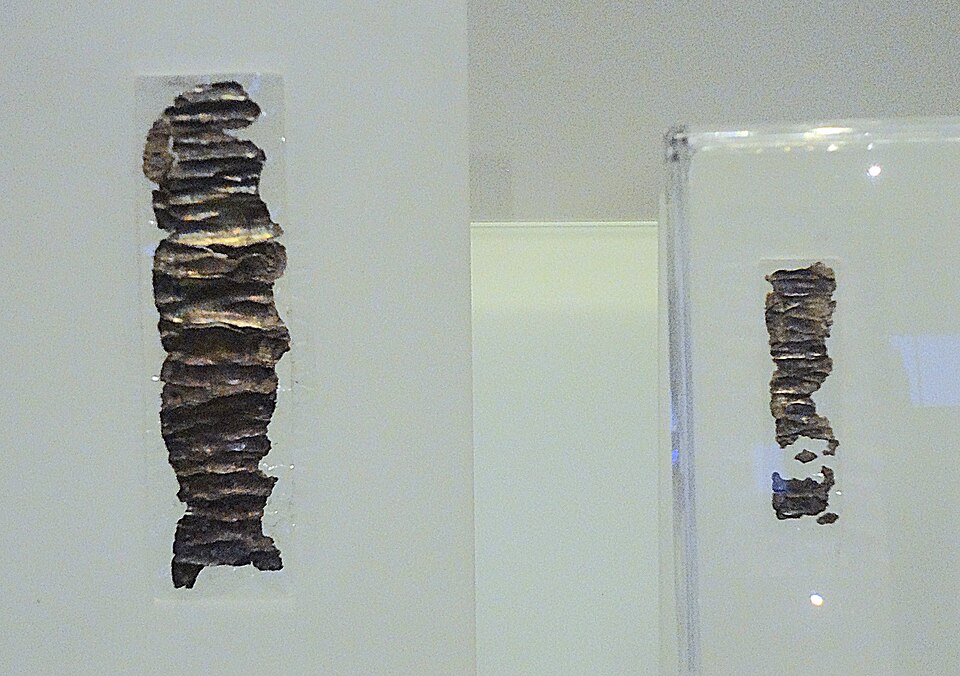
In 1979, a team led by Gabriel Barkay, then a professor of archaeology at Tel Aviv University, was excavating a burial complex at Ketef Hinnom, a rocky slope southwest of Jerusalem's Old City. The site looked archaeologically exhausted. During the Ottoman period, the tomb had even been used to store rifles, and nothing about it suggested it held secrets from a much older world. Then a thirteen-year-old volunteer noticed something the adults had missed, revealing that the ceiling of one chamber, Chamber 25 in Cave 24, had partially collapsed long ago, sealing and preserving its contents undisturbed for centuries.
What lay beneath was extraordinary. The cave itself was a First Temple period tomb, with five chambers and a central hall, capable of holding more than twenty-two bodies laid on stone benches with carved headrests. Beneath several chambers were repositories, spaces where the bones of the long dead were moved to make room for new burials. The repository beneath Chamber 25 held about 60 centimeters of accumulated material: over a thousand objects, including small pottery vessels, iron and bronze arrowheads, needles, pins, bone and ivory pieces, glass bottles, and gold and silver earrings.
Among this dense archaeological debris, excavators found two minuscule rolled silver scrolls, now known as KH1 and KH2. KH1 turned up in the middle of the repository, just 7 centimeters above the floor. KH2 emerged later, while workers were sifting dirt from the deposit's lower half, in its innermost section. Both were found separated from later Hellenistic material by three meters of horizontal distance and 25 centimeters of depth, embedded instead among pottery and artifacts dating to the 7th and 6th centuries BCE.
When unrolled and studied, the scrolls revealed faint Paleo-Hebrew script. Fragmentary as the text was, scholars recognized phrases paralleling the Priestly Blessing from the Book of Numbers 6:24-26. This made the scrolls the oldest known surviving texts paralleling passages from the Hebrew Bible, dated to approximately 600 BCE, placing them firmly within the First Temple period.
The dating was not settled without dispute. Barkay initially placed the inscriptions in the late 7th or early 6th century BCE, later refining this estimate based on the delicate paleo-Hebrew letterforms and surrounding pottery. Scholars Johannes Renz and Wolfgang Rollig challenged this, arguing the script was too deteriorated to date confidently and that a much later, 3rd or 2nd century BCE origin could not be ruled out, since the repository had functioned as a kind of accumulating rubbish bin across centuries, containing even fourth-century material.
More from Archaeology

The Bronze Disc That Rewrote the Sky
Two looters with a metal detector dug up something illegal, invisible in value, and older than Stonehenge's final stones — a map of the heavens buried for over three thousand years.

The Faceless Women of the Ice Age
Long before writing, before cities, before the wheel, someone carved a woman's body into stone and ivory — and left no name, no face, no explanation.

The Pebble That Might Be Human
A palm-sized stone found on a Moroccan riverbank may be humanity's oldest attempt to see itself — or simply a trick of erosion.

The Crown That Vanished: Deshret and the Red Land
A crown worn by kings for three thousand years has never once been found in a tomb — not one. So where did it go?

The Face That Traveled Between Empires
A farm worker's shovel struck stone in 1897 and unearthed a face so striking it would be sold to France, seized as war booty, and finally traded back for a Velázquez.

The Boy in the Dark Tunnel
A schoolboy fell into black water inside an ancient tunnel and surfaced with his fingers brushing letters no one had noticed for 2,600 years.