The Sixteen-Year-Old Who Carried a Nation's Map
A pregnant teenager, kidnapped from her people years before, would become the only reason a floundering American expedition survived the Rocky Mountains — and found its way home again.
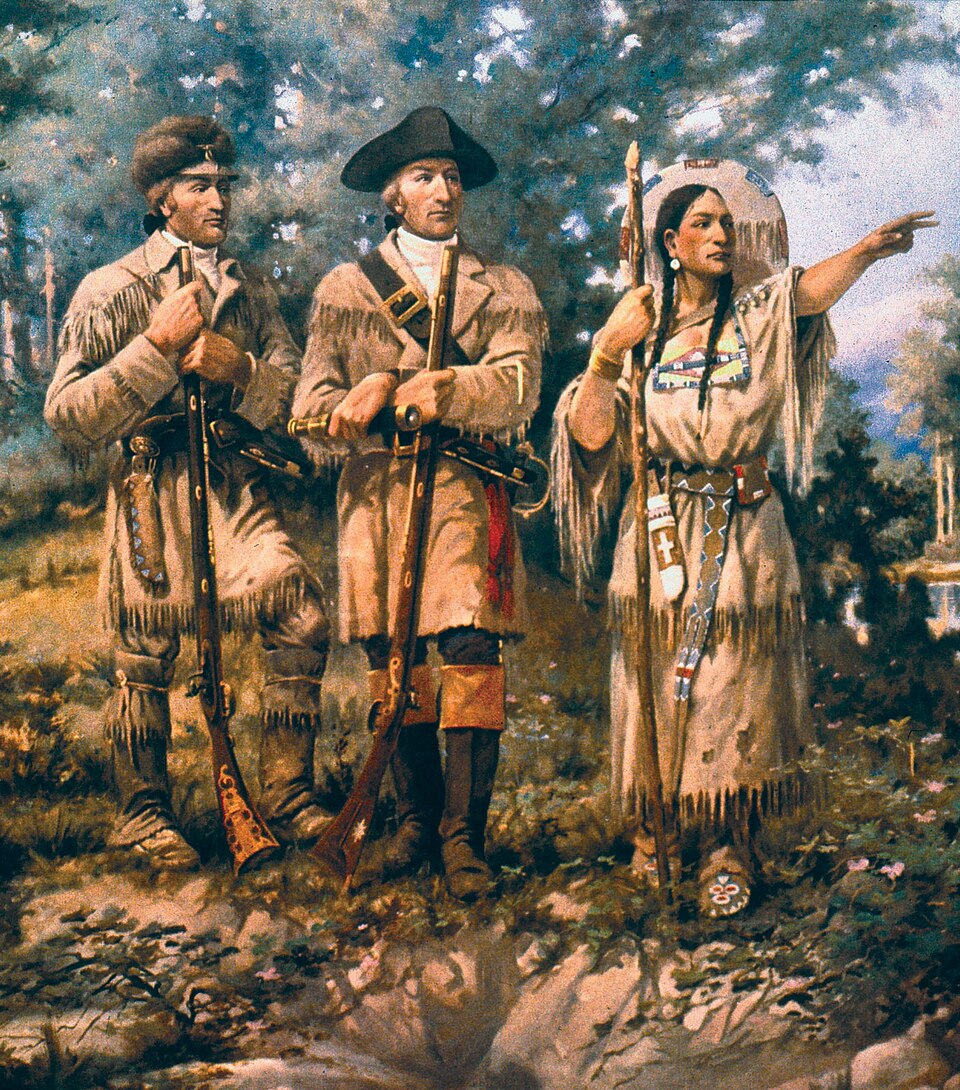
In the winter of 1804, at Fort Mandan in present-day North Dakota, Captains Meriwether Lewis and William Clark were desperate for someone who could speak to the tribes waiting at the headwaters of the Missouri River. They found their answer not in a seasoned guide, but in a young Shoshone woman living among the Hidatsa, married to a French-Canadian trapper named Toussaint Charbonneau. Her name was Sacagawea. Born around 1788, she was perhaps sixteen years old that winter, pregnant with her first child, and about to become indispensable to one of the most consequential journeys in American history.
Her path to that fort had already been marked by violence. Born into the Agaidika, or 'Salmon Eater,' band of the Lemhi Shoshone near present-day Salmon, Idaho, she was taken captive around 1800 at about age twelve during a Hidatsa raid that killed several Shoshone men, women, and boys. She was carried to a Hidatsa village near what is now Washburn, North Dakota. There, around age thirteen, she was given in marriage to Charbonneau, who — depending on the account — either purchased her from the Hidatsa or won her while gambling.
When Lewis and Clark arrived in the winter of 1804–05, they needed an interpreter who could speak Shoshone, the language of tribes they would meet near the Rocky Mountains. Charbonneau claimed to speak several Native languages, and one of his wives spoke Shoshone. On November 4, 1804, Clark wrote in his journal about hiring 'a french man by Name Chabonah' whose 'Squars' were Snake Indians, agreeing to take one of his wives along to interpret. A week later, Charbonneau and Sacagawea moved into the expedition's fort. Clark nicknamed her 'Janey.'
On February 11, 1805, still at the fort, Sacagawea gave birth to a son, Jean Baptiste Charbonneau, in a difficult delivery eased, Lewis noted, by crushed rattlesnake rattles administered in water. The boy became known to the men as 'Pomp' or 'Pompy,' and Sacagawea carried him on her back in a cradleboard for the thousands of miles that followed.
The expedition left Fort Mandan in April 1805, pushing up the Missouri River in pirogues. On May 14, one of the boats capsized, spilling supplies into the river — among them the journals and records that documented the entire mission. Sacagawea moved quickly and recovered the items before they were lost. Grateful for her composure, the captains named the Sacagawea River in her honor on May 20, 1805.
More from Explorations

Humboldt: The Man Who Measured the World
A Prussian noble's son, once mocked as a sickly child, would climb a volcano to a world-record height and rewrite how humanity understood nature itself.

The Man Who Named Canada
A Breton mariner planted a wooden cross on a foreign shore and claimed a kingdom he did not understand — then spent a winter frozen into its river, praying a stranger's remedy would save his men.

Sixty Ships Into the Unknown: Hanno's Voyage Down the African Coast
A Carthaginian fleet of sixty ships and thousands of settlers vanished past the Pillars of Hercules to found cities on an unmapped coast — and came home with the skins of hairy, hostile 'gorillas' as proof of how far they had gone.

HMS Challenger: The Voyage That Charted the Deep
A stripped-down warship, its guns torn out to make room for microscopes, set sail from Portsmouth to answer a question no one had ever properly asked: what lies at the bottom of the sea?

Scott's Last Expedition: The Letters Written at the End of the World
Five men reached the bottom of the world only to find a Norwegian flag already planted there. What followed was not glory, but a slow, frozen unraveling that the world would remember for a century.

Marco Polo: In the Court of Kublai Khan
A fifteen-year-old boy meets the father he barely knew — and is soon swept toward the richest court on Earth. Twenty-four years later, he returns home with tales so vast that Venice simply calls him 'Mister Millions'.