The Smallest Statue on the Moon
On the dusty grey surface of Hadley Rille lies an 8.9-centimeter aluminum figure — the only sculpture ever placed on another world, and for months, nobody on Earth knew it was there.
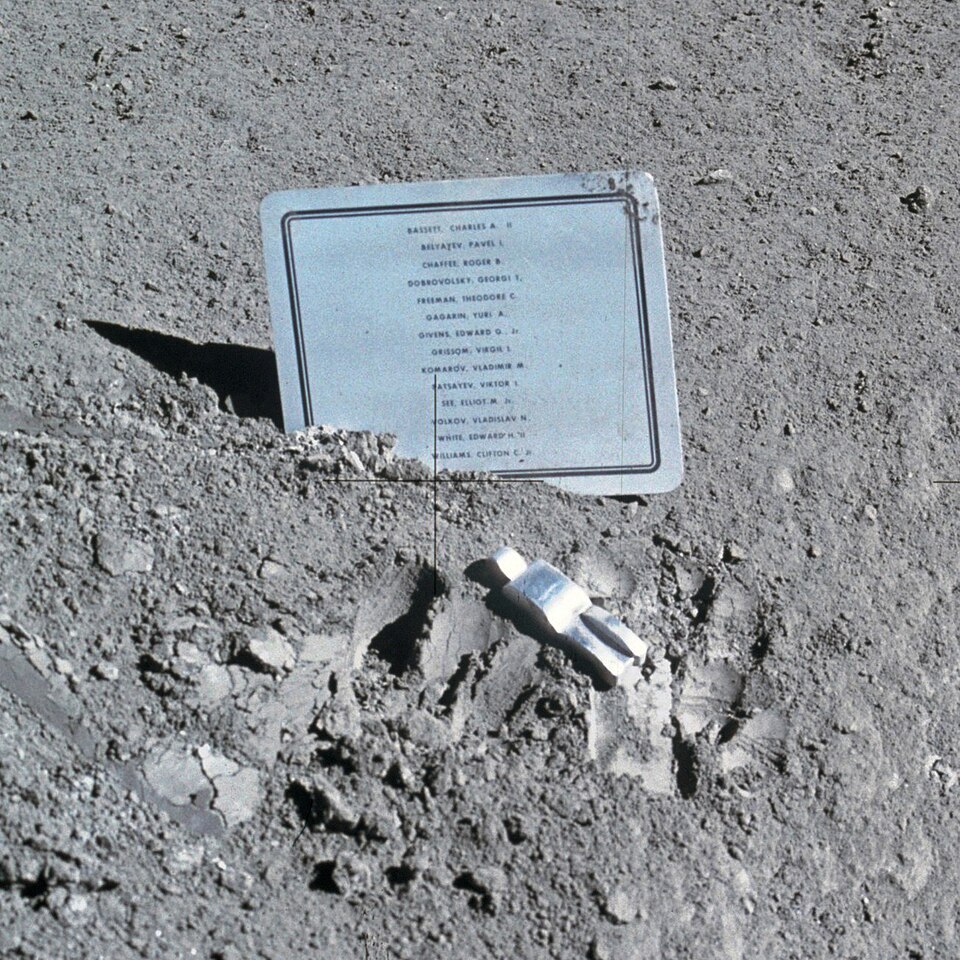
Before he ever boarded a rocket, David Scott sat down to dinner with a Belgian artist named Paul Van Hoeydonck. The two men struck an agreement that night, though what exactly they agreed to would later become a matter of dispute. Scott wanted something small to carry with him to the Moon, a private memorial to the astronauts and cosmonauts who had died pushing humanity toward the stars. Van Hoeydonck, a painter and printmaker, would make the piece.
Scott's specifications were precise. The sculpture had to be lightweight yet sturdy enough to survive the Moon's brutal temperature swings. It could not be identifiably male or female, nor tied to any particular ethnicity — a figure meant to stand for everyone. Scott also designed a plaque, separate from the statue, listing fourteen names: eight American astronauts and six Soviet cosmonauts who had died in the pursuit of spaceflight. According to Scott, it was agreed that Van Hoeydonck's name would stay out of the public eye, a safeguard against commercial exploitation of NASA's program. He secured permission from NASA management before the mission and packed the tiny aluminum figure aboard his spacecraft.
Van Hoeydonck remembers it differently. In interviews, including one with the Belgian newspaper Le Soir, he said the statue was meant to represent all of humanity, not specifically the fallen. He claimed he never knew it would become a memorial, that he neither chose nor approved the name 'Fallen Astronaut,' and that he had intended the figure to stand upright on the lunar surface, not lie flat. He also denied ever agreeing to anonymity. Decades later, in 2021, Scott offered yet another account in a document called 'Memorandum for the Record,' stating the figurine was actually designed and fabricated by NASA personnel, based on the simple stick figures used on bathroom signage.
Whatever its true origin, the statue made its journey. On August 2, 1971, near the end of his work on the Apollo 15 mission, David Scott placed Fallen Astronaut on the ground at Hadley Rille, beside the plaque bearing those fourteen names. He photographed the small memorial among the scattered footprints, then said nothing. The astronauts kept it secret through the rest of the mission, waiting until a press conference back on Earth to reveal what they had left behind.
Scott later noted that the plaque was incomplete. Missing were the names of Valentin Bondarenko and Grigori Nelyubov, two Soviet losses hidden from the West by the secrecy surrounding their space program. Also absent were Robert Henry Lawrence Jr., the first Black astronaut selected for a U.S. military space program, killed in a 1967 training accident, and Michael J. Adams, a test pilot who died flying the X-15 above fifty miles in altitude that same year.
More from Archaeology

The Bronze Disc That Rewrote the Sky
Two looters with a metal detector dug up something illegal, invisible in value, and older than Stonehenge's final stones — a map of the heavens buried for over three thousand years.

The Faceless Women of the Ice Age
Long before writing, before cities, before the wheel, someone carved a woman's body into stone and ivory — and left no name, no face, no explanation.

The Pebble That Might Be Human
A palm-sized stone found on a Moroccan riverbank may be humanity's oldest attempt to see itself — or simply a trick of erosion.

The Crown That Vanished: Deshret and the Red Land
A crown worn by kings for three thousand years has never once been found in a tomb — not one. So where did it go?

The Face That Traveled Between Empires
A farm worker's shovel struck stone in 1897 and unearthed a face so striking it would be sold to France, seized as war booty, and finally traded back for a Velázquez.

The Boy in the Dark Tunnel
A schoolboy fell into black water inside an ancient tunnel and surfaced with his fingers brushing letters no one had noticed for 2,600 years.