The Stone That Spoke Three Tongues
A slab of dark granodiorite lay buried under a fort's foundations for centuries — until a French soldier's shovel struck the key that would unlock four thousand years of silence.
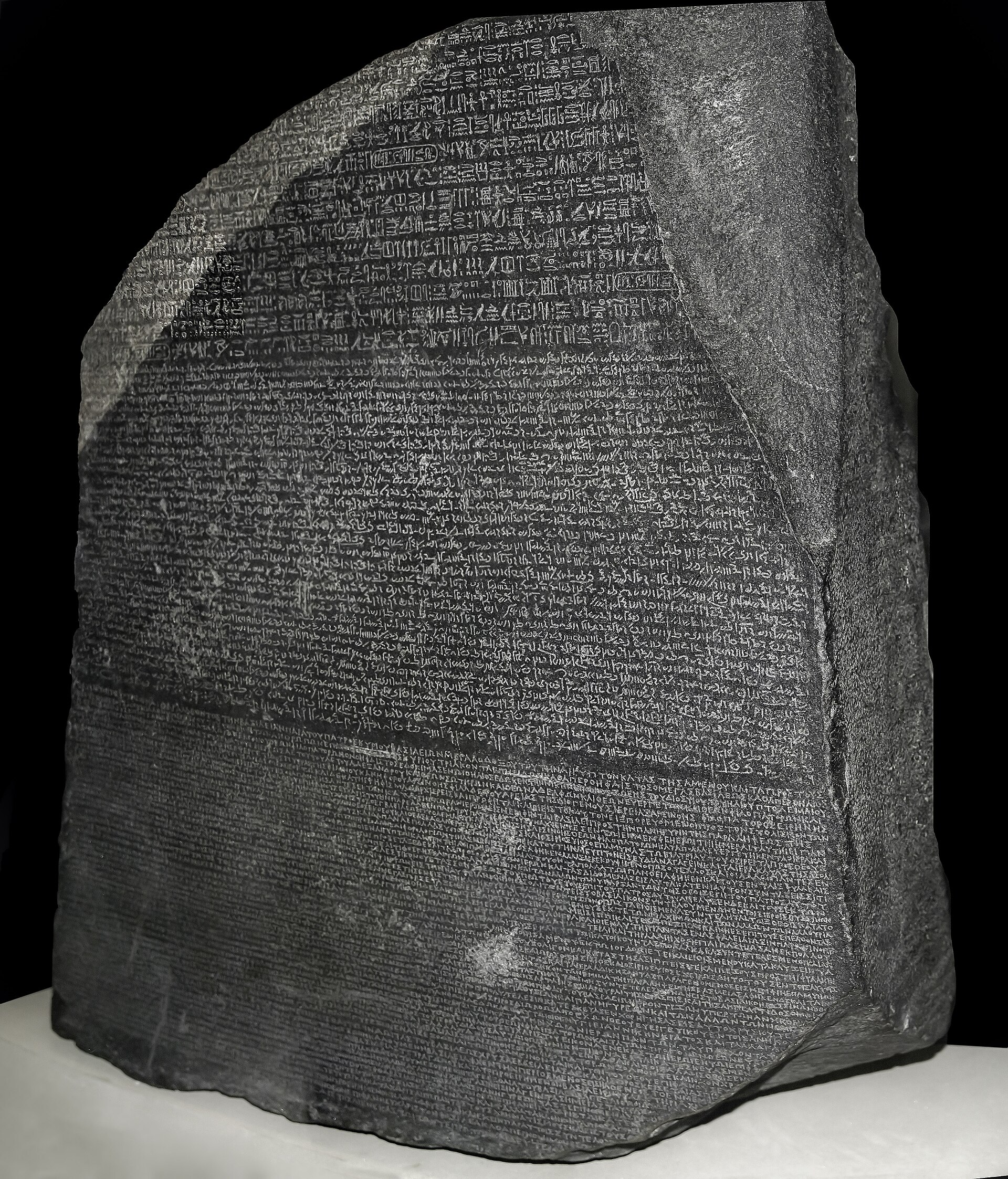
In July 1799, near the town of Rashid — known to Europeans as Rosetta — in the Nile Delta, French army officer Pierre-François Bouchard was overseeing work on Fort Julien when his men uncovered a large, inscribed block of stone. It had been repurposed as building material sometime in late antiquity or the Mamluk period, its original purpose long forgotten. No one working that day could have guessed they had just found the first bilingual Egyptian text recovered in the modern era, or that it would become the most visited object in a museum thousands of miles away.
The stone itself was a fragment, 112.3 centimetres at its tallest, 75.7 centimetres wide, 28.4 centimetres thick, and weighing roughly 760 kilograms. Its front face, polished smooth, carried three separate blocks of writing: fourteen surviving lines of Egyptian hieroglyphs at the top, thirty-two lines of Demotic script in the middle, and fifty-four lines of Ancient Greek at the bottom. All three texts, though damaged and incomplete, recorded the same decree — a fact that would prove to be the whole point.
The decree dated to 27 March 196 BC, during the ninth year of the reign of King Ptolemy V Epiphanes. It had been issued by a congress of priests gathered at Memphis, marking the young king's coronation and establishing his divine cult. The stele was carved during the Hellenistic period and is believed to have originally stood inside a temple, possibly at Sais, long before it was dismantled and dragged off to reinforce a fort wall.
Word of the discovery spread fast. Lithographic copies and plaster casts of the inscriptions began circulating among European museums and scholars almost immediately, since everyone recognised what was at stake: hieroglyphs had gone unread for centuries, and here, at last, sat a Greek translation right beside them. But politics intervened before scholarship could settle the matter. When British forces defeated the French in Egypt, the stone was handed over under the terms of the Capitulation of Alexandria in 1801, and shipped to London.
Since 1802, it has remained on public display at the British Museum almost without interruption. For years, visitors saw it coated in white chalk rubbed into the letters for legibility, sealed under a layer of carnauba wax to protect it from countless fingers — a treatment that darkened the stone so much it was long mistaken for black basalt. Only in 1999, when conservators cleaned it, did the original grey granodiorite reappear, along with a pink vein of mineral running across one corner, later matched to quarries at Gebel Tingar near Aswan.
More from Archaeology

The Bronze Disc That Rewrote the Sky
Two looters with a metal detector dug up something illegal, invisible in value, and older than Stonehenge's final stones — a map of the heavens buried for over three thousand years.

The Faceless Women of the Ice Age
Long before writing, before cities, before the wheel, someone carved a woman's body into stone and ivory — and left no name, no face, no explanation.

The Pebble That Might Be Human
A palm-sized stone found on a Moroccan riverbank may be humanity's oldest attempt to see itself — or simply a trick of erosion.

The Crown That Vanished: Deshret and the Red Land
A crown worn by kings for three thousand years has never once been found in a tomb — not one. So where did it go?

The Face That Traveled Between Empires
A farm worker's shovel struck stone in 1897 and unearthed a face so striking it would be sold to France, seized as war booty, and finally traded back for a Velázquez.

The Boy in the Dark Tunnel
A schoolboy fell into black water inside an ancient tunnel and surfaced with his fingers brushing letters no one had noticed for 2,600 years.