The Strait That Swallowed a Fleet
Outnumbered and cornered against a narrow strait near Athens, the Greeks gambled everything on a lie whispered into the ear of a king.
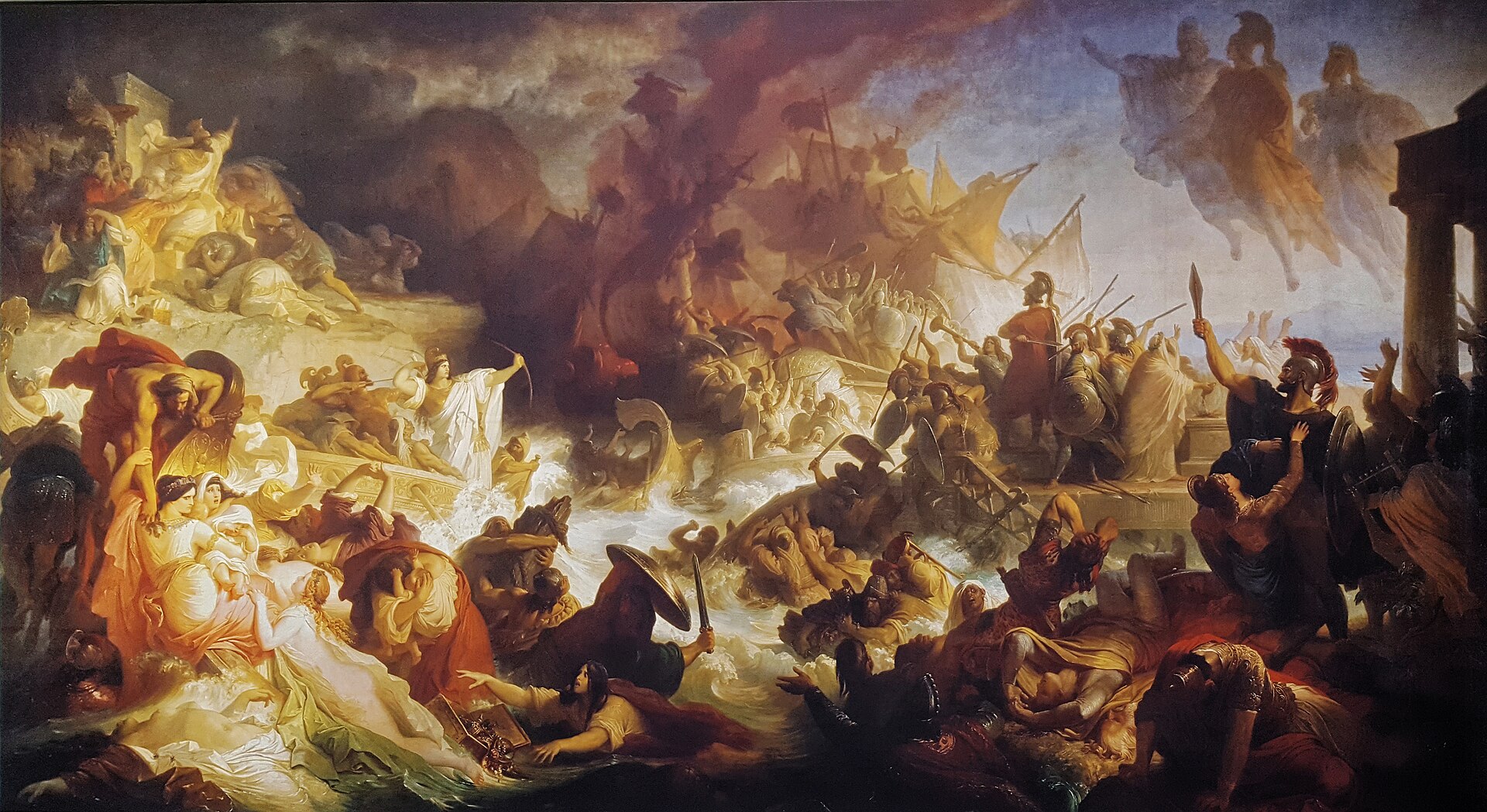
In September of 480 BC, the Persian king Xerxes I sat on a hillside throne overlooking the waters between the Greek mainland and the small island of Salamis, expecting to watch the final destruction of Greek resistance. Behind him lay a campaign of extraordinary scale: bridges of boats across the Hellespont, a canal cut through the isthmus of Mount Athos, and an army that had already burned its way through Phocis, Boeotia, and Attica. Ahead of him, in the cramped straits, waited a Greek fleet that had every reason to expect defeat.
The road to Salamis had been paved with Greek losses. A small force under Spartan command had died to the last man holding the pass at Thermopylae, buying time for the allied fleet fighting nearby at Artemisium. That naval battle, too, had gone badly for the Greeks, who suffered heavy casualties and withdrew once Thermopylae fell. With the land route open, Persian forces swept into central Greece, and the allied army fell back to fortify the Isthmus of Corinth while the fleet regrouped at Salamis.
It was here that the Athenian general Themistocles made his case: rather than retreat further and abandon the sea to Persia, the outnumbered Greek ships should stand and fight in the narrow waters near Salamis. A victory, he argued, might halt Persian naval operations against the Peloponnese entirely. Xerxes, for his part, wanted nothing more than a decisive battle to end the war outright.
Themistocles then engineered the trap. He sent a secret message to Xerxes revealing that a large portion of the Greek fleet was stationed at Salamis — true information, but delivered to provoke exactly the response he wanted. Believing he could trap and annihilate the Greeks in one stroke, Xerxes ordered his fleet to row into the straits and seal off both entrances.
It was a catastrophic miscalculation. The Persian numbers, so formidable in open water, became a liability in the confined channel. Ships jostled for space, oars tangled, formations dissolved into chaos as commanders tried to maneuver vessels never built for such tight quarters. The Greeks, drawn up in disciplined line, watched the disorder spread through the Persian ranks before striking.
More from History

The Morning Bingham Climbed to Machu Picchu
On a cold July morning in 1911, an American historian scrambled up a jungle-choked ridge above the Urubamba River — and by afternoon, a forgotten Inca citadel would belong to the world.

The Last Half-Hour of the Hindenburg
It was already half a day late, and the public had been told to keep away — but at seven o'clock that evening, the Hindenburg finally turned toward its mooring mast for the last time.

The Last Hours of Pompeii: August 24, 79 AD
By noon it was just another hot day beside the Bay of Naples. By evening, an entire mountain had rewritten the fate of thousands.

The Longest Walk: Mandela's Last Steps to Freedom
After 27 years behind bars, a 71-year-old man had to relearn how to walk out of a prison gate — into a waiting world of cameras, crowds, and a country holding its breath.

The Document Lincoln Signed on the First Day of 1863
On a single January morning, a president's pen would change the legal status of more than three million people — if the ink held and his hand did not shake.

The Day of the Dream: August 28, 1963
Two hundred and fifty thousand people converged on the National Mall that morning — by nightfall, one voice from the steps of the Lincoln Memorial would echo for generations.