The Sunday Sweden Turned Right
At 4:50 in the morning, every car on Sweden's empty roads came to a dead stop — and then, in one choreographed motion, the entire nation switched sides.
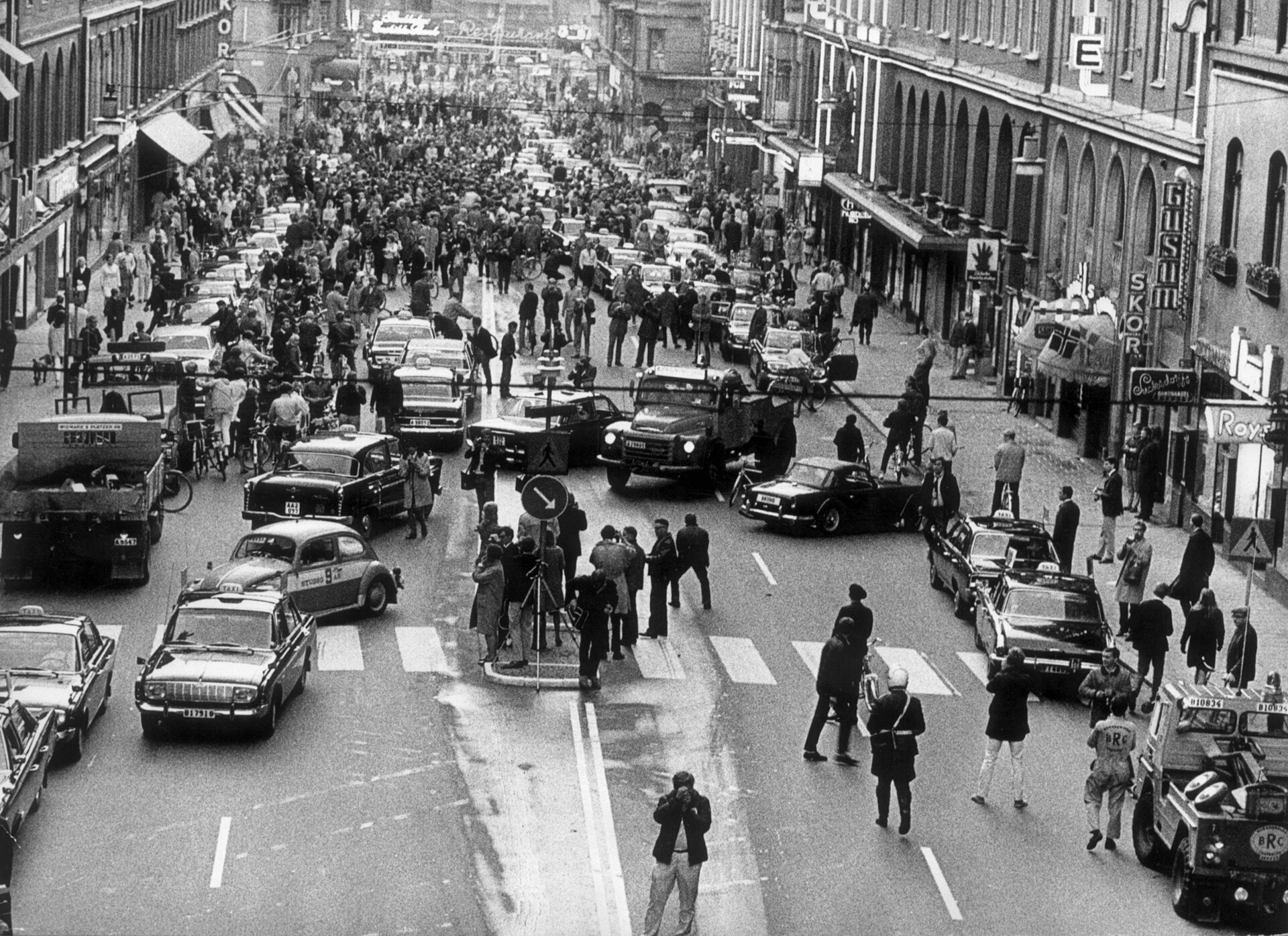
Sunday, 3 September 1967 began not with traffic but with silence. Since 1:00 a.m., non-essential vehicles had been banned from Swedish roads, part of a plan years in the making to move the country from left-hand to right-hand driving. In Stockholm and Malmö the emptiness had started even earlier — from 10:00 the previous Saturday morning — giving work crews a full day and night to reconfigure intersections before the switch. Some other towns saw their own extended bans, running from 3:00 p.m. Saturday to 3:00 p.m. Sunday.
Through those dark hours, workers moved through the streets stripping black plastic sheeting from poles and traffic signals that had been pre-installed weeks earlier, ready to be unveiled at the right moment. Beneath layers of black tape lay a second set of road markings, painted in white, waiting to replace the old yellow lines that had guided Swedish drivers on the left for generations. Roughly 350,000 signs across the country had already been swapped or repositioned in the run-up to this morning, 20,000 of them in Stockholm alone.
At 4:50 a.m., any vehicle still on the road came to a complete stop. Drivers who had spent their whole lives keeping left now had to carefully steer their cars across to the right-hand side of the road. Then, deliberately, they stopped again — a pause built into the plan to give every other driver on every other stretch of road time to make the same move, so that no one would round a bend and meet a car still crossing from the other direction.
For ten minutes the country sat there, frozen mid-maneuver, cars newly arranged on unfamiliar sides of empty streets. It was, in its way, the strangest ten minutes in Swedish traffic history: a whole nation paused between one rule of the road and another.
At 5:00 a.m., they were allowed to proceed. Sweden was now driving on the right.
More from History

The Morning Bingham Climbed to Machu Picchu
On a cold July morning in 1911, an American historian scrambled up a jungle-choked ridge above the Urubamba River — and by afternoon, a forgotten Inca citadel would belong to the world.

The Last Half-Hour of the Hindenburg
It was already half a day late, and the public had been told to keep away — but at seven o'clock that evening, the Hindenburg finally turned toward its mooring mast for the last time.

The Last Hours of Pompeii: August 24, 79 AD
By noon it was just another hot day beside the Bay of Naples. By evening, an entire mountain had rewritten the fate of thousands.

The Longest Walk: Mandela's Last Steps to Freedom
After 27 years behind bars, a 71-year-old man had to relearn how to walk out of a prison gate — into a waiting world of cameras, crowds, and a country holding its breath.

The Document Lincoln Signed on the First Day of 1863
On a single January morning, a president's pen would change the legal status of more than three million people — if the ink held and his hand did not shake.

The Day of the Dream: August 28, 1963
Two hundred and fifty thousand people converged on the National Mall that morning — by nightfall, one voice from the steps of the Lincoln Memorial would echo for generations.