The Temple That Outran a Flood
A sand dune swallowed it for centuries. A rising lake nearly swallowed it forever. Somehow it survived both.
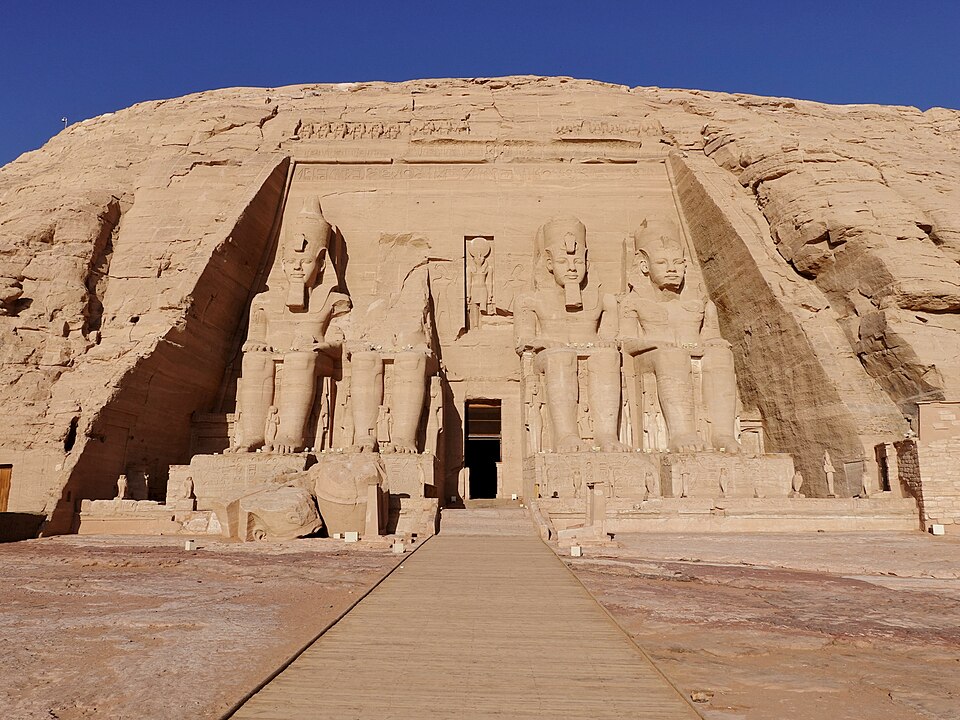
For centuries, Abu Simbel was little more than a rumor — a set of colossal heads breaking through a sand dune on the western bank of the Nile, near the border of modern Egypt and Sudan. By the 6th century BC, drifting sand had already crept up to the knees of the great statues carved into the mountainside. Europeans knew nothing of it until March 1813, when the Swiss researcher Johann Ludwig Burckhardt stumbled onto the small temple and the top frieze of the main temple while descending a steep, sand-choked cleft in the rock.
Burckhardt's own account captures the strangeness of the discovery: six colossal standing figures flanking the entrance of the small temple, in complete preservation, and then, some two hundred yards from that small temple, four more immense statues, cut from the rock in a separate recess and almost entirely buried in sand, their heads and shoulders barely visible above the drifts. He could not even tell whether they sat or stood — only that the desert had nearly erased them.
Word of the site spread slowly. In 1815, the British explorer William John Bankes visited but could not force his way into the Great Temple; he vowed to return properly equipped. In early 1816, the French ex-consul Bernardino Drovetti tried a different approach, leaving 300 piastres with the local sheikh to pay for digging out the entrance. When Drovetti came back, the money was untouched — the Nubians had seen no reason to value these odd metal discs, and no digging had been done.
A few months later, in September 1816, the Italian explorer Giovanni Belzoni arrived, having heard of the site through Burckhardt. He found, in his words, 'one figure of enormous size, with the head and shoulders only projecting out of the sand.' Belzoni succeeded where Drovetti had failed, convincing the sheikh that coins had real value, and striking a deal of two piastres a day per laborer. He managed to expose the figure over the doorway and the head and shoulders of the north-central colossus of Ramesses II — before running out of food and money to keep the Nubian workers digging.
The temples themselves had been carved starting around 1264 BC, during the reign of Pharaoh Ramesses II of the 19th Dynasty. Construction took about twenty years. Known as the Temple of Ramesses, Beloved by Amun, the complex was part of Ramesses's broader campaign to project Egyptian power into Nubia, a region prized for gold and trade goods. The Great Temple honored Ramesses himself, its colossal exterior figures becoming some of the most recognizable images in Egyptian art, with his wife Nefertari and their children carved as smaller figures at his feet. Inside, reliefs commemorated his role at the Battle of Kadesh. The Small Temple was dedicated to Nefertari.
More from Architecture

Stonehenge: The Stones That Refuse to Explain Themselves
For more than 4,500 years, a ring of leaning giants has watched the sun rise and set on the same two days each year — and no one alive can say for certain why.

The Dome That Refused to Fall
Two thousand years ago, Roman engineers poured a dome so vast that no one has dared build a bigger one from unreinforced concrete since. It still stands, open to the sky.

A Minaret Rising Over Kingsland Road
On a busy London street better known for shops and buses, the tallest minaret in Britain quietly reaches into the sky. Its story began not in Sinan's sixteenth-century Istanbul, but in 1990s Hackney.

The Bridge That Was Killed Twice
For 427 years it arched over the Neretva like a stone rainbow. Then, in a matter of days in 1993, it simply ceased to exist.

Hoover Dam: The Concrete That Tamed a River
In the scorched depths of Black Canyon, thousands of men built the largest concrete structure the world had ever seen — and finished it two years early, at a cost of over a hundred lives.

Neuschwanstein: The Castle Built for a Ghost
A king who despised his own palace built the most famous fairy-tale castle on earth — and died before he ever truly lived in it.