The Tower That Watched an Empire
A fortress built to remind Londoners who ruled them ended up holding the ruled and the ruler alike — kings, queens, spies, and a future queen imprisoned before her crown. Its walls have seen coronations, executions, and the quiet turning of ravens' wings for nearly a thousand years.
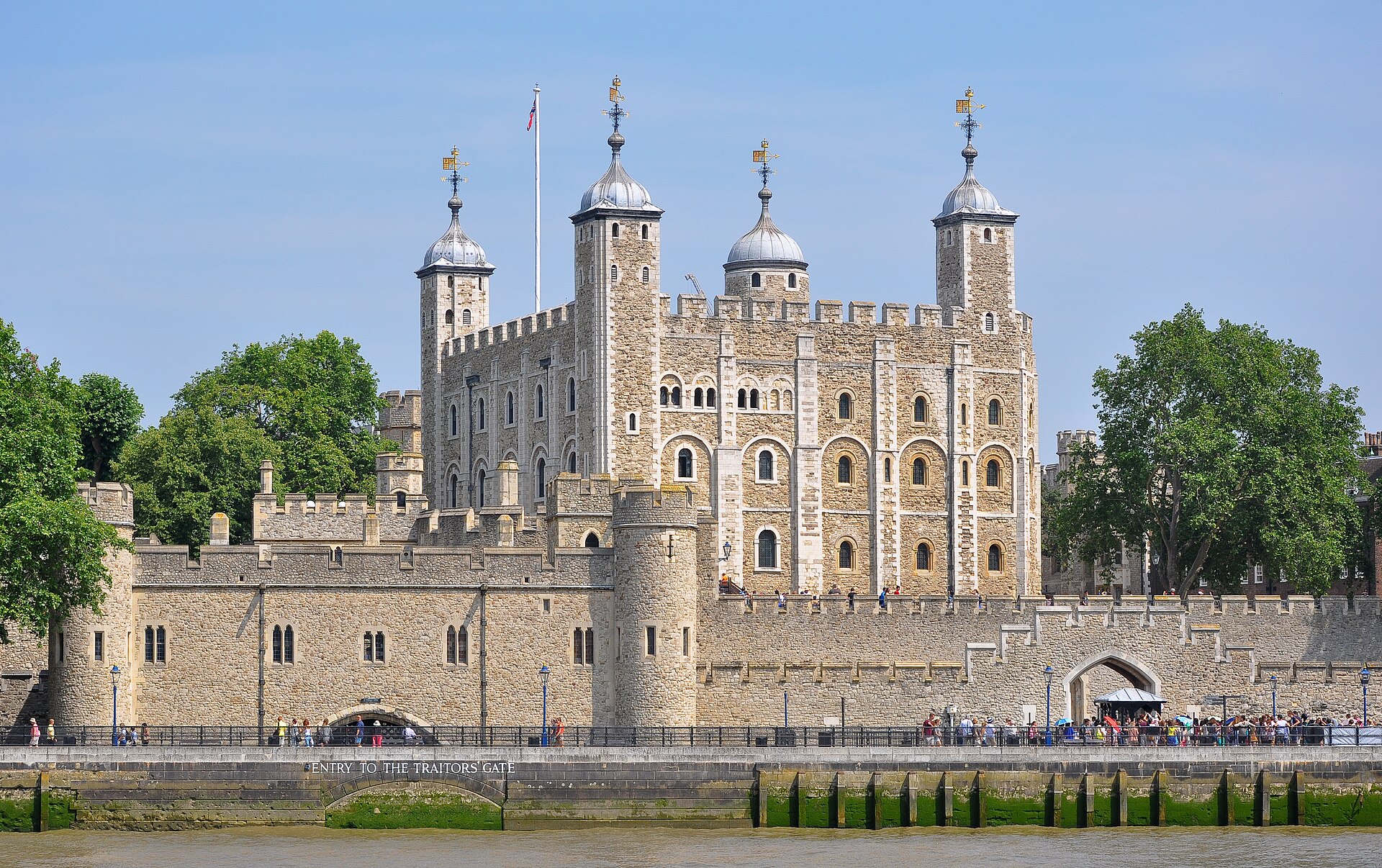
In the last months of 1066, as William the Conqueror tightened his grip on a newly subdued England, he ordered a fortress raised on the north bank of the Thames. By 1078 the White Tower — the great keep that gives the whole complex its name — rose from stone brought in from France, under the direction of the Bishop of Rochester, a structure so imposing that Londoners of the time saw it not as protection but as oppression, a Norman fist planted at the edge of their city.
The White Tower itself is a marvel of eleventh-century engineering: roughly 36 by 32 metres at its base, standing 27 metres high at its southern battlements, originally three storeys with a basement, an entrance level reached by a removable wooden staircase, and an upper floor. Historians have called it 'the most complete eleventh-century palace in Europe,' a keep meant to shelter a king or his representative in both comfort and unassailable strength.
Over the following two centuries, the Tower grew far beyond that single keep. Richard I, in the late twelfth century, and later Henry III and Edward I expanded it into the layered complex still visible today — an innermost ward around the White Tower, an inner ward built under Richard I, and an outer ward completed by Edward I in 1285. By then the general layout of concentric walls and moat had settled into the form it holds to this day, enclosing nearly 12 acres, with a further 6 acres of surrounding land known as the Tower Liberties.
The Tower was never merely defensive. It served, at different times, as a royal palace, an armoury, a treasury, a menagerie, the home of the Royal Mint, a public record office, and — most famously — the repository of the Crown Jewels. From the early fourteenth century until the reign of Charles II in the seventeenth, monarchs would traditionally spend several nights within its walls before processing from the Tower to Westminster Abbey for their coronation.
But the Tower's darker reputation rests on its long service as a prison, a role it held from around 1100 until 1952. Its most notorious mystery involves the Princes in the Tower, two boys housed there in the late fifteenth century who mysteriously vanished, presumed murdered. Decades later, Elizabeth I was held within its walls before she became queen, alongside figures like Sir Walter Raleigh and Elizabeth Throckmorton — imprisonments so common that the phrase 'sent to the Tower' entered the language itself.
More from Architecture

Stonehenge: The Stones That Refuse to Explain Themselves
For more than 4,500 years, a ring of leaning giants has watched the sun rise and set on the same two days each year — and no one alive can say for certain why.

The Dome That Refused to Fall
Two thousand years ago, Roman engineers poured a dome so vast that no one has dared build a bigger one from unreinforced concrete since. It still stands, open to the sky.

A Minaret Rising Over Kingsland Road
On a busy London street better known for shops and buses, the tallest minaret in Britain quietly reaches into the sky. Its story began not in Sinan's sixteenth-century Istanbul, but in 1990s Hackney.

The Bridge That Was Killed Twice
For 427 years it arched over the Neretva like a stone rainbow. Then, in a matter of days in 1993, it simply ceased to exist.

Hoover Dam: The Concrete That Tamed a River
In the scorched depths of Black Canyon, thousands of men built the largest concrete structure the world had ever seen — and finished it two years early, at a cost of over a hundred lives.

Neuschwanstein: The Castle Built for a Ghost
A king who despised his own palace built the most famous fairy-tale castle on earth — and died before he ever truly lived in it.