The Wall of a Thousand Hands
For nearly eight thousand years, hunters kept returning to the same rock wall in Patagonia to leave the same mark: the outline of a hand. No one knows exactly why.
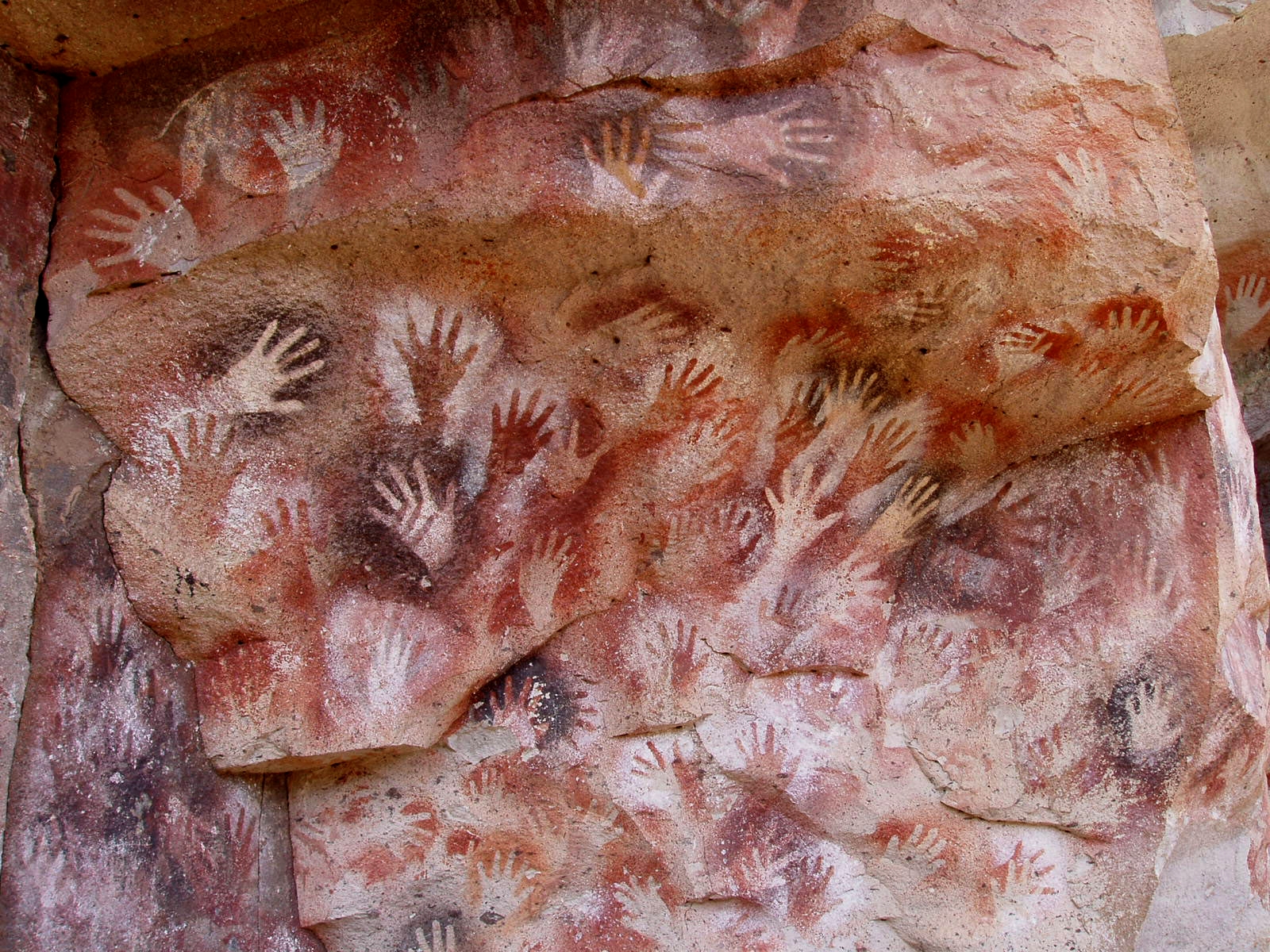
Deep in a canyon carved by the Pinturas River, in Argentina's Santa Cruz province, a cliff face holds one of the strangest galleries on Earth. Hundreds of human hands, stenciled in red, black, white and ochre, overlap in dense collages across the stone. This is Cueva de las Manos — the Cave of Hands — located 163 kilometers south of the town of Perito Moreno, in an isolated stretch of Patagonia.
The paintings were not made in a single burst of inspiration. They were created in successive waves between 7,300 BC and AD 700, spanning the Archaic period of pre-Columbian South America. Researchers determined this timeline using remains of bone pipes that ancient artists used to spray pigment onto the rock, along with radiocarbon dating of the artwork itself and stratigraphic analysis of the cave floor.
When the site was in use, the Pinturas and Deseado rivers still drained into the Atlantic, sustaining herds of guanaco — the wild cousin of the llama — that drew Paleoindian hunters to the canyon. A microclimate between 400 and 500 meters above sea level supported grassland rich in edible plants, tubers, medicinal herbs, and fruiting shrubs like Berberis, alongside the Schinus molle plant used for resins, adhesives and firewood.
Archaeologists have recovered projectile points, a bola stone fragment, side-scrapers and fire pits alongside the bones of guanaco, puma, fox and birds. Guanaco was the primary food source, hunted with bolas, ambushes, and coordinated drives that funneled the animals into ravines. That very technique — hunters herding guanaco through the landscape — appears recorded in the cave's paintings, a direct link between the terrain, the hunt, and the art on the walls.
The presence of obsidian near the cave, a material foreign to the region, hints at long trade networks connecting the people here to distant groups. Archaeologist Carlos J. Gradin, who led the most significant excavations at the site beginning in 1964 as part of a thirty-year study, argued that the rock art throughout the area reflects the hunter-gatherer life of the people who made it — a society that, as archaeologist Francisco Mena has noted, never developed agriculture or full pastoralism.
More from Archaeology

The Bronze Disc That Rewrote the Sky
Two looters with a metal detector dug up something illegal, invisible in value, and older than Stonehenge's final stones — a map of the heavens buried for over three thousand years.

The Faceless Women of the Ice Age
Long before writing, before cities, before the wheel, someone carved a woman's body into stone and ivory — and left no name, no face, no explanation.

The Pebble That Might Be Human
A palm-sized stone found on a Moroccan riverbank may be humanity's oldest attempt to see itself — or simply a trick of erosion.

The Crown That Vanished: Deshret and the Red Land
A crown worn by kings for three thousand years has never once been found in a tomb — not one. So where did it go?

The Face That Traveled Between Empires
A farm worker's shovel struck stone in 1897 and unearthed a face so striking it would be sold to France, seized as war booty, and finally traded back for a Velázquez.

The Boy in the Dark Tunnel
A schoolboy fell into black water inside an ancient tunnel and surfaced with his fingers brushing letters no one had noticed for 2,600 years.