The Warship That Sank in Sight of Its Own Shipyard
She was the pride of an empire, built to terrify enemies across the Baltic — and she made it barely a kilometer before rolling over and drowning.
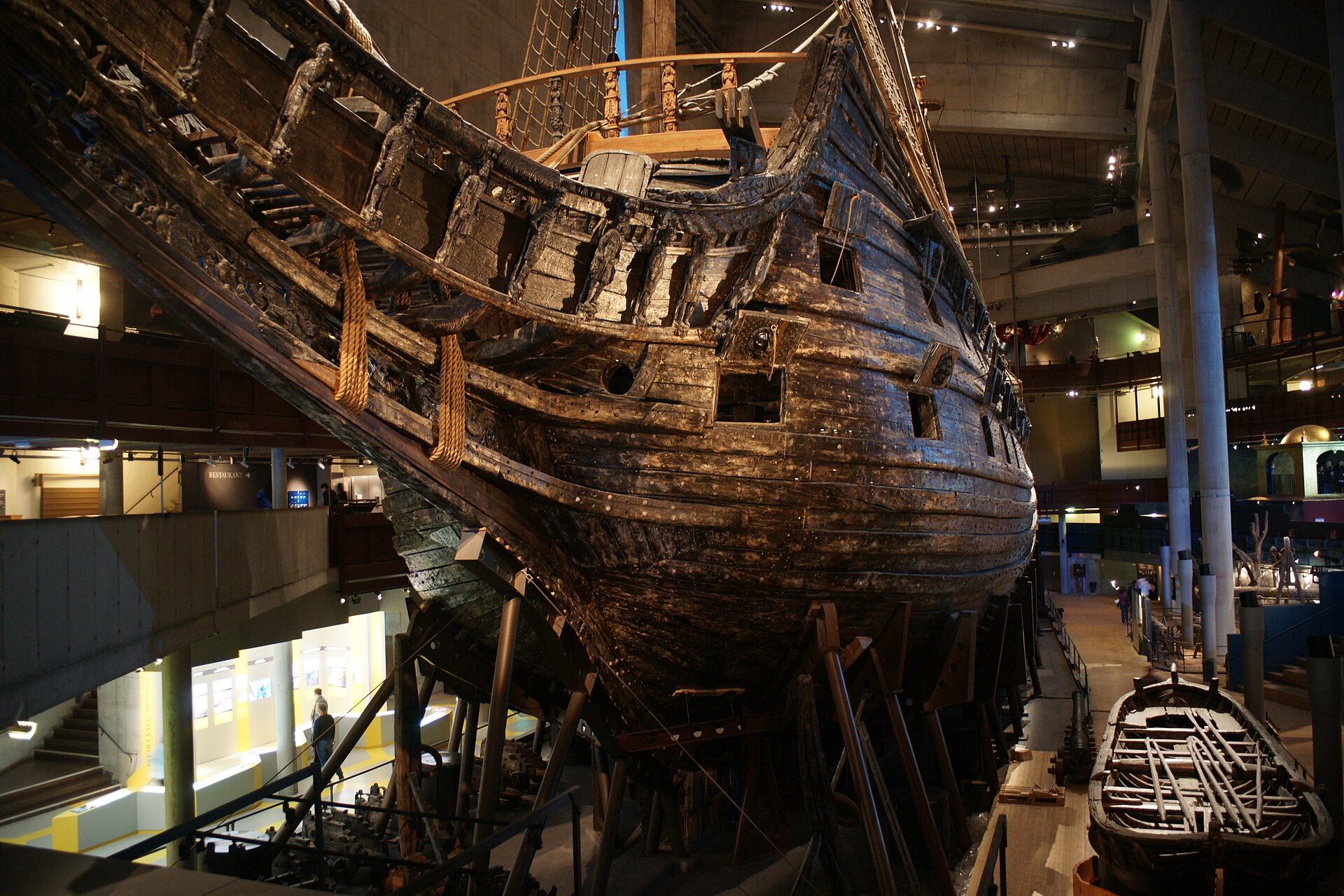
On 10 August 1628, crowds lined Stockholm's harbor to watch Vasa set sail on her maiden voyage. She had been built between 1626 and 1628 on the orders of King Gustavus Adolphus, part of his military buildup during the war with Poland-Lithuania. She never reached open water. After sailing roughly 1,300 meters, a gust of wind stronger than a mere breeze caught her sails, and she rolled onto her side and sank within minutes, taking at least 15 people down with her.
The disaster was not a mystery of engineering alone but a story of politics and fear. Gustavus Adolphus, leading his army in Poland at the time, was impatient for the ship to join the reserve squadron at Älvsnabben in the Stockholm Archipelago. His subordinates, aware of the ship's instability, lacked the courage to delay her launch or openly challenge the king's timeline. The Swedish Privy Council later convened an inquiry to find who was responsible for the catastrophe. In the end, no one was punished.
Vasa had been built to be one of the most powerfully armed vessels in the world, richly decorated as a symbol of the king's ambitions for Sweden and for himself. But that ambition came at a structural cost: too much weight sat high in the ship's hull, making her dangerously top-heavy. The 1620s had already been brutal for the Swedish navy — ten ships wrecked in a 1625 storm in the Bay of Riga, two large ships lost at the Battle of Oliwa in 1627, and in 1628 alone, three more major ships lost within a month, Vasa among them.
Sweden's rapid naval expansion was driven by extraordinary ambitions. The kingdom was transforming from a poor, peripheral northern power into a dominant Baltic force, a shift Swedish historians call stormaktstiden — the age of greatness. Gustavus Adolphus fought on multiple fronts: against Poland-Lithuania directly, and against the broader currents of the Thirty Years' War, fearing that a Catholic conquest of Copenhagen and Zealand would hand rivals control over the passages between the Baltic and North Seas.
After most of her valuable bronze cannons were salvaged in the 17th century, Vasa slipped into obscurity, resting on the seabed of Stockholm harbor for 333 years. She was rediscovered in the late 1950s in a busy shipping lane, and on 24 April 1961 she was raised with her hull largely intact — an almost unimaginable feat of preservation for a 17th-century wooden ship.
More from Archaeology

The Bronze Disc That Rewrote the Sky
Two looters with a metal detector dug up something illegal, invisible in value, and older than Stonehenge's final stones — a map of the heavens buried for over three thousand years.

The Faceless Women of the Ice Age
Long before writing, before cities, before the wheel, someone carved a woman's body into stone and ivory — and left no name, no face, no explanation.

The Pebble That Might Be Human
A palm-sized stone found on a Moroccan riverbank may be humanity's oldest attempt to see itself — or simply a trick of erosion.

The Crown That Vanished: Deshret and the Red Land
A crown worn by kings for three thousand years has never once been found in a tomb — not one. So where did it go?

The Face That Traveled Between Empires
A farm worker's shovel struck stone in 1897 and unearthed a face so striking it would be sold to France, seized as war booty, and finally traded back for a Velázquez.

The Boy in the Dark Tunnel
A schoolboy fell into black water inside an ancient tunnel and surfaced with his fingers brushing letters no one had noticed for 2,600 years.