Fifteen Days That Shook the Kremlin: The Hungarian Revolution of 1956
For fifteen days in the autumn of 1956, a captive nation dared to imagine freedom — until the tanks came back.
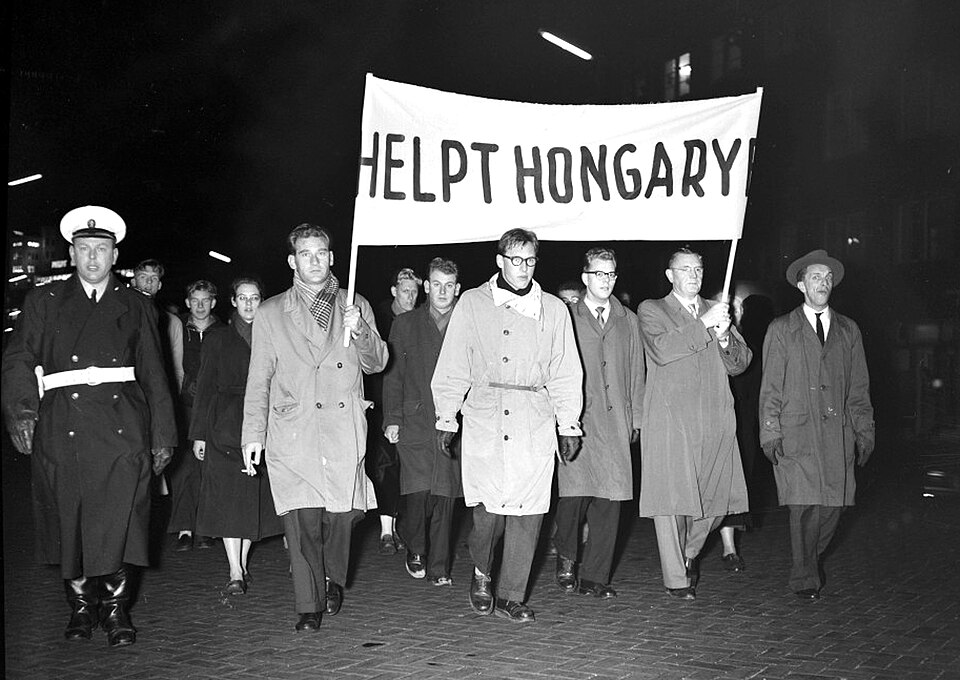
On the evening of 23 October 1956, university students in Budapest marched toward the Hungarian Parliament Building, carrying with them sixteen demands for political and economic reform. Crowds swelled around them, ordinary citizens drawn by a hope that had been building for years under the weight of Soviet-imposed rule. A delegation of students went further, entering the offices of Magyar Rádió to broadcast their demands to the nation — only to be seized by security guards. When the crowd outside called for their release, officers of the ÁVH, the dreaded State Protection Authority, opened fire, killing several students. What had been a peaceful protest became something else entirely.
The siege of the Radio building lasted through the night, ending around eight the next morning when revolutionaries broke in and took the ÁVH men, cadets, and soldiers inside as prisoners. One ÁVH officer, Major Fehér, was executed with a shot to the back of the head. Word spread quickly, and across Budapest and beyond, Hungarians organized themselves into revolutionary militias. Local communist officials and ÁVH policemen were hunted down and, in many cases, executed on the spot. Political prisoners were released from jail and handed weapons.
The uprising did not emerge from nothing. Hungary had spent the postwar years under the heavy hand of the USSR, its brief experiment in multi-party democracy — with President Zoltán Tildy and Prime Minister Ferenc Nagy — dismantled piece by piece through Communist Party pressure, even though the Communists had won only 17 percent of the vote in 1945. Control of the ÁVH passed to the Communists, who used it to intimidate, imprison, and torture opponents. By 1949, Hungary was formally declared a socialist state, its economy nationalized, Soviet troops stationed on its soil under COMECON arrangements.
Yet by 1955, a strange loosening had occurred. Intellectuals and journalists began openly criticizing the government of Mátyás Rákosi, the Stalinist leader who had briefly ceded power to reformer Imre Nagy in 1953, only to see Nagy purged in 1955 when Moscow's favor shifted. Developments in the USSR — the campaign against Stalin's legacy — and in Poland had emboldened Hungarians to imagine change was possible. That imagining exploded into the streets on 23 October.
As the fighting spread, something remarkable happened: local councils, workers' soviets, sprang up in nearly every city, assuming control of municipal government from the ruling Hungarian Working People's Party. Peasants seized collectivized land. The old bureaucracy and police apparatus simply dissolved. Imre Nagy, restored to power, made concession after concession — disbanding the ÁVH on 28 October, allowing old political parties to revive, permitting the Church to regain influence it had lost under communism.
More from History

The Morning Bingham Climbed to Machu Picchu
On a cold July morning in 1911, an American historian scrambled up a jungle-choked ridge above the Urubamba River — and by afternoon, a forgotten Inca citadel would belong to the world.

The Last Half-Hour of the Hindenburg
It was already half a day late, and the public had been told to keep away — but at seven o'clock that evening, the Hindenburg finally turned toward its mooring mast for the last time.

The Last Hours of Pompeii: August 24, 79 AD
By noon it was just another hot day beside the Bay of Naples. By evening, an entire mountain had rewritten the fate of thousands.

The Longest Walk: Mandela's Last Steps to Freedom
After 27 years behind bars, a 71-year-old man had to relearn how to walk out of a prison gate — into a waiting world of cameras, crowds, and a country holding its breath.

The Document Lincoln Signed on the First Day of 1863
On a single January morning, a president's pen would change the legal status of more than three million people — if the ink held and his hand did not shake.

The Day of the Dream: August 28, 1963
Two hundred and fifty thousand people converged on the National Mall that morning — by nightfall, one voice from the steps of the Lincoln Memorial would echo for generations.