Thirty Years of Ruin: How a Bohemian Quarrel Bled Europe White
It began with a king deposed and a defenestration in Prague — and ended, thirty years later, with a continent so depopulated that some German regions had lost more than half their people.
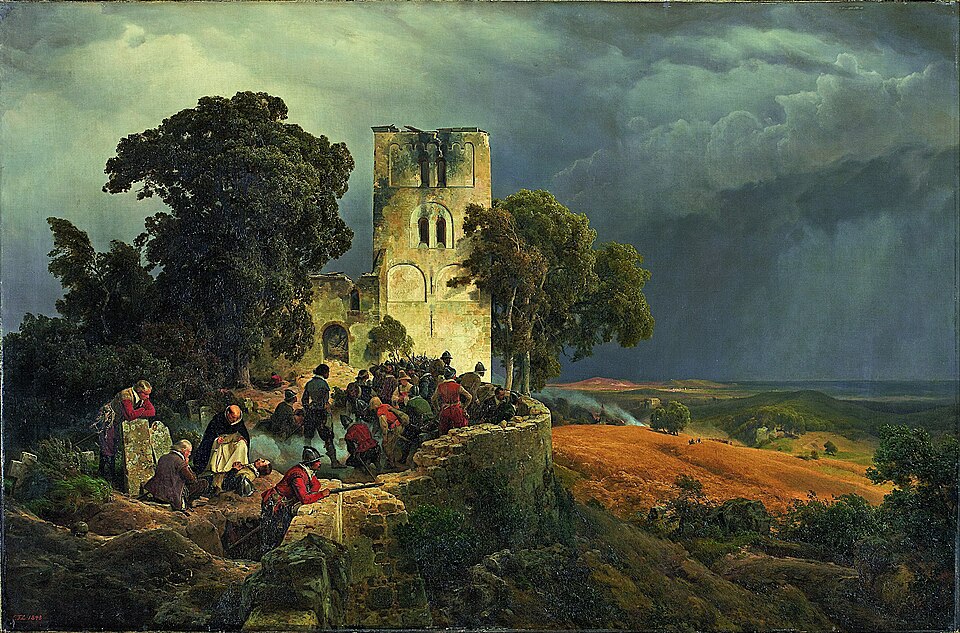
The war that would consume Central Europe for three decades did not start as a continental catastrophe. It began in 1618 as a dynastic and religious dispute within the Holy Roman Empire, when the Catholic emperor Ferdinand II was removed as king of Bohemia and replaced by the Protestant Frederick V of the Palatinate. Frederick's reign lasted barely a season, but his gamble had consequences far beyond Prague, dragging the strategically vital Palatinate into open conflict.
The roots of the crisis stretched back to the Reformation. The 1555 Peace of Augsburg had tried to freeze the religious map of the empire, dividing it into Lutheran and Catholic territories under the principle that a ruler's faith determined his subjects'. It was a fragile peace from the start, undermined as Protestantism — especially Calvinism, distrusted by Lutherans and Catholics alike — spread beyond the boundaries Augsburg had drawn. Combined with disputes over imperial authority, religion supplied the spark, even if it was not the whole fire.
That fire needed fuel, and the empire's fractured politics provided it. Some 300 imperial estates, from powerful Prince-electors to modest imperial cities like Hamburg, operated with real autonomy, grouped into regional Circles that rarely coordinated. Above them sat the Imperial Diet, a body built for talk rather than legislation. Holding this patchwork together had depended, before the Reformation, on shared faith. Once that faith split, ambitious states like Lutheran Saxony and Catholic Bavaria found room to expand their own power at the empire's expense.
The House of Habsburg sat at the center of it all. Holding the imperial crown since 1440, they directly ruled some eight million subjects across Austria, Bohemia, and Hungary, and had controlled the Spanish Empire until 1556, when Charles V split his domains between Austrian and Spanish branches. The two Habsburg lines were bound by frequent intermarriage and Spain's continued possessions inside the empire — the Spanish Netherlands, Milan, Franche-Comté — but they were fundamentally different powers: Spain a global maritime empire, Austria a land power anchored in Germany and wary of the Ottomans to its east.
More from History

The Morning Bingham Climbed to Machu Picchu
On a cold July morning in 1911, an American historian scrambled up a jungle-choked ridge above the Urubamba River — and by afternoon, a forgotten Inca citadel would belong to the world.

The Last Half-Hour of the Hindenburg
It was already half a day late, and the public had been told to keep away — but at seven o'clock that evening, the Hindenburg finally turned toward its mooring mast for the last time.

The Last Hours of Pompeii: August 24, 79 AD
By noon it was just another hot day beside the Bay of Naples. By evening, an entire mountain had rewritten the fate of thousands.

The Longest Walk: Mandela's Last Steps to Freedom
After 27 years behind bars, a 71-year-old man had to relearn how to walk out of a prison gate — into a waiting world of cameras, crowds, and a country holding its breath.

The Document Lincoln Signed on the First Day of 1863
On a single January morning, a president's pen would change the legal status of more than three million people — if the ink held and his hand did not shake.

The Day of the Dream: August 28, 1963
Two hundred and fifty thousand people converged on the National Mall that morning — by nightfall, one voice from the steps of the Lincoln Memorial would echo for generations.