Troy: From Legend to Excavation
For more than two thousand years, everyone believed Troy was only a story. Then a mound in northwest Turkey called Hisarlık gave up nine cities buried inside itself.
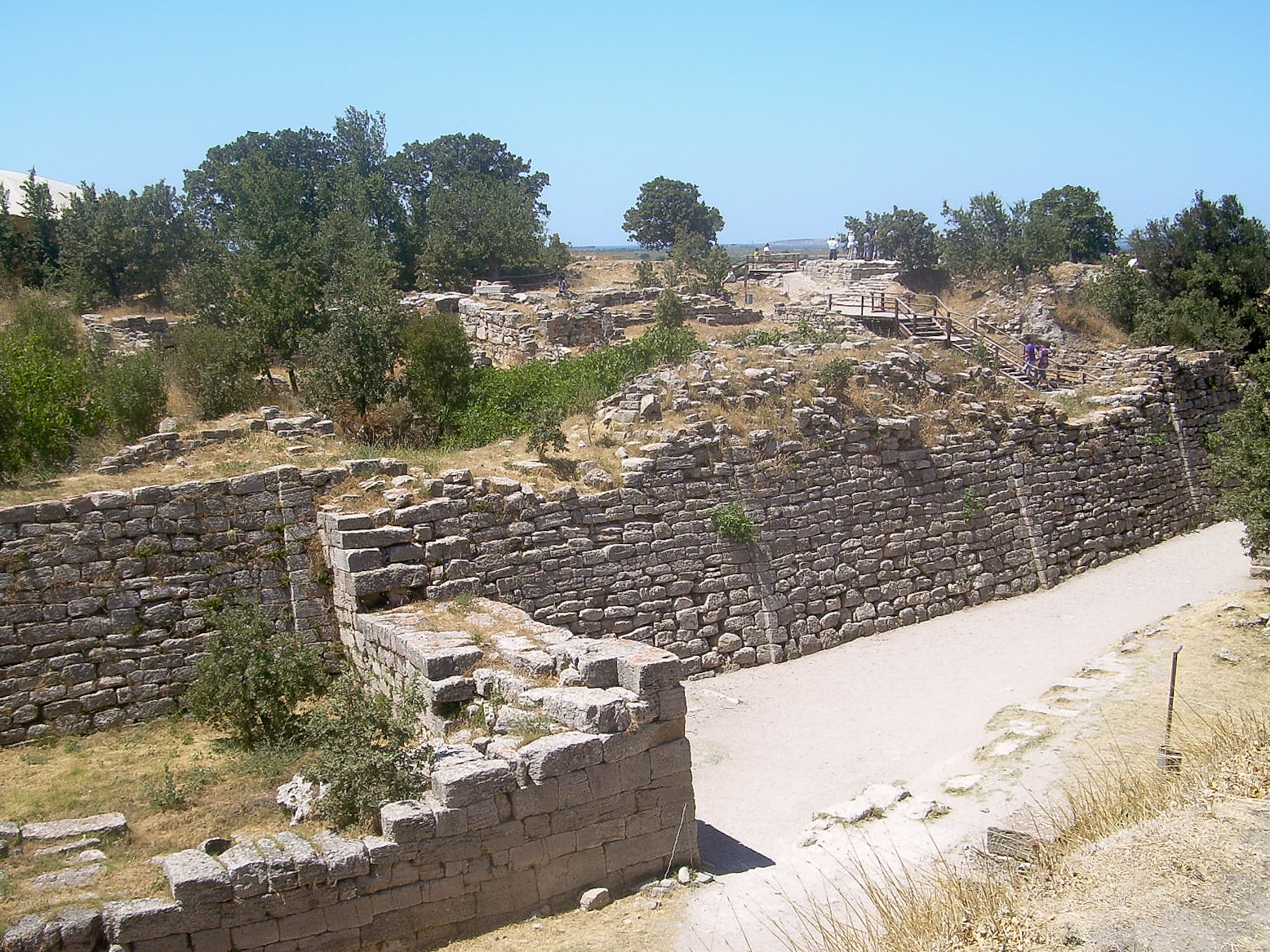
Long before anyone dug a trench, Troy existed as words: the steep hill, the sloping stone walls, the massive gates that could be bolted shut, the broad streets leading up to the Temple of Athena and King Priam's sprawling palace. This was the Troy of Homer's Iliad, a rich and powerful capital able to summon allies from across the region to defend it against the Achaeans camped by the Scamander river. The Odyssey, Aeschylus, and later Virgil's Aeneid and Quintus Smyrnaeus's continuation of the war's final days all kept the city alive in imagination, long after — if it ever truly fell — its walls had crumbled.
The Greeks and Romans never doubted Troy was real. During his campaign against the Persian Empire, Alexander the Great visited the site in 334 BC and made sacrifices at tombs said to belong to Achilles and Patroclus. But knowing the story was one thing; knowing where the city actually stood was another. By the 16th and 17th centuries, that knowledge had been lost. Travelers like Pierre Belon and Pietro Della Valle mistakenly placed Troy at Alexandria Troas, a ruined town some 20 kilometers south of the real site. In the late 1700s, French scholar Jean-Baptiste le Chevalier proposed a different mound near Pınarbaşı, and for almost a century that theory dominated.
It took a Scottish journalist, Charles Maclaren, to point confidently in 1822 to the place now accepted as correct. British engineer John Brunton dug the first exploratory trenches there in 1855. But the man who truly opened the site was Frank Calvert, an Englishman who owned a nearby farm and began excavating Hisarlık in 1865. Calvert correctly matched the mound to classical-era Ilion — and convinced a visiting German businessman that Homeric Troy might lie beneath those later ruins.
That businessman was Heinrich Schliemann, who secured permission to dig at Hisarlık in 1868 and began his own excavation in April 1870. At the time, the mound measured roughly 200 by 150 meters and rose 31.2 meters above the plain, 38.5 meters above sea level. Schliemann cut a trench straight down through its layers, and beneath the Greek and Roman city he expected, he found the remains of far older settlements stacked one atop another.
What Schliemann and Calvert uncovered was not one Troy but many. Archaeologists eventually distinguished nine major layers, numbered with Roman numerals from Troy I to Troy IX, representing roughly 4,000 years of continuous rebuilding on the same hill. Troy I was a small fortified settlement dated to around 3200–2600 BC. Troy II, centuries later, astonished excavators with its wealth and imposing architecture. During the Late Bronze Age, the city is often identified with Wilusa, a vassal state of the Hittite Empire — a name eerily close to the 'Wilios' that meter suggests once opened the word Ilios in Homer's verse.
More from History

The Morning Bingham Climbed to Machu Picchu
On a cold July morning in 1911, an American historian scrambled up a jungle-choked ridge above the Urubamba River — and by afternoon, a forgotten Inca citadel would belong to the world.

The Last Half-Hour of the Hindenburg
It was already half a day late, and the public had been told to keep away — but at seven o'clock that evening, the Hindenburg finally turned toward its mooring mast for the last time.

The Last Hours of Pompeii: August 24, 79 AD
By noon it was just another hot day beside the Bay of Naples. By evening, an entire mountain had rewritten the fate of thousands.

The Longest Walk: Mandela's Last Steps to Freedom
After 27 years behind bars, a 71-year-old man had to relearn how to walk out of a prison gate — into a waiting world of cameras, crowds, and a country holding its breath.

The Document Lincoln Signed on the First Day of 1863
On a single January morning, a president's pen would change the legal status of more than three million people — if the ink held and his hand did not shake.

The Day of the Dream: August 28, 1963
Two hundred and fifty thousand people converged on the National Mall that morning — by nightfall, one voice from the steps of the Lincoln Memorial would echo for generations.