Tutankhamun's Tomb: Carter's 'Wonderful Things'
For over three thousand years a boy-king's tomb lay buried under flood silt and workmen's huts, waiting undisturbed for a candlelight and a single word: 'wonderful.'
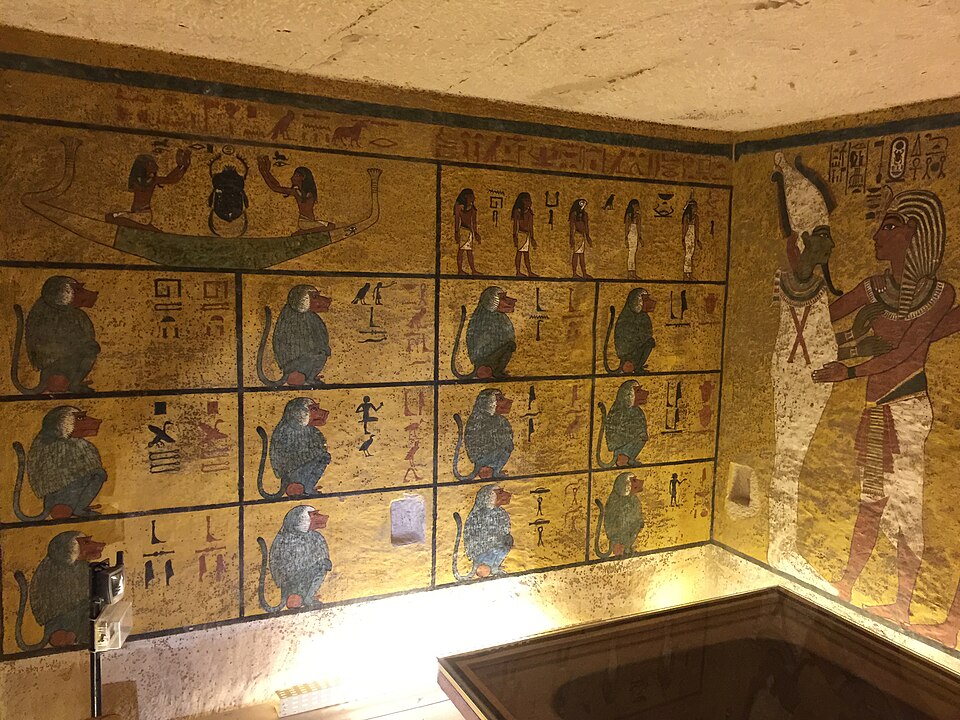
Tutankhamun ruled Egypt as a child, reigning c. 1332 to 1323 BC, taking the throne after his likely father Akhenaten had overturned Egypt's religion by worshipping only the god Aten. One of the young king's first acts was to reverse this upheaval, changing his own name from Tutankhaten to Tutankhamun to honour the god Amun, and renaming his queen from Ankhesenpaaten to Ankhesenamun as traditional worship was restored.
Shortly after taking power, Tutankhamun commissioned a full royal tomb in the Valley of the Kings, but he died prematurely, and the modest tomb known as KV62 — likely originally intended for a non-royal person, possibly his advisor Ay — was hastily enlarged for his burial. Ay became pharaoh after him and was buried instead in the grander tomb WV23, possibly by design, since Ay was already elderly and needed a suitably royal resting place ready. Tutankhamun's successor Horemheb later tried to erase both Akhenaten and Tutankhamun from official memory, and later king-lists skip straight from Amenhotep III to Horemheb.
Within a few years of the burial, robbers broke into the tomb twice. Officials repaired the damage after the first intrusion, repacking goods and filling the entrance corridor with limestone chips, only for a second set of thieves to burrow through. After this was discovered, the tomb was hastily restored again and resealed. Despite this, Tutankhamun's mummy and the bulk of his burial goods survived intact — a rarity in the Valley of the Kings.
The tomb's survival owed much to geography. Dug low into the valley floor, its entrance was gradually buried under alluvium deposited by flash floods, and later covered further by debris and workers' huts built during the construction of KV9, the tomb of Ramesses V and VI, more than 150 years afterward. While other royal tombs were stripped bare during the Third Intermediate Period, Tutankhamun's simply vanished from view.
It remained hidden until 1922. Howard Carter, who had concentrated his search on the valley's southern section from 1917 onward, noticed a gap in the ground that earlier excavators had overlooked. The exposure of a staircase late that year, its entrance seal remarkably intact, signalled that something extraordinary lay beneath. The find, sponsored by Carter's patron George Herbert, 5th Earl of Carnarvon, triggered a media frenzy that made it the most famous discovery in the history of Egyptology.
More from Archaeology

The Bronze Disc That Rewrote the Sky
Two looters with a metal detector dug up something illegal, invisible in value, and older than Stonehenge's final stones — a map of the heavens buried for over three thousand years.

The Faceless Women of the Ice Age
Long before writing, before cities, before the wheel, someone carved a woman's body into stone and ivory — and left no name, no face, no explanation.

The Pebble That Might Be Human
A palm-sized stone found on a Moroccan riverbank may be humanity's oldest attempt to see itself — or simply a trick of erosion.

The Crown That Vanished: Deshret and the Red Land
A crown worn by kings for three thousand years has never once been found in a tomb — not one. So where did it go?

The Face That Traveled Between Empires
A farm worker's shovel struck stone in 1897 and unearthed a face so striking it would be sold to France, seized as war booty, and finally traded back for a Velázquez.

The Boy in the Dark Tunnel
A schoolboy fell into black water inside an ancient tunnel and surfaced with his fingers brushing letters no one had noticed for 2,600 years.