Victorio Peak: The Mountain That Ate a Fortune
A rocky outcrop in the New Mexico desert holds a name born of war and a legend born of gold — and nobody has ever proven which one truly explains the peak's hold on people.
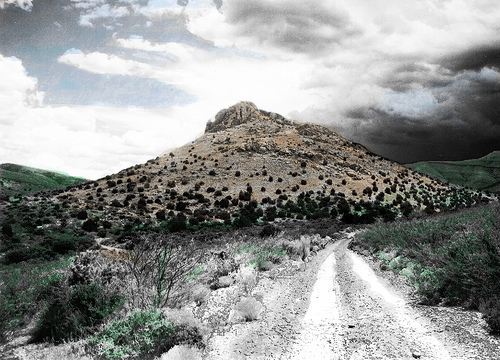
Rising out of the Hembrillo Basin in southern New Mexico, Victorio Peak looks like just another jagged rock formation in a landscape full of them. But its layered slopes, formed from Permian and Carboniferous sedimentary rock tilted gently westward atop far older Precambrian metamorphic stone, would prove strategically useful long before anyone dreamed of treasure hidden inside.
The mountain takes its name from Chief Victorio, the Apache leader who used the Hembrillo Basin as a hideout. In 1880, the basin became a battlefield when components of the U.S. Army's Sixth and Ninth Cavalry, the latter the famed Buffalo Soldiers, clashed with Chiricahua and Mescalero Apache warriors under Victorio's command. Victorio's forces pinned down a small detachment of American soldiers, but when larger U.S. forces arrived, he withdrew from the field rather than risk annihilation.
The terrain itself favored the Apaches. The mudrocks and sandstones of the Abo and Yeso formations weather into a stair-step pattern of sandstone caps and gentler argillaceous slopes, natural cover and vantage points that Victorio's fighters used to their advantage during the standoff.
For decades afterward, the peak's name became a point of confusion. When the U.S. Army prepared briefings for Operation Goldfinder, officials labeled the mountain 'Victoria Peak,' having followed New Mexico historians who mistakenly believed it honored Queen Victoria. It took the persistence of Albuquerque Tribune reporter Howard Bryan to set the record straight, tracing the name back to Chief Victorio and the battle fought in the basin below.
By then, though, the mountain's reputation rested less on its Apache namesake than on a treasure story that had gripped the public imagination since the 1930s. In 1933, prospectors Milton 'Doc' Noss and his wife Ova 'Babe' Noss claimed to have discovered a hidden cache of gold and artifacts inside the peak, a find that, if real, would have been one of the great treasure discoveries in American history.
More from Treasures

The Legend of the Nazi Gold Train
Somewhere beneath the hills of Poland, rumor insists, a train loaded with looted treasure vanished into a tunnel and was never seen again. The story survives because the plunder behind it was terrifyingly real.

The Treasure List Carved in Copper
While every other Dead Sea Scroll was written on parchment or papyrus, one was hammered into metal — a list of buried gold and silver that no one has ever found.

The Diamond That Vanished for a Century
For decades, treasure hunters and novelists spun theories about a lost 137-carat gem — sold, recut, melted into legend. It was sitting in a Quebec bank vault the entire time.

Gold, Ghosts, and the Mountain That Keeps Its Secret
For over a century, treasure hunters have vanished into a jagged Arizona range chasing a fortune that may never have existed at all. What they left behind was not gold, but one of America's most enduring legends.

The King Who Buried a River
When Rome finally cornered the Dacian king, it wasn't a sword that gave up his secret — it was a traitor's whisper about a riverbed.

The Fortune Dutch Schultz Took to His Grave
He asked New York's mob bosses for permission to kill a federal prosecutor — and when they said no, he disobeyed them anyway. It was a decision that would end his life and leave behind a fortune that has never been found.