Zheng He: The Eunuch Admiral Who Sailed China's Treasure Fleets to the World
A castrated stable boy from a conquered province rose to command the largest wooden ships ever built and sail them to Africa — decades before Europe's Age of Exploration began.
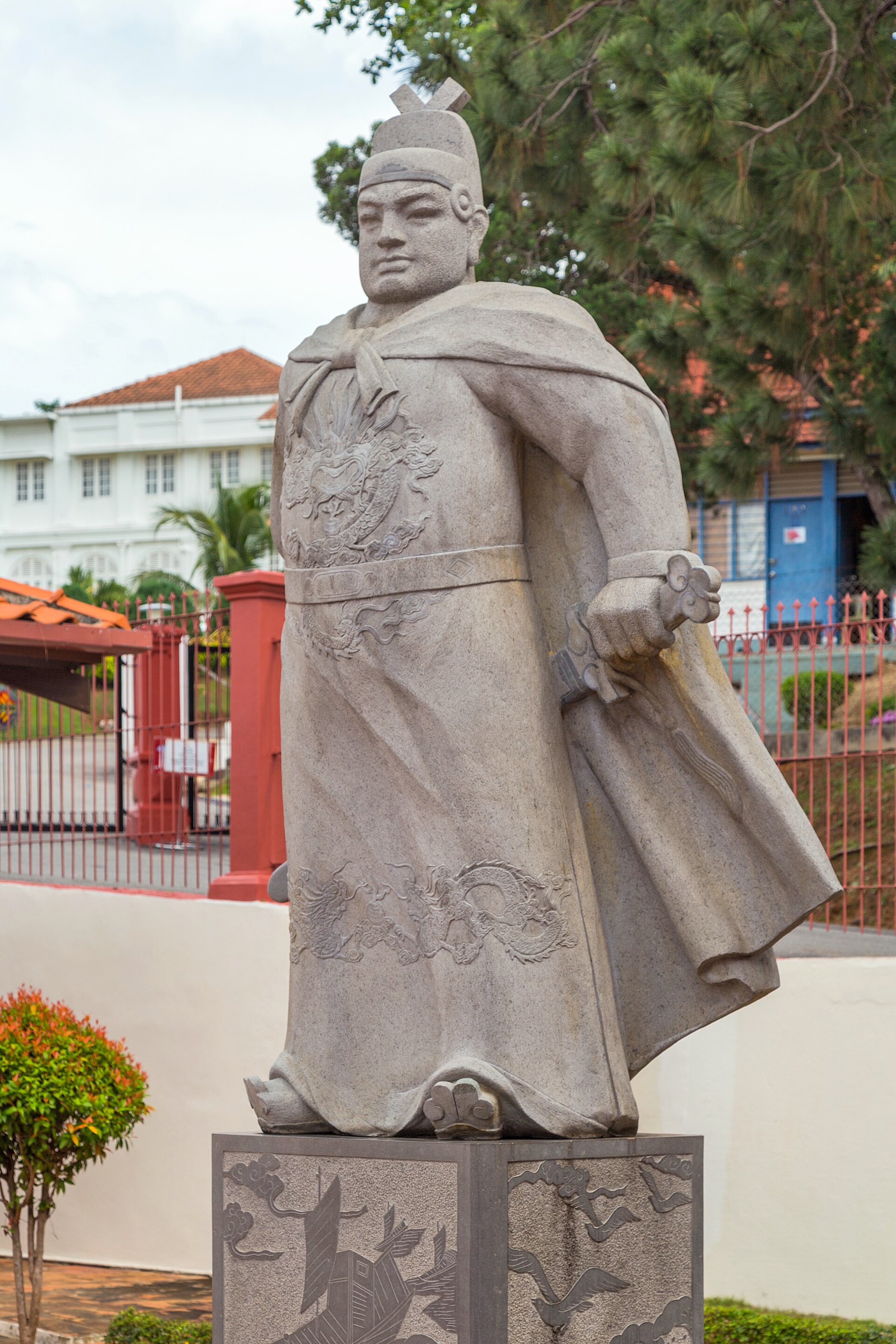
In the autumn of 1382, Ming armies swept into Yunnan and crushed the last Mongol-loyal principality standing in China's southwest. Among the casualties of that campaign was a boy born Ma He to a Muslim Hui family in Kunyang. His father and grandfather had both carried the title hajji, having made the pilgrimage to Mecca — a mark of devotion that placed the family in a proud, far-traveling tradition. That tradition ended abruptly in violence: Ma He's father died in the fighting in 1381, and the boy himself was captured by Ming forces that same year, castrated between the ages of ten and fourteen, and sent into palace service.
He was placed in the household of Zhu Di, the Prince of Yan, eleven years his senior. What might have been a life of obscurity became instead an apprenticeship in power. Ma He fought alongside the prince on the northern frontier against Mongol tribes, was present at the 1390 campaign that saw the Mongol commander Naghachu surrender, and — unusually for a eunuch — received a proper education in Beiping, away from the suspicious eye of the Hongwu Emperor, who distrusted literate eunuchs.
When the Hongwu Emperor died in 1398 and the succession passed to his grandson, the Jianwen Emperor, tensions between the new ruler and his uncle Zhu Di erupted into the Jingnan Campaign of 1399–1402. Ma He stood by the Prince of Yan throughout, and when Zhu Di seized the throne as the Yongle Emperor, his loyal eunuch was rewarded richly: a new surname, Zheng, and a name that would echo through centuries.
Zheng He was, by description, an imposing figure — seven chi tall, broad-waisted, high-browed, with a voice said to ring like a bell. The Yongle Emperor made him commander of the southern capital, Nanjing, and then handed him something far larger: command of the treasure fleets, the greatest naval expeditions the world had yet seen.
Between 1405 and 1433, across seven voyages, Zheng He led armadas of more than three hundred ships and some thirty thousand men into the Indian Ocean. The 1405 fleet alone carried 317 ships and 27,800 men. At its heart sailed the treasure ships — nine-masted vessels roughly 120 meters long and 50 meters wide, dwarfing anything European shipyards would produce for centuries. Travelers of the era, including accounts echoing figures like Ibn Battuta and Marco Polo, corroborated the almost unbelievable scale of Chinese shipbuilding.
More from Explorations

Humboldt: The Man Who Measured the World
A Prussian noble's son, once mocked as a sickly child, would climb a volcano to a world-record height and rewrite how humanity understood nature itself.

The Man Who Named Canada
A Breton mariner planted a wooden cross on a foreign shore and claimed a kingdom he did not understand — then spent a winter frozen into its river, praying a stranger's remedy would save his men.

Sixty Ships Into the Unknown: Hanno's Voyage Down the African Coast
A Carthaginian fleet of sixty ships and thousands of settlers vanished past the Pillars of Hercules to found cities on an unmapped coast — and came home with the skins of hairy, hostile 'gorillas' as proof of how far they had gone.

HMS Challenger: The Voyage That Charted the Deep
A stripped-down warship, its guns torn out to make room for microscopes, set sail from Portsmouth to answer a question no one had ever properly asked: what lies at the bottom of the sea?

Scott's Last Expedition: The Letters Written at the End of the World
Five men reached the bottom of the world only to find a Norwegian flag already planted there. What followed was not glory, but a slow, frozen unraveling that the world would remember for a century.

Marco Polo: In the Court of Kublai Khan
A fifteen-year-old boy meets the father he barely knew — and is soon swept toward the richest court on Earth. Twenty-four years later, he returns home with tales so vast that Venice simply calls him 'Mister Millions'.