872 Days: The Siege That Could Not Break Leningrad
Hitler was so certain of victory that he had invitations printed for a celebration inside Leningrad's finest hotel. The party never happened — but the city paid for his confidence in starvation and blood.
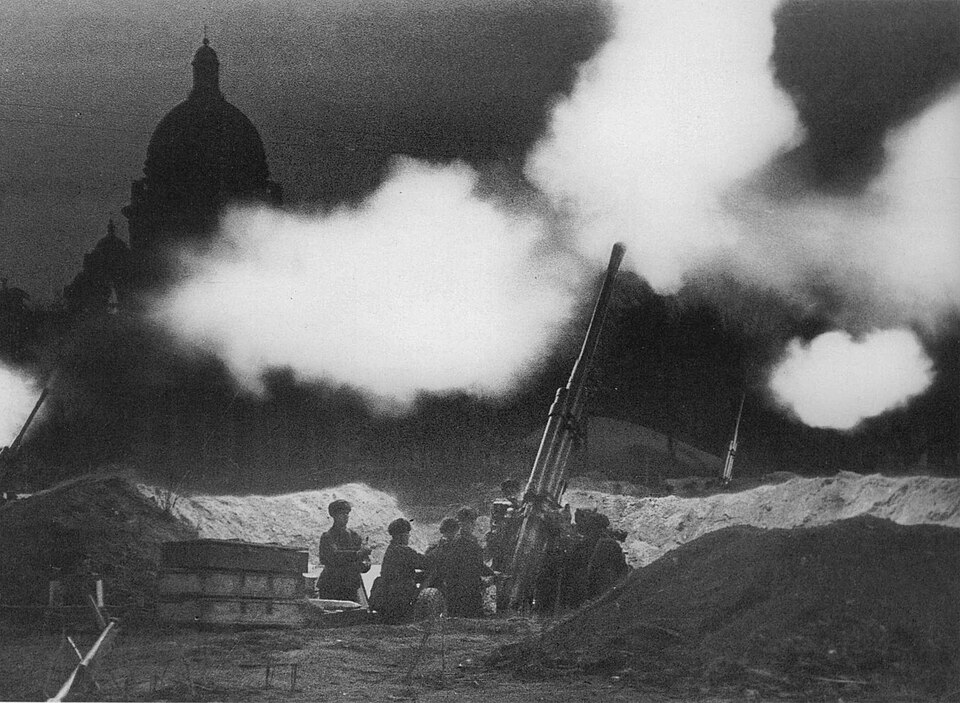
On 8 September 1941, the last road out of Leningrad went silent. German Army Group North, having swept through the Baltic states and taken Pskov, Narva, and Novgorod, closed the ring around the Soviet Union's second-largest city. Finnish forces held the north; German divisions the south. The encirclement was not an accident of war but a strategy: Leningrad's fall was one of three central goals of Operation Barbarossa, prized for its symbolism as the cradle of the Russian Revolution, its industrial output — eleven percent of Soviet production in 1939 — and its status as home to the Soviet Baltic Fleet.
Hitler's confidence bordered on theater. He believed the city would fall so completely that victory invitations were printed for a celebration at the Hotel Astoria. But his real intention, laid out in a directive to Army Group North on 29 September 1941, was darker than occupation: there could be no interest, it read, in feeding or relocating Leningrad's population once the war against the Soviets was won. Surrender would be refused. The city and its people were to be erased, the land north of the Neva handed to Finland.
German scientists calculated that starvation alone would break Leningrad within weeks. Rather than storm the city, German forces chose to bombard it and wait. What they had not accounted for was the scale of civilian resistance already underway. Beginning 27 June 1941, the Leningrad Soviet organized 'first response groups,' and within days over a million citizens were mobilized to build fortifications. They dug 25,000 kilometers of open trenches, raised 306 kilometers of timber barricades, strung 635 kilometers of wire entanglements, and carved 700 kilometers of anti-tank ditches — even stripping guns from the cruiser Aurora to defend the city.
None of it stopped the noose from closing. By August 1941, every rail line linking Leningrad to the rest of the country was severed. The first winter, 1941–1942, brought famine on a scale that still defines the siege's memory. German commanders had planned for exactly this: a population starved into submission rather than conquered by force.
What kept Leningrad alive was a single, fragile route: Lake Ladoga. In warmer months, supplies came by ship and by air; when the lake froze, trucks crossed on the ice road residents called the Road of Life. American Lend-Lease shipments, arriving from late 1941 and expanded by Arctic convoys through 1943, supplemented what little reached the city. Germany tried to sever even this lifeline — in August 1942, Operation Nordlicht aimed to finally take the city, and Axis naval detachments patrolled Ladoga's waters to choke supply routes. Soviet counterattacks, including the Sinyavino Offensive, blunted the German effort.
More from History

The Morning Bingham Climbed to Machu Picchu
On a cold July morning in 1911, an American historian scrambled up a jungle-choked ridge above the Urubamba River — and by afternoon, a forgotten Inca citadel would belong to the world.

The Last Half-Hour of the Hindenburg
It was already half a day late, and the public had been told to keep away — but at seven o'clock that evening, the Hindenburg finally turned toward its mooring mast for the last time.

The Last Hours of Pompeii: August 24, 79 AD
By noon it was just another hot day beside the Bay of Naples. By evening, an entire mountain had rewritten the fate of thousands.

The Longest Walk: Mandela's Last Steps to Freedom
After 27 years behind bars, a 71-year-old man had to relearn how to walk out of a prison gate — into a waiting world of cameras, crowds, and a country holding its breath.

The Document Lincoln Signed on the First Day of 1863
On a single January morning, a president's pen would change the legal status of more than three million people — if the ink held and his hand did not shake.

The Day of the Dream: August 28, 1963
Two hundred and fifty thousand people converged on the National Mall that morning — by nightfall, one voice from the steps of the Lincoln Memorial would echo for generations.